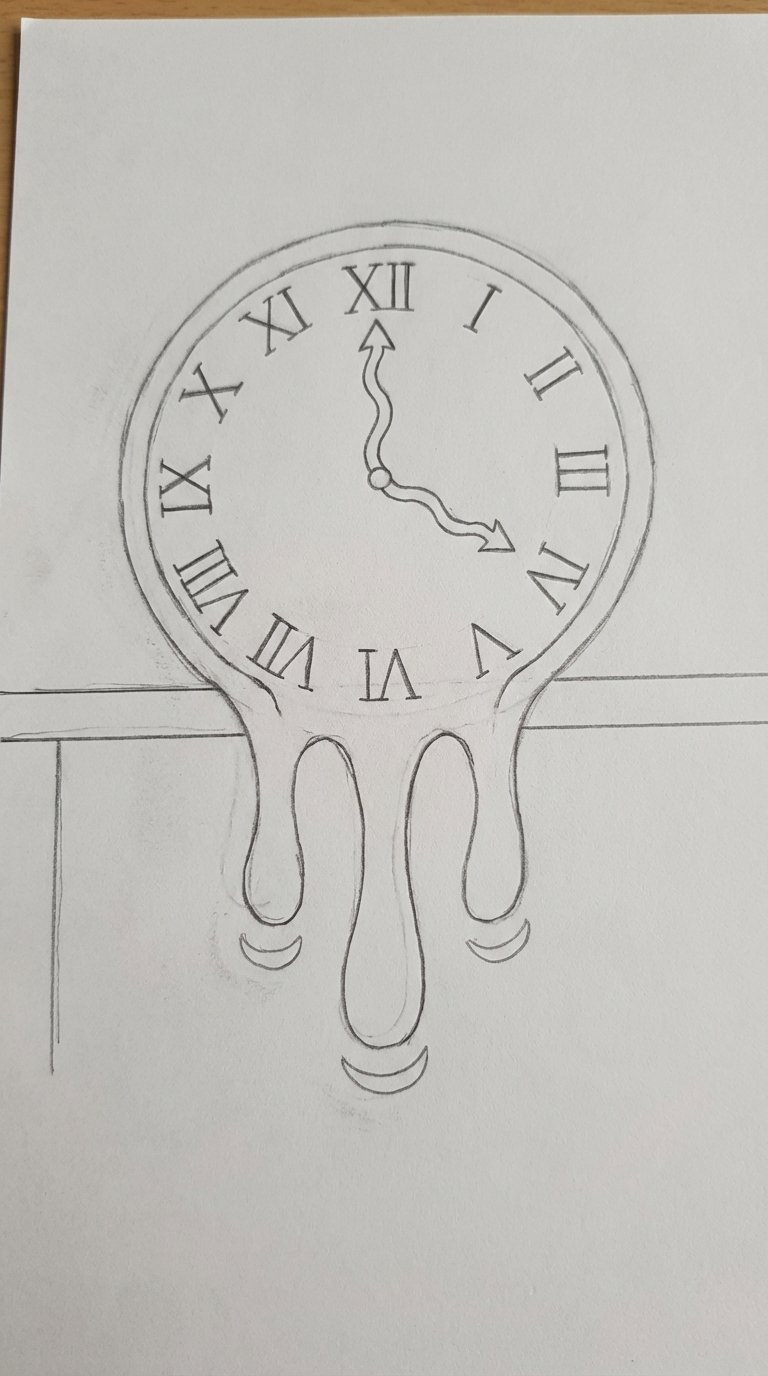
Have you ever stared at a blank piece of paper and had no idea what to draw? You are not alone. So many kids and beginners feel that way. The good news is that trippy drawing ideas are some of the easiest and most fun things you can create, and you do not need any special skills to make them look amazing.
Trippy art is all about playing with patterns, shapes, and lines that create a sense of movement or optical illusion. Most trippy drawing ideas are built from simple shapes like circles, spirals, wavy lines, and grids. No shading required.
Whether you love doodling in notebooks or filling sketchbooks with cool designs, these beginner-friendly ideas will keep your creativity flowing for hours. Let us dive in.
Spiral Galaxy Tunnel
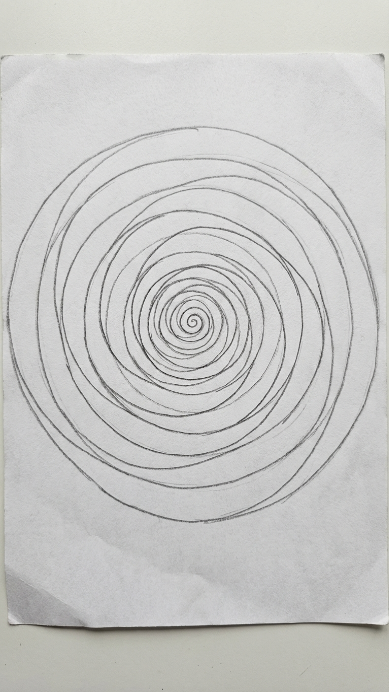
One of the most magical and mesmerizing things you can draw is a spiral tunnel that looks like it is pulling you right into it. This is a classic trippy design that uses nothing but curved lines and circles yet it creates a totally hypnotic effect. Kids love this one because it feels like you are designing your own wormhole or portal to another dimension. Even if your circles are not perfectly round, the design still looks fantastic. That slight imperfection actually adds to the handmade charm of the artwork.
Step-by-Step Instructions:
- Start at the center of your paper and draw a very small circle about the size of a pea using your pencil with medium pressure.
- Draw a larger circle around it, leaving a small even gap between the two circles. Repeat this again and again, making each ring slightly bigger, until your circles fill most of the page.
- Now, starting from the innermost circle, draw short curved lines connecting each ring to the next one in a consistent direction (always curving clockwise or always counter-clockwise). These lines give the tunnel a spiraling, swirling look.
- Add a final outer border circle near the edge of the page to frame the whole design neatly.
- Optional: Use a fine-tip Sharpie to trace over the pencil lines for a bolder, finished look.
Checkerboard Wave Illusion
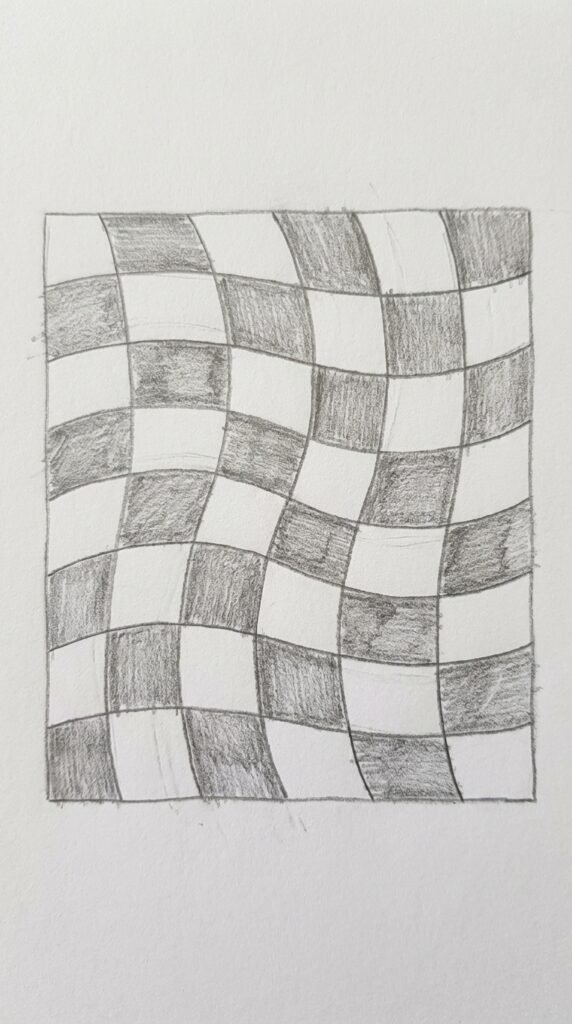
This optical illusion drawing is one of those trippy designs that makes people do a double take. It starts as a simple flat checkerboard grid and then transforms into a wavy, billowing surface like a flag blowing in the wind or a bedsheet floating in slow motion. The secret is in how you bend the grid lines gradually from straight at the edges to curved in the middle. Kids absolutely love this because it looks incredibly complex but is actually built from just two shapes: squares and waves.
Step-by-Step Instructions:
- Lightly draw a large square or rectangle that fills most of your page this will be the border of your checkerboard.
- Draw a series of horizontal lines across the shape, but instead of keeping them straight, gently curve them upward in the middle like a gentle hill. Space each line evenly from top to bottom.
- Now draw vertical lines from top to bottom, but curve these ones slightly from side to side like they are bending with the wave.
- Color in (or shade with pencil) alternating squares of the resulting grid to create the checkerboard pattern. The squares will look like they are warping with the wave.
- Add a thin border around the entire design to frame it cleanly on the page.
Infinite Staircase Loop
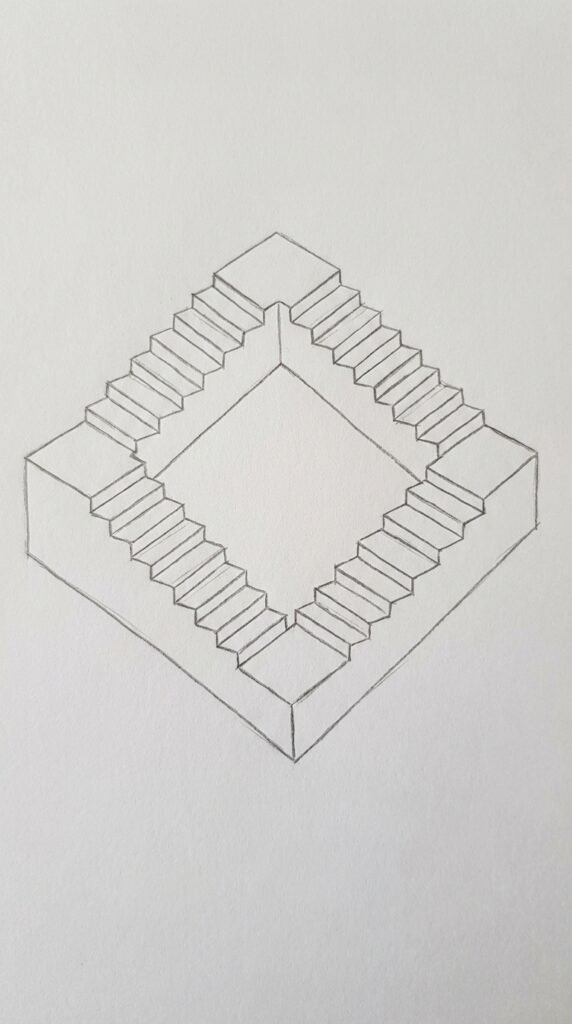
This is one of the most famous optical illusion drawings in the world an impossible staircase that seems to loop endlessly with no beginning and no end. It looks incredibly complex but is actually made from a series of simple L-shaped steps connected in a rectangle. Kids find this one fascinating because it plays a trick on your brain. Every time you follow the stairs with your eyes, you feel like you should reach the top but you never do!
Step-by-Step Instructions:
- Draw a large, open square outline in the center of your page, about 4 to 5 inches on each side.
- Starting at the top-left corner, draw the first step going right: a short horizontal line, then a short vertical line going down. Repeat this pattern along the top edge of the square all the way to the top-right corner.
- Along the right side of the square, continue the stair pattern going downward toward the bottom-right corner.
- Continue along the bottom of the square (going left) and then up the left side, so the stairs form a continuous rectangle of steps.
- Add thin horizontal lines to the flat surfaces of each step to indicate the flat “floor” of each stair, giving the illusion of depth without shading.
Zentangle Eye
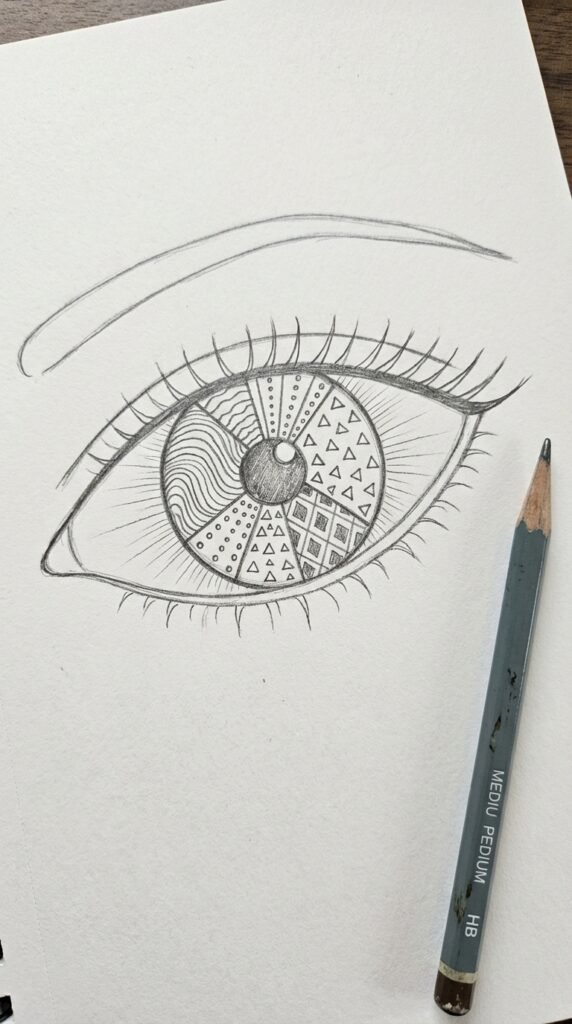
The zentangle eye is one of the coolest trippy art ideas easy enough for total beginners. You draw a large eye shape and then fill it with intricate little patterns inside each section of the eye gets its own doodle design. It looks incredibly detailed and professional, but each individual pattern inside is simple: dots, tiny waves, crosshatching, or repeating leaf shapes. The result is a mesmerizing, almost psychedelic eye that looks like it belongs in a fantasy illustration or a trippy art gallery.
Step-by-Step Instructions:
- Draw a large eye shape in the center of your paper two curved lines meeting at points on each side, like a classic almond or leaf shape. Make it big, taking up about half the page width.
- Inside the eye, draw a large circle for the iris and a smaller circle inside that for the pupil.
- Divide the iris into 4 to 6 wedge sections (like slicing a pie), then fill each wedge section with a different repeating pattern: tiny dots, parallel wavy lines, small triangles, or diamond shapes.
- In the white area around the iris (between the iris and the eyelid line), add a pattern of fine radiating lines spreading outward from the iris like sunbeams.
- Along the upper eyelid, draw a row of simple eyelashes short tapered lines evenly spaced. Add eyebrow arch above with a thin slightly curved line.
Melting Clock Face
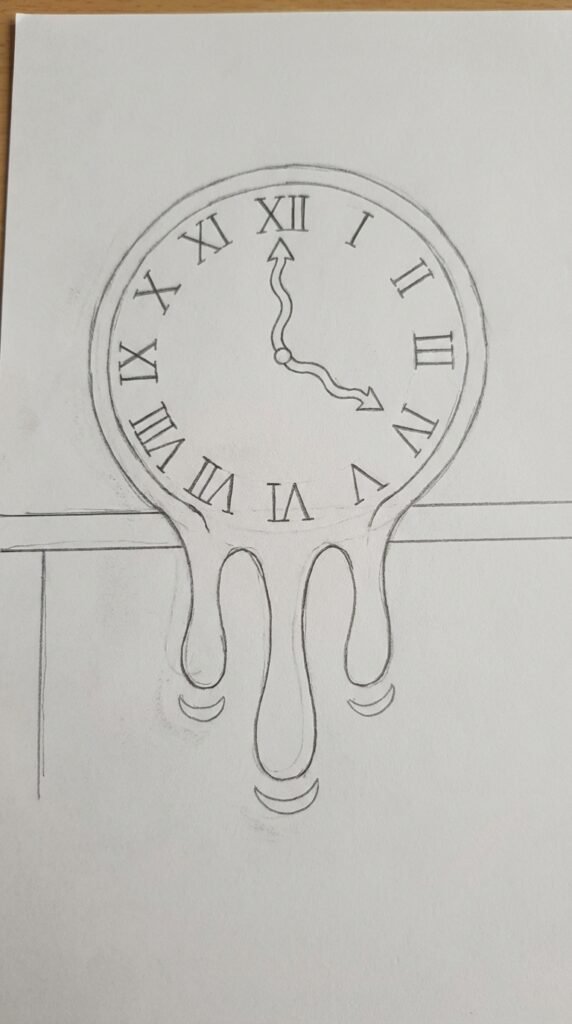
Inspired by surrealist art, the melting clock is a classic weird drawing that looks trippy and imaginative without being hard to draw at all. You draw a normal clock face and then let it “melt” over the edge of a surface like it is made of soft warm wax. The drooping, dripping edges of the clock are what give it that unmistakable surreal quality. Kids love this because it turns a simple everyday object into something completely fantastical and dreamlike.
Step-by-Step Instructions:
- Draw a horizontal line across the lower third of your page to represent the edge of a table or shelf.
- Above the line, draw a large oval or circle for the clock face, slightly tilted to one side as if it is beginning to slump over.
- Add clock details to the face: numbers 12, 3, 6, and 9 placed at the top, right, bottom, and left positions, and two clock hands pointing to any time you like.
- Now draw the melting effect: let the bottom edge of the clock droop and drip below the table line with 2 to 3 long, drooping curves that hang down like melted wax each drip slightly different in length.
- Draw the table edge continuing on either side of the clock for a complete scene. Add a simple shadow line under each drip for a grounding effect.
Floating 3D Cube Stack
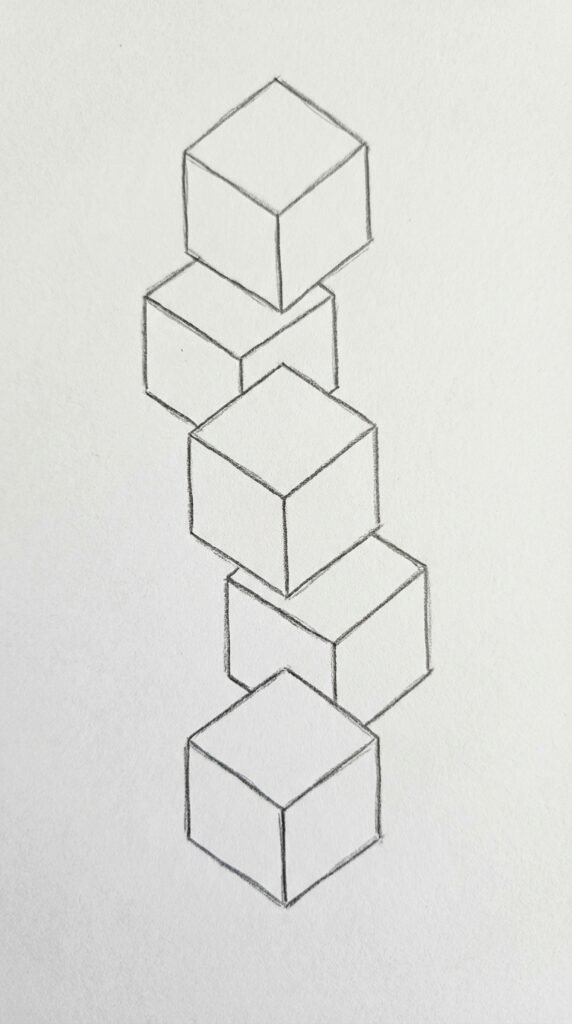
This one looks mind-bendingly complex but is totally achievable for beginners. You draw a series of cubes that look like they are stacked and floating in mid-air, creating a cascading tower effect. The key trick is that each cube is made from just three parallelograms the same simple shape repeated three times. Once you learn to draw one cube, you can stack as many as you want. The finished result looks like a trippy architectural sculpture floating in space.
Step-by-Step Instructions:
- Start near the top center of your page. Draw a small flat diamond shape (a rhombus) this is the top face of your first cube.
- From the left bottom corner of the diamond, draw two parallel vertical lines going straight down, then connect them at the bottom with a slightly curved horizontal line. This creates the left side of the cube.
- Repeat for the right side of the diamond: two parallel vertical lines down, connected at the bottom. This creates the right face.
- Draw your second cube directly below and slightly overlapping the first, following the same three-step process.
- Add two to three more cubes below, each slightly larger or at a slightly different angle. Use your pencil lines to suggest the edges of each cube face clearly.
Radial Sunburst Web
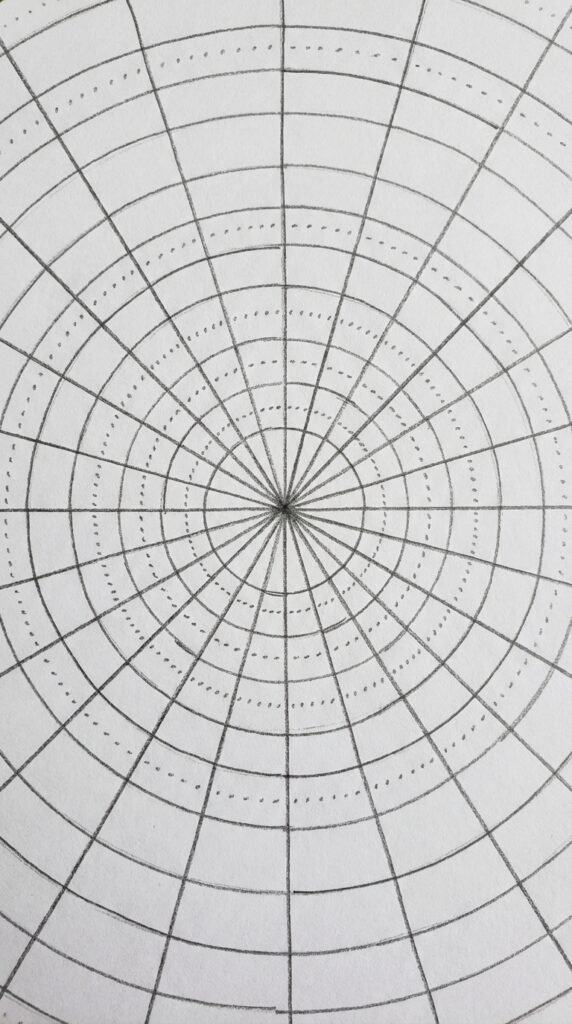
This trippy doodle idea creates a mesmerizing web of lines radiating out from a single center point like an exploding sun or a giant spider’s web shot with a camera flash. It looks hugely detailed and intricate but is made entirely from straight lines and concentric circles. The more lines you add, the denser and more hypnotic the design becomes. This is a great easy Sharpie drawing idea because tracing over the pencil lines with a black marker makes the radial lines really pop.
Step-by-Step Instructions:
- Make a small dot in the very center of your page. This is your anchor point every line will start or end here.
- Draw straight lines radiating outward from the center dot to the edges of the paper, like the spokes of a wheel. Aim for at least 16 to 20 lines evenly spaced around the center.
- Now draw concentric circles around the center point start very small and keep adding larger and larger circles until the outermost one nearly reaches the edge of the page. Aim for 8 to 12 rings.
- In alternating sections between the radiating lines, add small repeating patterns: a row of tiny dots, small dashes, or short parallel lines between each ring. This adds visual interest to the web.
- Draw a final clean outer circle to border the whole design and give it a finished, contained look.
Impossible Triangle
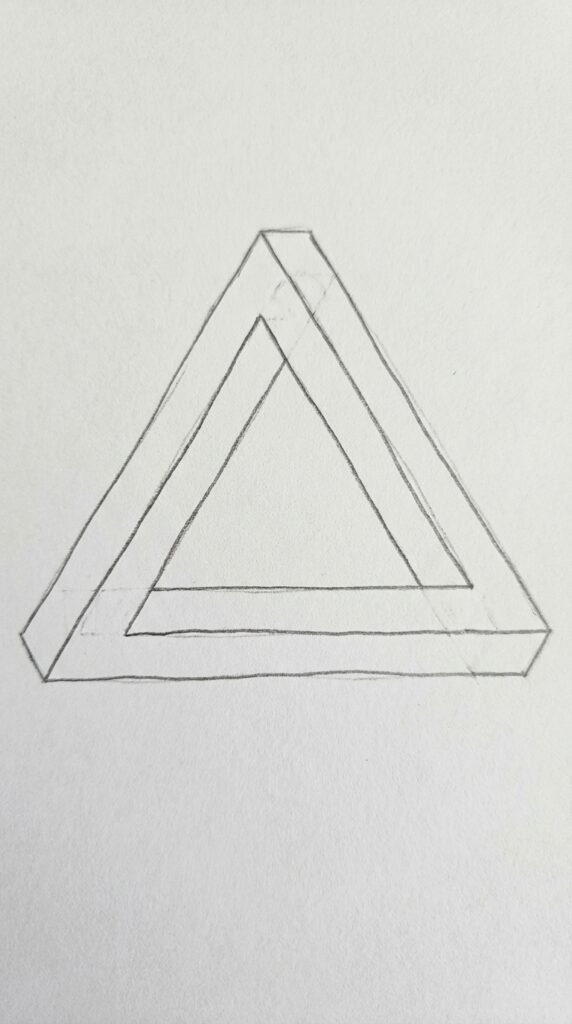
The impossible triangle also known as the Penrose triangle is one of the most iconic trippy art pieces in the world. It is a triangle that looks completely normal at first glance but becomes impossible the more you study it: each corner appears to connect in a way that defies the laws of three-dimensional space. The great news is that once you learn the basic trick to draw it, it becomes very repeatable and satisfying. This is a go-to cool trippy art easy enough for kids who want to impress their friends.
Step-by-Step Instructions:
- Draw a large equilateral triangle lightly in pencil make each side about 4 inches long so you have plenty of room to work inside.
- Inside the triangle, draw a second smaller triangle parallel to the first, leaving a gap of about half an inch between the inner and outer triangle lines on each side.
- At each of the three corners, draw a short horizontal or angled line that connects the two triangle edges in a way that makes it look like the bars of the triangle are overlapping each other this is the key trick that creates the impossible illusion.
- Erase the inner corner sections where one bar appears to pass in front of or behind the other bar, carefully removing the lines that break the illusion.
- Thicken the remaining lines slightly to make the finished triangle look bold and intentional. Add a clean outline around the whole drawing if desired.
Psychedelic Flower Mandala
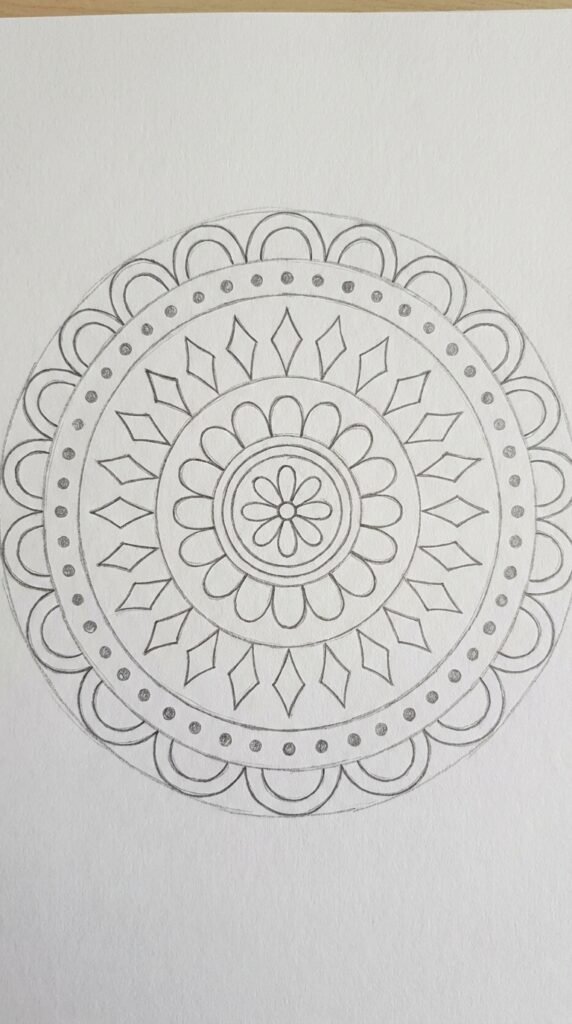
A mandala is a circular pattern built from repeating shapes radiating outward from a central point and a flower-themed mandala is one of the most beautiful and beginner-friendly trippy designs to draw. Each “layer” of the mandala is a ring of identical small shapes: petals, dots, diamonds, or arcs. The more layers you add, the more magical and complex it looks yet every individual element is incredibly simple. This is one of the best trippy doodle ideas for kids who enjoy detailed and meditative drawing.
Step-by-Step Instructions:
- Draw a small circle in the exact center of your page about the size of a coin. Inside it, draw a tiny 6-petaled flower shape using simple rounded petal forms.
- Draw a larger circle around your center. Along this circle, draw 6 evenly spaced larger petals pointing outward like a blooming flower. Each petal should be a simple rounded teardrop or oval shape.
- Draw another larger circle around the petals. Along this ring, draw 6 evenly spaced pointed diamond shapes in the gaps between the previous petals, alternating so the new shapes appear between the old ones.
- Continue adding rings: a row of evenly spaced small dots, then a row of arch shapes, then another row of petals each ring alternating with the last, all centered on the middle point.
- Draw a final clean outer circle to border the mandala and give it a polished circular frame.
Exploding Star Burst
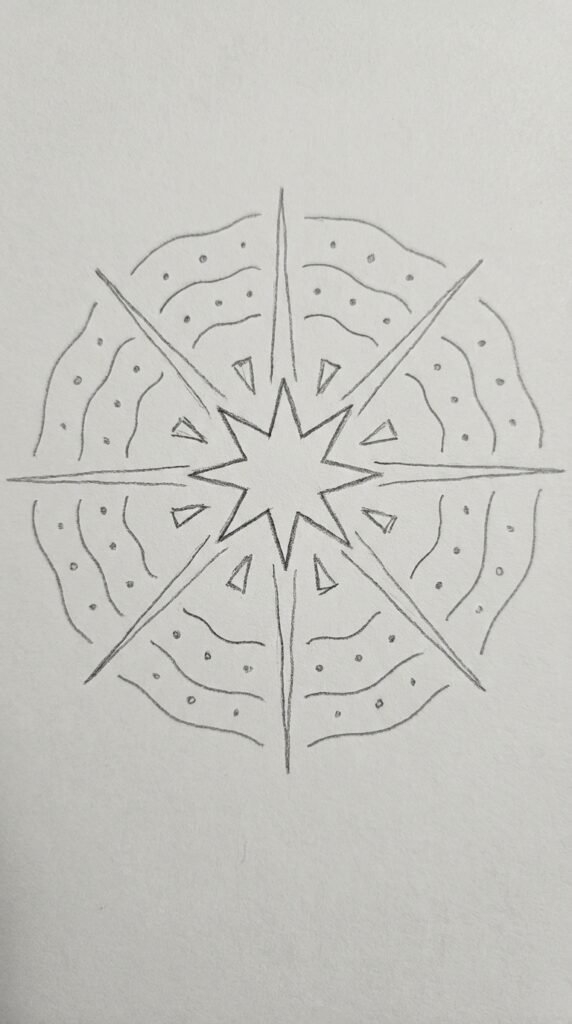
The exploding star burst is a dynamic and energetic trippy sketch idea that looks like a star is mid-explosion radiating sharp points, speed lines, and pulsing rings of energy. It combines the boldness of a geometric star with the movement of radiating wave lines, making it one of those cool drawings that is trippy and creative without requiring any advanced technique. It looks awesome traced over with a Sharpie or colored markers and makes a fantastic notebook cover design.
Step-by-Step Instructions:
- Draw a small 8-pointed star shape in the center of your page each point should be sharp and extend about 1 inch from the center. You can do this by drawing two overlapping squares rotated 45 degrees from each other.
- From the tip of each star point, draw two straight lines extending further outward like speed lines shooting away from the star. Make these lines about 2 to 3 inches long.
- Between each pair of speed lines, draw a small triangular shape pointing toward the star center to fill the gap between adjacent star points.
- Draw 3 to 4 concentric wavy rings around the entire star, centered on the same middle point. Make each wave slightly irregular for a more dynamic, energetic feel.
- Add a cluster of small dots in the spaces between the wavy rings and the star to suggest scattered energy particles.
Tunnel of Hexagons
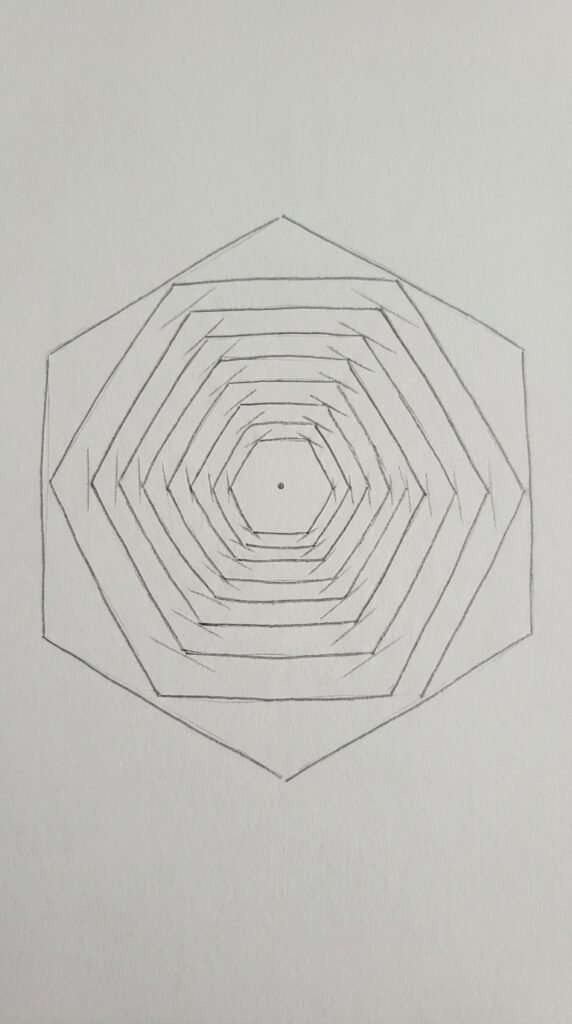
Hexagons are one of those shapes that instantly look trippy when repeated in a diminishing pattern. This design creates the illusion of a long tunnel stretching deep into the page built entirely from one repeated shape. Starting with a large hexagon at the outer edge and drawing progressively smaller hexagons inside it creates a powerful sense of depth and perspective, like you are looking down a long corridor made of honeycomb walls. This is one of those cool sketches trippy enough to make anyone stop and stare.
Step-by-Step Instructions:
- Draw a large regular hexagon that fills most of the page, leaving about an inch of margin on all sides. A hexagon has six equal sides draw it as flat-topped (one horizontal edge at top and bottom).
- Inside the first hexagon, draw a slightly smaller hexagon, centered inside it with even spacing on all sides. Aim for about half an inch of gap between the two.
- Continue drawing progressively smaller hexagons inside each other about 6 to 8 total until the innermost one is very small, about the size of a fingertip.
- In each of the six corner sections between the rings, draw short diagonal lines connecting the corners of adjacent hexagons. This adds a sense of depth and makes the tunnel effect stronger.
- Add a final tiny hexagon or dot at the very center to act as the “end” of the tunnel.
Melting Rainbow Drips
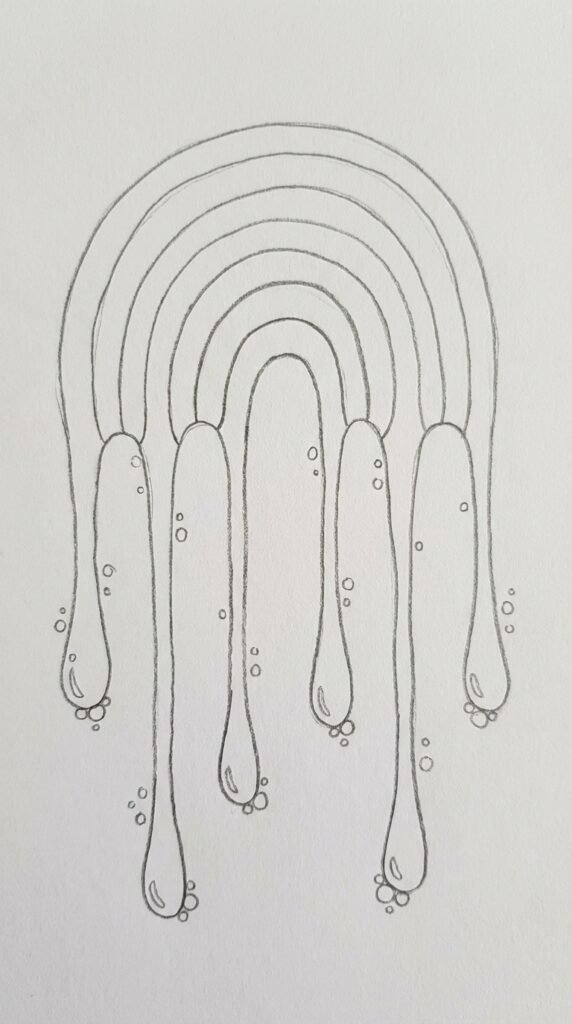
This is one of those fun and quirky trippy draws doodles that feels joyful and imaginative a row of colorful arched rainbow stripes that appear to melt downward into long, bubbly drips, as if the rainbow itself is made of ice cream and is slowly melting on a warm day. While this design looks best with Sharpies or colored pencils added later, the pencil sketch stage is very satisfying and straightforward. It is one of the most cheerful weird drawings for kids who love whimsical, unusual art.
Step-by-Step Instructions:
- Near the top of the page, draw a large arch like the top half of a circle spanning most of the page width. This is your first rainbow stripe.
- Draw 4 to 5 more arches inside the first one, each progressively smaller and centered on the same base point, like a classic rainbow with multiple bands.
- From the bottom edge of the lowest arch, draw 5 to 7 long curved drip shapes hanging downward. Each drip should be a narrow teardrop shape wider at the top where it meets the rainbow and tapering to a rounded point at the bottom. Make the drips different lengths for variety.
- At the tip of each drip, add a small round bubble or teardrop shape to represent the falling drop of melted rainbow.
- Add small circular bubble shapes along the sides and bottom of the drips to suggest the texture of melting, dripping liquid.
Drawing Tips for Trippy Art
Getting started with trippy drawing ideas is easy once you know a few key things that make a big difference in how your artwork turns out. Here are some tried-and-true tips to help you get the best results every time.
Start light, then go darker. Always begin your pencil drawing with very light lines. This makes it easy to erase mistakes and adjust proportions before committing to your final lines. Once you are happy with the design, you can press slightly harder to make your final lines clearer.
Use a ruler for straight-line designs. Ideas like the checkerboard wave, impossible triangle, and hexagon tunnel all benefit from having straight reference lines drawn with a ruler first. You do not have to be perfectly freehand tools are there to help!
Work from the center outward. For radial and mandala-style designs, always start at the center of the page and build outward in rings or layers. This keeps your design balanced and symmetrical naturally.
Go over pencil lines with a Sharpie. Once your pencil drawing is complete, tracing over it with a black fine-tip Sharpie gives your trippy design a bold, polished, professional look. Wait for the ink to dry fully before erasing the underlying pencil lines.
Be patient with optical illusion drawings. Designs like the impossible triangle and the infinite staircase take a little more focus and careful erasing. Do not rush work slowly and check your lines from different angles as you go.
Fill patterns consistently. For mandala and zentangle designs, try to keep your repeating patterns as even and consistent as possible. This regularity is what creates the beautiful, hypnotic quality of these drawings.
Common Mistakes to Avoid
Even the most enthusiastic young artists make a few common mistakes when first trying trippy drawing ideas. Knowing what to watch out for will save you time and frustration.
Making the center too small or too large. For tunnel and mandala designs, the center element sets the scale for everything else. If it is too tiny, you will run out of space before you build up enough rings to fill the page. If it is too large, the design will feel cramped. Aim for a center that is about a thumbnail size for most full-page designs.
Pressing too hard with the pencil too early. Many kids press down hard from the start, making lines impossible to erase when adjustments need to be made. Remember: start light, finish darker.
Skipping the sketch stage and going straight to Sharpie. It is tempting to skip the pencil stage and draw directly in marker but this makes it impossible to fix mistakes. Always pencil first, even if it feels like an extra step.
Making rings or lines uneven. For concentric designs like the spiral tunnel or hexagon tunnel, uneven spacing between rings makes the design look accidental rather than intentional. Take time to space each ring as evenly as your eye can judge.
Giving up on optical illusion drawings too soon. The impossible triangle and infinite staircase can feel confusing the first time. Do not give up! Look at a reference image, work slowly, and try it two or three times. By the third attempt, most kids have it figured out and feel incredibly proud of the result.
Frequently Asked Questions
Q: Are these trippy drawing ideas really suitable for kids?
Absolutely! All of the trippy drawing ideas in this guide have been designed with beginners and children in mind. Every design uses basic shapes like circles, triangles, squares, and curved lines. No complicated techniques, no shading skills, and no prior drawing experience are required. Children as young as 6 or 7 years old can start with simpler designs like the spiral galaxy tunnel or exploding starburst, while older kids and tweens will enjoy the more detailed mandala and impossible triangle.
Q: What supplies do I need for these easy trippy drawings?
You only need a standard HB or 2B pencil, a good eraser, and plain white paper to get started. A ruler is helpful for straight-line designs. If you want to make your finished drawings look even more vibrant and bold, a set of fine-tip black Sharpies or colored markers is a great addition many of these designs look absolutely stunning traced in Sharpie and colored with bright markers or colored pencils afterward.
Q: How long does each trippy drawing take to complete?
Simpler designs like the exploding starburst or melting rainbow drips can be completed in 15 to 30 minutes. More detailed designs like the psychedelic flower mandala or zentangle eye may take 45 minutes to over an hour if you add lots of fine interior patterns. The impossible triangle is quick to draw but may take a few attempts to master the illusion usually about 20 to 30 minutes once you understand the trick.
Q: Can I add color to these trippy drawing ideas?
Definitely, and it is highly recommended! Color is what really brings trippy art to life. Once you have completed your pencil sketch and gone over it with black Sharpie lines, you can add color using Crayola markers, Sharpie markers, colored pencils, or watercolor paints. Bright, contrasting colors electric blue next to orange, hot pink next to lime green are especially popular in trippy art and make the optical illusion effects even stronger.