Have you ever wanted to draw a monkey but did not know where to start? You are not alone. Many beginners feel stuck before they even put pencil to paper. The good news is that drawing monkeys is actually much easier than it looks. Once you understand that almost every part of a monkey can be broken down into simple circles, ovals, and curved lines, the whole process becomes enjoyable and stress-free.
This guide gives you 13 monkey drawing ideas that are perfect for beginners, kids, and anyone who wants to improve their drawing skills without feeling overwhelmed. Each idea uses basic shapes as the starting point. You do not need any special art supplies. A regular pencil, an eraser, and a plain piece of paper are all you need.
These monkey drawing ideas cover a wide range of poses and styles. You will find sitting monkeys, swinging monkeys, cartoon-style faces, and even cute baby monkeys. Every idea comes with clear step-by-step instructions that are easy to follow. The steps explain where to place each shape, how big to draw it, and how to connect the parts together.
No shading is required in any of these tutorials. The focus is entirely on clean, simple outlines that look good even without shading or color. Of course, if you want to add color or light shading afterward, you are welcome to do that. But the tutorials themselves are designed so that the finished drawing looks complete and satisfying with just pencil outlines.
Whether you are drawing for fun, practicing for school, or looking for a creative activity for your kids, these 13 monkey drawing ideas will give you plenty to explore. Pick the one that catches your eye and get started. You might surprise yourself with how well it turns out.
Sitting Monkey Drawing
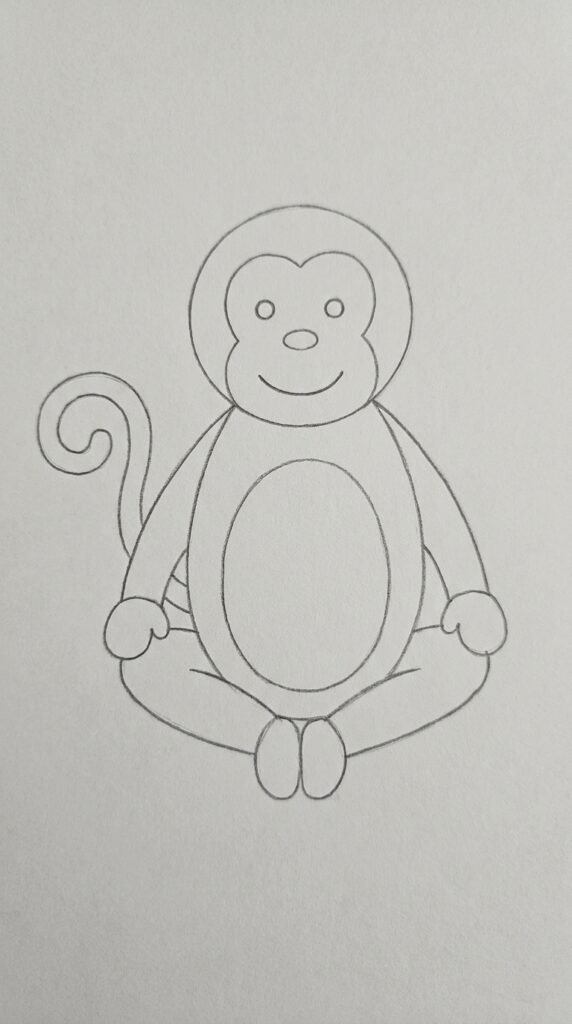
A sitting monkey is one of the most beginner-friendly poses you can draw. The body is in a relaxed position, which means you mostly work with rounded shapes and gentle curves. This is a great starting point if you have never drawn an animal before. The proportions are forgiving, and small mistakes are easy to fix or incorporate into the overall look.
Step-by-Step Instructions:
- Draw a medium circle in the center of your paper for the monkey’s head. Make it slightly larger than you think you need, because the body will sit below it.
- Below the head, draw a larger oval shape for the body. The oval should be about one and a half times the size of the head circle. Leave a small gap between the head and body to attach the neck.
- Connect the head and body with two short curved lines on each side to form the neck. Keep the neck short and wide rather than long and thin.
- Add two short curved arms on either side of the body, each ending in a small rounded hand shape. The arms can rest on the monkey’s knees.
- Draw two legs at the bottom of the body, bending outward like the monkey is sitting cross-legged. Add small rounded feet at the ends.
- Draw the face details inside the head circle: two small circles for eyes, a small oval snout in the lower half of the face, and a curved smile line across the snout.
- Add two small curved ears on the sides of the head, and draw a long curved tail coming from the lower back of the body, curling to one side.
Cartoon Monkey Face Drawing
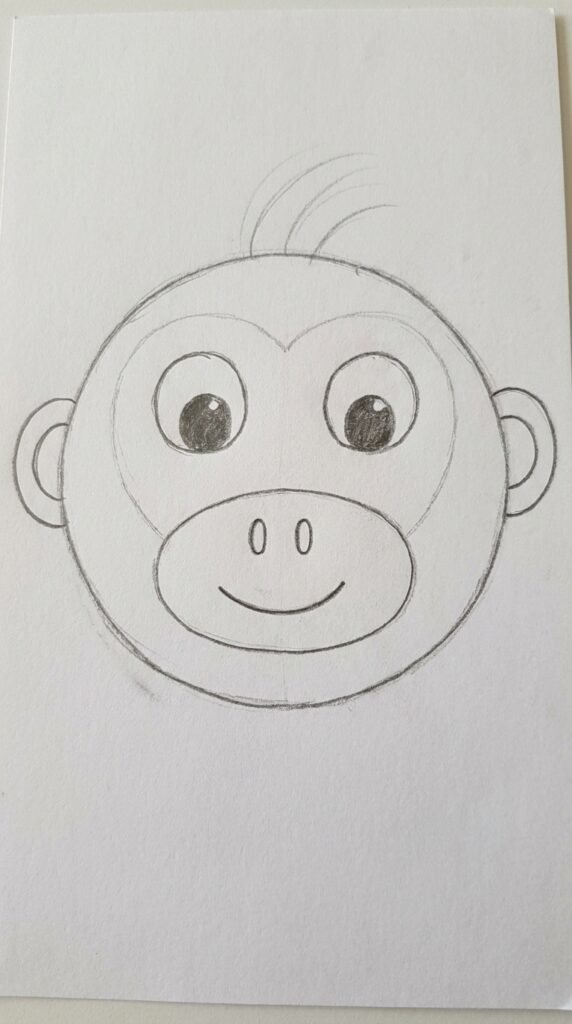
Drawing just the face of a monkey is an excellent idea for absolute beginners. You only need to focus on one area, which makes it much less intimidating. A cartoon monkey face is full of personality and can be drawn in just a few minutes once you understand the basic layout. The large eyes and expressive snout are what give the monkey its charm.
Step-by-Step Instructions:
- Draw a large circle in the middle of your paper. This will be the main face shape.
- Inside the lower portion of the circle, draw a smaller oval or egg shape for the snout. Position it so the bottom of the snout aligns with the lower edge of the main circle.
- Draw two large circle eyes in the upper half of the face. Leave enough space between them for the nose bridge. Add a smaller filled circle inside each eye for the pupils.
- Draw a small curved line above each eye for simple eyebrows. Slightly angled eyebrows can give the monkey a curious or happy expression.
- Inside the snout oval, draw two small oval nostrils side by side in the upper portion. Add a curved smile line across the lower half of the snout.
- Add two rounded ears on the left and right sides of the main face circle. Each ear should be a simple half-circle shape attached to the edge of the face.
- Add a few short curved lines on the top of the head to suggest hair or a tuft of fur, keeping the lines light and simple.
Swinging Monkey Drawing
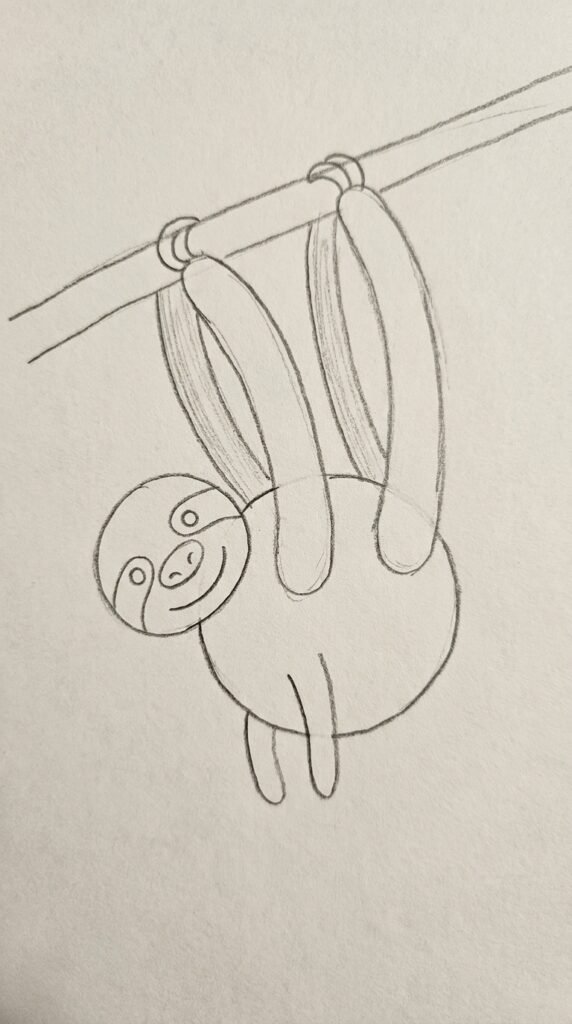
A monkey swinging from a branch is a classic pose that looks dynamic and fun. Even though it appears more complex than a sitting pose, the key shapes are still very simple. The arms are extended upward, and the body hangs below them. This idea works beautifully on its own or as part of a jungle scene.
Step-by-Step Instructions:
- Start by drawing a horizontal line near the top of your paper to represent a branch. Make it slightly diagonal for a more natural look.
- Draw two long oval arms reaching upward from just below the branch. Position the hands gripping the branch, which you can represent as simple curved finger shapes at the top of each arm.
- Below the arms, draw a rounded oval for the body, hanging down naturally. The body should be positioned slightly off-center to give a sense of movement.
- Draw a circle for the head at the top of the body, slightly tilted to one side to suggest the monkey is looking ahead while swinging.
- Add two short curved legs hanging below the body, with small rounded feet at the ends. The legs can be slightly bent at the knee.
- Draw the face details: two circle eyes, a small oval snout in the lower half, two tiny nostril dots, and a curved happy smile.
- Add a long tail curving away from the lower body, and draw small ear shapes on either side of the head.
Baby Monkey Drawing
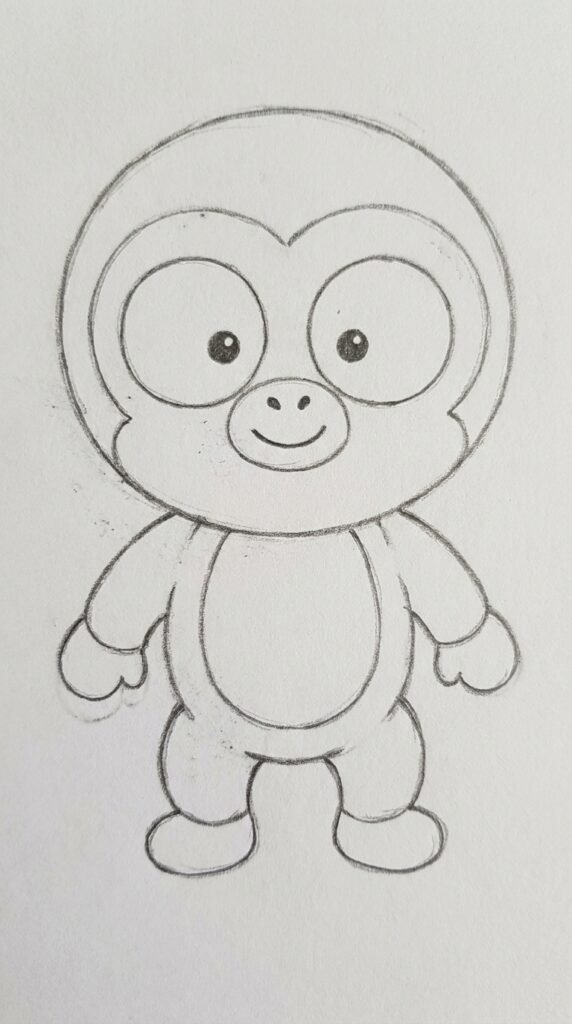
Baby monkeys have larger heads and eyes compared to their bodies, which makes them instantly cute and appealing. This style is very popular in children’s art and is surprisingly simple to draw. The key is making the head noticeably bigger than the body and keeping the features soft and round.
Step-by-Step Instructions:
- Draw a large circle for the baby monkey’s head. Make it take up about half of your drawing space because the body will be much smaller.
- Below the head, draw a small oval for the body. The body should be noticeably shorter and rounder than what you would draw for an adult monkey.
- Connect the head and body with a very short neck using two small curved lines on either side.
- Draw two short stubby arms on either side of the body, each ending in a small round hand. Keep the arms close to the body rather than extending them outward.
- Draw two short chubby legs at the bottom of the body, each ending in a rounded foot. The legs should be slightly bent and pointing downward.
- In the face, draw two very large circle eyes placed in the upper half of the head. Large eyes emphasize the baby look. Add small pupils inside each eye.
- Draw a tiny oval snout in the lower center of the face, add a small curved smile, and place two tiny dot nostrils above the smile. Add small rounded ears on each side of the head.
Monkey Hanging from a Tree Drawing
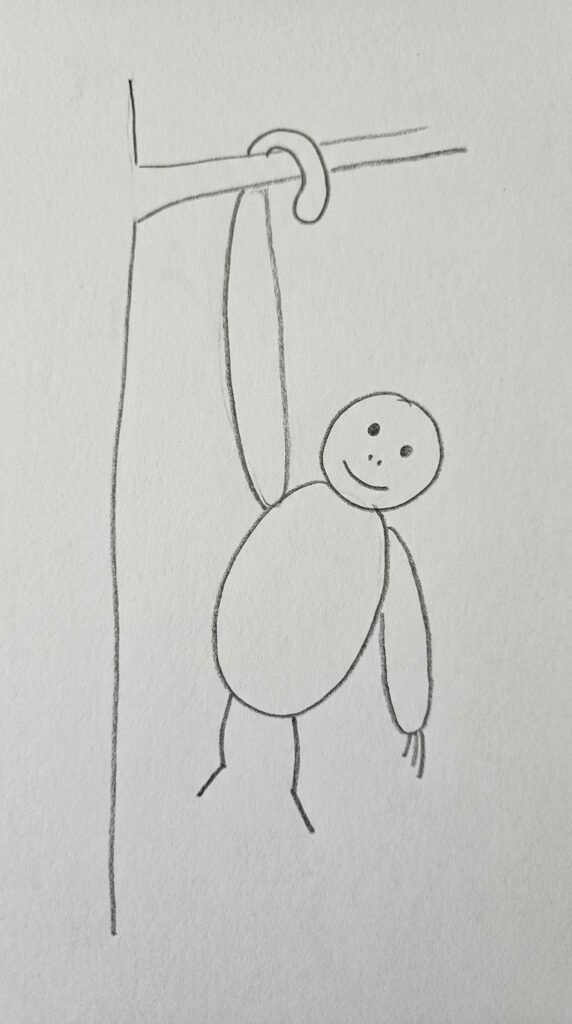
This pose shows a monkey hanging vertically from a tree limb, gripping with one or both hands. It is a slightly different pose from swinging and gives a calmer, more relaxed feeling. The vertical orientation of the body makes it an interesting composition on the page.
Step-by-Step Instructions:
- Draw a vertical line slightly to one side of your paper to represent a tree trunk or thick branch.
- From the top of that vertical line, draw a short horizontal branch extending to the right or left.
- Draw a hand shape at the end of one arm gripping the bottom of the branch. The arm should be a long, slightly curved rectangle connecting the hand to the shoulder.
- Draw the monkey’s body as a rounded oval below the shoulder, hanging vertically. Position it so it looks like it is hanging naturally under gravity.
- Add a circle head at the top of the body, slightly looking to one side. Connect head and body with a short neck.
- Draw the second arm either resting at the side or also reaching upward to grip the branch. Add legs hanging below the body with small rounded feet.
- Complete the face with circle eyes, an oval snout, smile, and nostril dots. Add the curling tail behind the body.
Monkey Eating a Banana Drawing
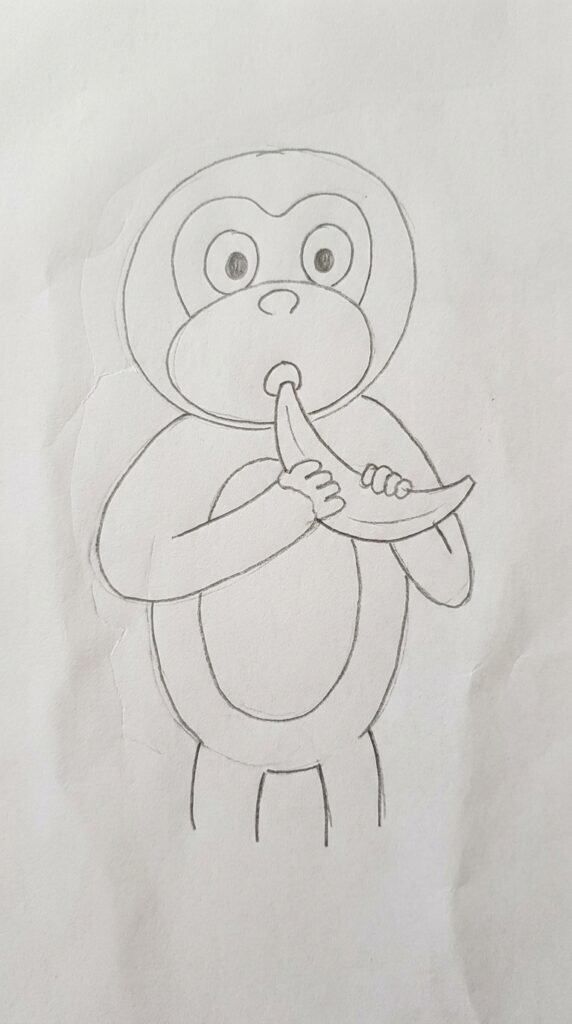
Adding a prop like a banana makes a monkey drawing much more entertaining and recognizable. This idea is great for kids because it is fun and tells a little story. The banana is drawn as a simple curved crescent shape, making it very easy to add to any monkey pose.
Step-by-Step Instructions:
- Draw a medium circle for the monkey’s head in the upper center of your page.
- Below the head, draw a slightly larger oval for the body. Connect them with a short neck.
- Draw the left arm bending upward so the hand is close to the monkey’s mouth. The arm should be a curved rectangular shape.
- Draw the right arm in a similar bent position, meeting the left hand in front of the face. Both hands will hold the banana.
- Between the two hands, draw the banana as a simple curved crescent shape. One end points up and the other end points slightly to the right. The banana should look like a gentle C-curve or a smile shape turned sideways.
- Draw the face looking slightly downward toward the banana. Add large circle eyes, an oval snout slightly open as if taking a bite, and tiny nostril dots.
- Add two short legs at the bottom of the body, a curling tail behind the body, and two rounded ears on the sides of the head.
Monkey Face with Detailed Expression Drawing
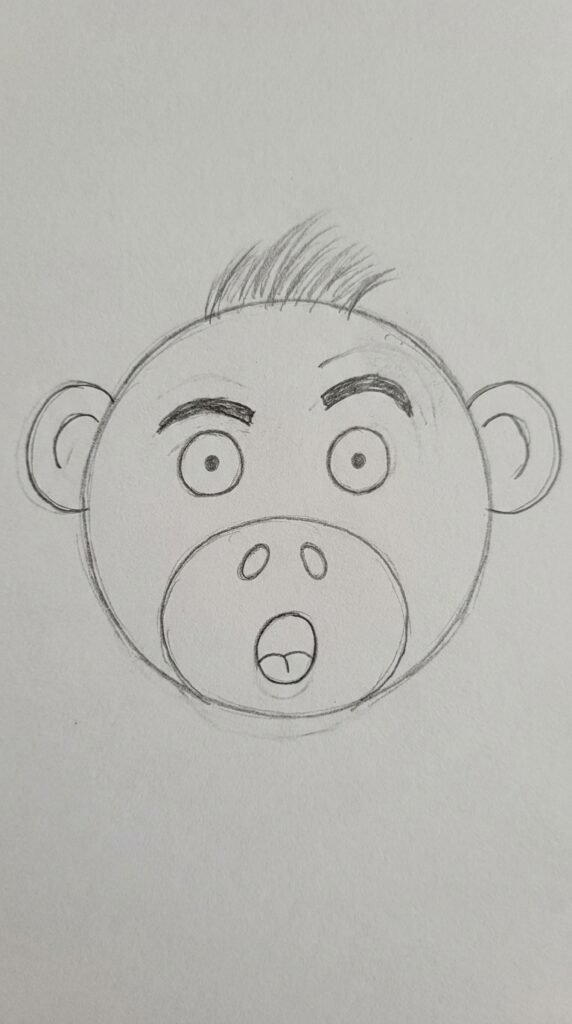
This idea focuses on giving the monkey face a more expressive look. You will practice drawing raised eyebrows, wide eyes, and an open mouth. This adds character and emotion to your drawing. It is still simple to do, but the result feels more lively and engaging than a plain face.
Step-by-Step Instructions:
- Draw a large circle for the main face. Add a smaller oval inside the lower portion for the snout, just as you did in the basic cartoon face.
- Draw two large circle eyes in the upper half, but this time make them slightly wider apart to create a surprised or excited expression.
- Draw two thick curved lines above the eyes for eyebrows. Arch one eyebrow higher than the other to create an asymmetrical, expressive look.
- Inside the snout, draw an open oval mouth shape in the lower half instead of a simple smile line. This open mouth gives the monkey a laughing or surprised expression.
- Add a small curved tongue shape inside the open mouth by drawing a half-oval at the bottom of the mouth opening.
- Draw two slightly larger ears on the sides of the head. Add a simple curved line inside each ear to define the inner ear area.
- Add a few short lines above the head for hair tufts and make the pupils in the eyes slightly larger than in the basic design to add to the expressive feeling.
Monkey in a Tree Drawing
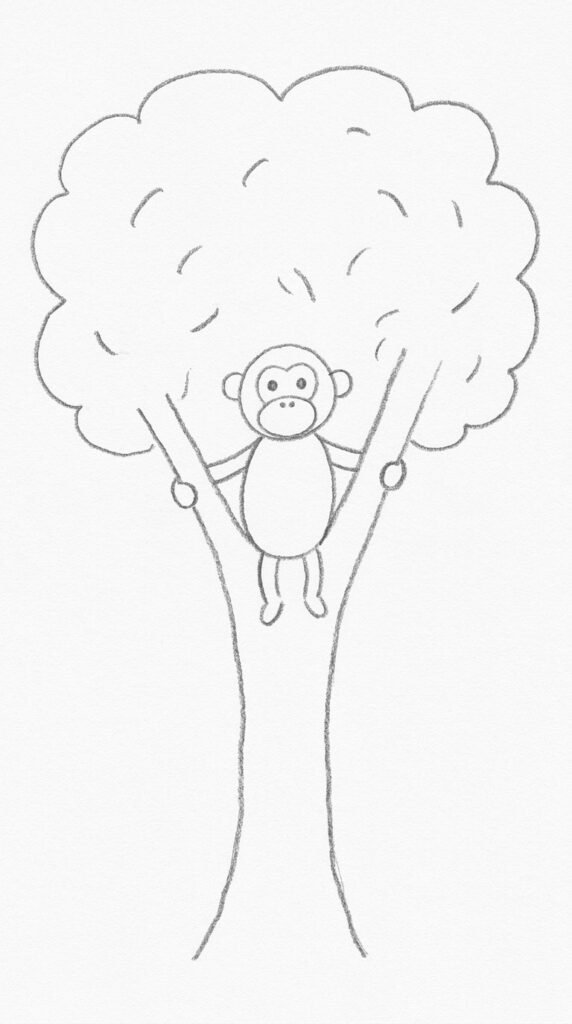
Drawing a monkey perched inside a tree adds a background element and creates a small scene. This is a step up from drawing just the monkey, but the tree is kept very simple so the difficulty level remains beginner-friendly. The combination of the monkey and the tree together creates a satisfying finished drawing.
Step-by-Step Instructions:
- Draw a large tree by starting with a wide V-shape or Y-shape for the main trunk and two branches spreading outward and upward.
- At the top and around the branches, draw a large irregular cloud-like shape to represent the treetop full of leaves. Keep the shape loose and round rather than trying to draw individual leaves.
- Seat the monkey in the fork of the tree where the trunk splits into branches. Draw the monkey’s body as an oval sitting in that V-shaped fork.
- Add the monkey’s head as a circle on top of the body, and draw two arms reaching out to grip the two branches on either side.
- Draw two short legs dangling below the body in the fork of the tree. Add a curling tail hanging down along one side of the trunk.
- Draw the face inside the head circle: circle eyes, oval snout, smile, and nostril dots.
- Add some short curved lines inside the cloud-shaped treetop to suggest individual leaf clusters, keeping the lines light and loose.
Walking Monkey Drawing
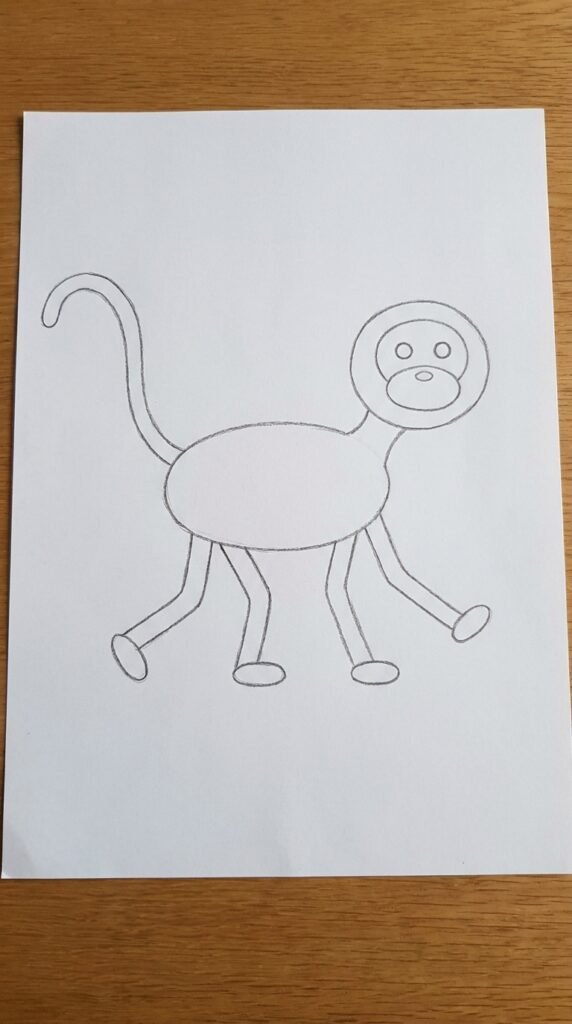
A monkey walking on all fours is a more naturalistic pose that introduces beginners to drawing animals in motion. It does not require realistic proportions, so you can keep the shapes simple and still achieve a walking pose that is clearly recognizable. This is a great way to practice drawing four limbs in different positions.
Step-by-Step Instructions:
- Draw an oval in the center of your paper for the monkey’s body. Position it horizontally, like an egg lying on its side.
- Draw a circle for the head at the front-left end of the body. Connect the head to the body with a short curved neck.
- Draw two front legs extending downward from the front portion of the body. The front-right leg should be slightly more forward than the front-left leg to suggest a walking stride.
- Draw two back legs from the rear portion of the body. Mirror the front legs so the back-right leg is slightly behind the back-left leg. All four feet should be small oval shapes.
- Draw the face on the front of the head circle: two circle eyes, a small oval snout, and a slight smile.
- Add two rounded ears on top of the head, positioned so they face slightly upward since the monkey is looking forward while walking.
- Draw a long tail curving upward from the back end of the body. The tail can arch over the back in a relaxed curve.
Monkey Waving Drawing
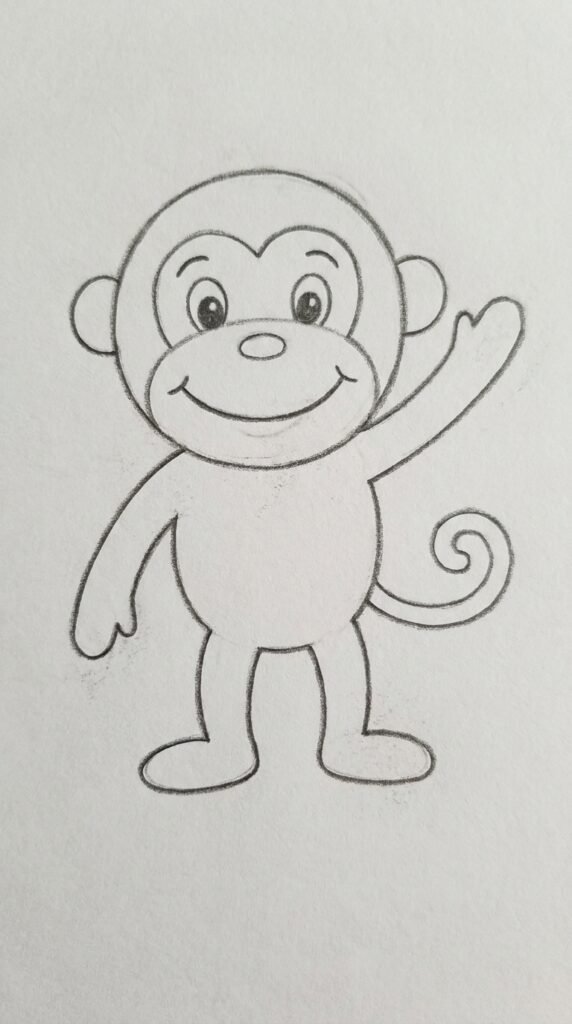
A waving monkey is a friendly, simple pose that is very popular in children’s drawings and illustrations. One arm is raised with the hand open, which gives the drawing a cheerful and welcoming feeling. This pose is easy to adapt from the basic sitting monkey by simply raising one arm.
Step-by-Step Instructions:
- Draw a medium circle for the head near the top-center of your paper.
- Below the head, draw a slightly larger oval for the body. Connect them with a short neck.
- Draw the left arm of the monkey (which appears on the right side of your paper) pointing upward and outward at about a 45-degree angle. At the end of this arm, draw a simple open hand shape with four short lines for fingers and one angled line for the thumb.
- Draw the other arm resting at the side of the body in a relaxed downward position, ending in a simple rounded hand.
- Draw two short legs at the bottom of the body, slightly apart with small oval feet pointing outward.
- Draw a cheerful face: two large circle eyes, a wide curved smile, a small oval snout, and tiny nostril dots. You can angle the eyebrows upward to reinforce the happy expression.
- Add a curling tail behind the body and two rounded ears on the sides of the head. Optionally add a few lines on top of the head to suggest short fur.
Monkey Sleeping Drawing
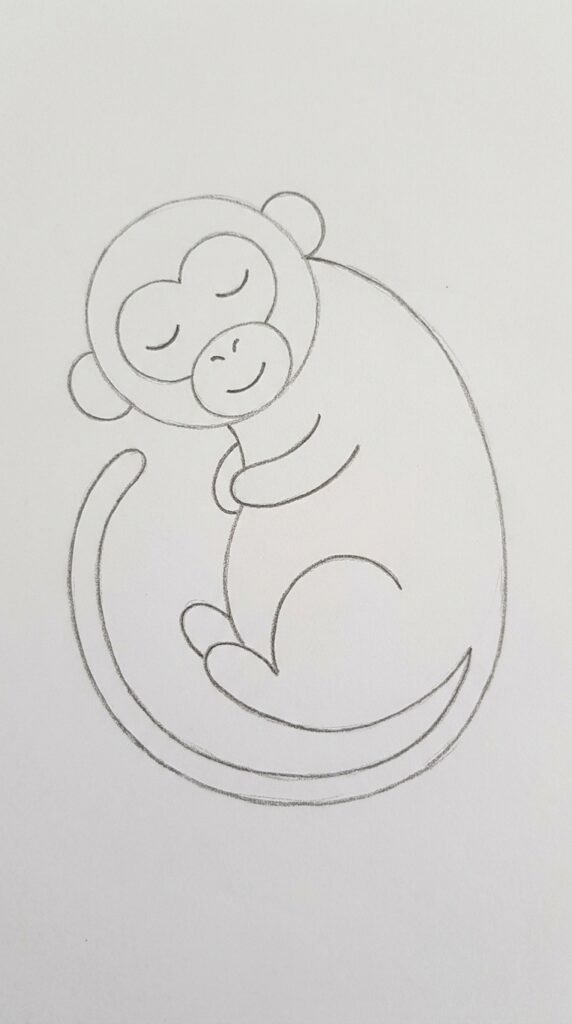
A sleeping monkey is an adorable and unique drawing idea that uses soft rounded shapes. The closed eyes are represented by simple curved lines, which gives the drawing a peaceful and gentle feeling. This is one of the easiest poses because the body is curled and compact, and the face has very few details.
Step-by-Step Instructions:
- Draw a large irregular oval or slightly bean-shaped form for the body curled up in a sleeping position. The shape should be wider at one end and narrower at the other.
- At the wider end, draw a circle for the head resting against the body as though the monkey is sleeping with its head resting on its own body or a surface.
- Draw two short arms folded in front of the body, tucked close to the chest. The hands can be drawn as simple small rounded shapes.
- Draw two legs curled at the bottom of the body, with the knees pulled slightly upward in a sleeping curl. Add small rounded feet.
- On the face, draw two closed eyes using simple curved lines (like upside-down U shapes or soft parenthesis curves). This immediately communicates sleep.
- Add a small curved smile on the oval snout area to give the sleeping monkey a happy, content expression.
- Draw two small rounded ears on the sides of the head, and add a long tail curling around the body as if wrapping around for warmth.
Monkey Jumping Drawing
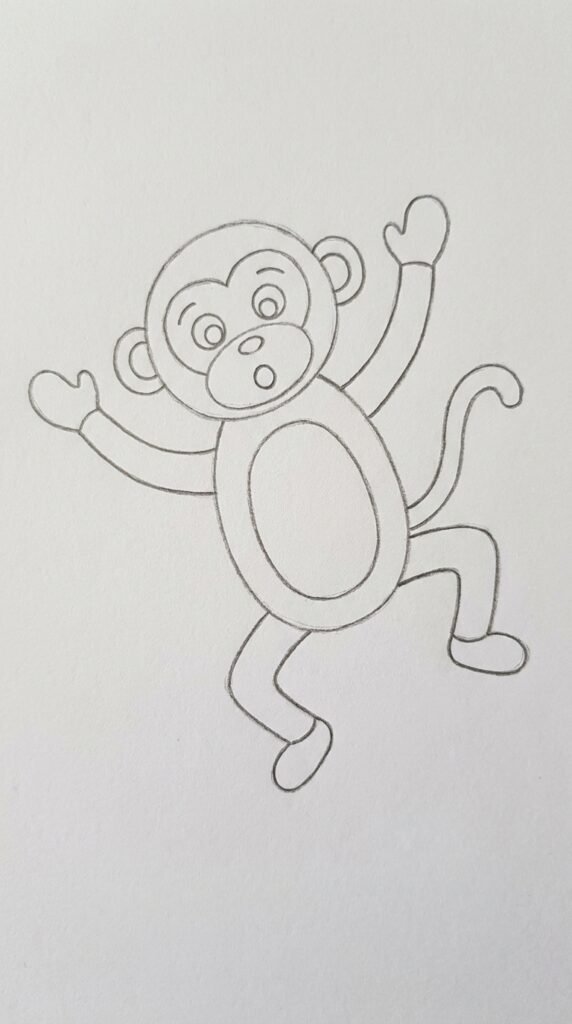
A jumping monkey captures motion and energy in a drawing. The arms and legs are spread outward, and the body is in mid-air. This pose is more dynamic than a sitting or sleeping monkey, but it is still built from the same simple shapes. The key is spreading the limbs outward to convey the jumping motion.
Step-by-Step Instructions:
- Draw a medium oval for the body in the center of your paper. Tilt it very slightly to one side to suggest motion.
- Draw a circle for the head at the top of the oval, also slightly tilted.
- Draw both arms spread outward from the shoulders, angled upward and to the sides. Each arm should end in a simple curved hand shape with short finger lines.
- Draw both legs spread downward and outward from the hips. Bend each leg slightly at the knee to suggest the monkey is in mid-jump rather than just standing with legs apart.
- Draw small rounded feet at the end of each leg, pointing outward and slightly downward.
- On the face, draw two wide circle eyes, two arched excited eyebrows, and an open circle mouth to convey the excitement of jumping. Add a small oval snout around the mouth.
- Add two small ears on the sides of the head and draw a tail curving upward and behind the body as if trailing behind during the jump.
Monkey with a Hat Drawing
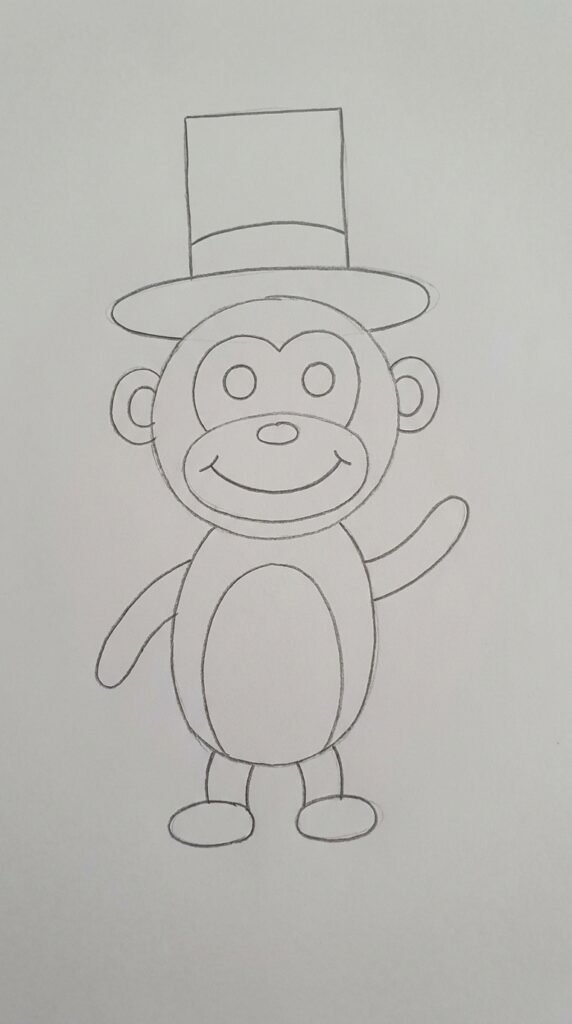
Adding a small accessory like a hat makes a monkey drawing more fun and gives it a distinct personality. A simple top hat or a round hat shape is very easy to draw and immediately makes the monkey look charming and humorous. This is a great idea for personalized drawings and greetings cards.
Step-by-Step Instructions:
- Draw a medium circle for the monkey’s head in the center-upper area of your paper.
- On top of the head, draw a small rectangular shape for the body of the hat. The rectangle should be centered on the top of the head circle and slightly narrower than the head.
- At the bottom of the rectangle, draw a flat horizontal oval that extends slightly wider than the rectangle on both sides to form the hat brim.
- Below the head, draw a slightly larger oval for the body and connect them with a short neck.
- Draw two arms at the sides of the body in a relaxed position. You can have one arm raised slightly as if tipping the hat for added character.
- Draw two short legs at the bottom of the body with small oval feet.
- Draw the face inside the head circle: two circle eyes, a wide smile, a small oval snout with nostril dots, and two rounded ears on either side of the head. Add a small curved line inside the hat rectangle to suggest a hatband.
Drawing Tips Section
Learning to draw monkeys becomes easier when you keep a few simple principles in mind. These tips apply to all 13 monkey drawing ideas in this guide.
Always start with the lightest possible pencil marks when blocking in your initial shapes. This way, if a circle is slightly off-center or an oval is the wrong size, you can erase it easily and try again without leaving harsh marks on the paper. The initial shapes are just guides, not final lines.
Work from the center of the figure outward. For most monkey drawings, this means starting with the head and body before adding the limbs, tail, and face details. This approach helps you maintain proper proportions because the most important parts are placed first.
Keep your shapes consistent in size relative to each other. A common beginner mistake is drawing a head that is too small for the body, or arms that are too long. Look at your shapes regularly as you draw and compare their sizes to each other before continuing.
Do not press too hard with your pencil during the early stages. A lighter line is easier to erase and adjust. Once you are happy with the overall shape and placement, you can go over your lines with a slightly firmer press to finalize them.
Practice the same drawing more than once. The second and third attempt will always look better than the first because your hand becomes more familiar with the shapes and proportions. Repetition is the fastest way to improve.
Common Mistakes Section
Many beginners make the same few mistakes when drawing monkeys. Being aware of these in advance will save you a lot of frustration.
Drawing the head too small is one of the most frequent mistakes. Monkeys, especially in cartoon style, have large heads relative to their bodies. If your monkey looks stiff or robotic, check whether the head is large enough compared to the body.
Making the arms too short is another common issue. Monkey arms are characteristically long, even in simplified cartoon versions. Short arms make the monkey look more like a round toy than an actual monkey. Extend the arms a little further than feels natural at first.
Placing all the features too close together in the face is a mistake that makes the expression hard to read. Space the eyes apart more than you think necessary, and give the snout area enough room to sit clearly in the lower half of the face.
Pressing too hard with the pencil too early in the drawing process is a mistake that leaves marks that are difficult to erase. Keep early lines light and only firm them up once you are satisfied with the shape and placement.
Skipping the initial shape-blocking stage and going straight to detail lines almost always results in a lopsided or poorly proportioned drawing. Even experienced artists block in basic shapes before adding details. Do not skip this step.
FAQ Section
What basic shapes do I need to draw a monkey?
Almost every part of a monkey drawing can be built from circles and ovals. The head is a circle, the body is a larger oval, and the limbs are elongated ovals or curved rectangles. Once you are comfortable making these basic shapes, you can draw any of the 13 monkey drawing ideas in this guide with confidence.
Are these monkey drawing ideas suitable for young children?
Yes, all 13 monkey drawing ideas in this guide are designed to be beginner-friendly and child-appropriate. The steps are broken down into simple, manageable actions, and the instructions describe exactly where to place each shape and how large to make it. Children as young as five or six years old with some basic pencil control can follow many of these tutorials with a small amount of adult guidance.
Do I need special art supplies to draw these monkey ideas?
No special supplies are required. A standard HB pencil, a clean eraser, and a plain piece of white paper are all you need to complete any of the drawings in this guide. If you want to add color afterward, colored pencils or crayons work perfectly, but color is entirely optional. The outlines alone create complete and satisfying drawings.
How can I make my monkey drawing look better without shading?
Clean, confident lines make the biggest difference without any shading. Focus on making your outlines smooth and consistent in thickness. Adding simple details like a hatband, finger lines, or inner ear curves also adds visual interest without requiring shading techniques. Once you are comfortable with the basic shapes, small detail additions bring a lot of life to a simple outline drawing.