If you have ever looked at a peony flower and thought, “That is way too complicated to draw,” you are not alone. Peonies have so many layered petals, soft curves, and gorgeous details that they can look intimidating at first glance. But here is the good news: with the right approach, drawing a peony flower is much easier than it looks, and it is something even complete beginners can do with just a pencil and a piece of paper.
This article gives you 12 easy peony flower drawing ideas that are broken down into simple, clear steps. Every idea in this list starts with basic shapes like circles, ovals, and curved lines. You do not need to know how to shade, blend, or use any special tools. A regular HB pencil is all you need. These tutorials are designed for kids, teens, adults who are just starting out, and anyone who loves bullet journaling, sketchbooks, or creative journaling pages.
Peonies are one of the most popular flowers to draw because of their rich, full appearance. They look beautiful on their own, grouped together in a bouquet arrangement, or used as decorative elements in planners, greeting cards, and art journals. Whether you are drawing for fun, practice, or to create Pinterest-worthy content, this guide has something for everyone.
Each idea below includes a heading, a short description, step-by-step drawing instructions, an ALT text description, and a detailed image prompt. You will also find drawing tips, common mistakes to avoid, frequently asked questions, and suggestions for related tutorials at the end of this article.
Take your time with each drawing. Do not rush. Remember that every artist starts somewhere, and simple shapes drawn with care and confidence can turn into something truly beautiful.
Simple Peony Bud Drawing
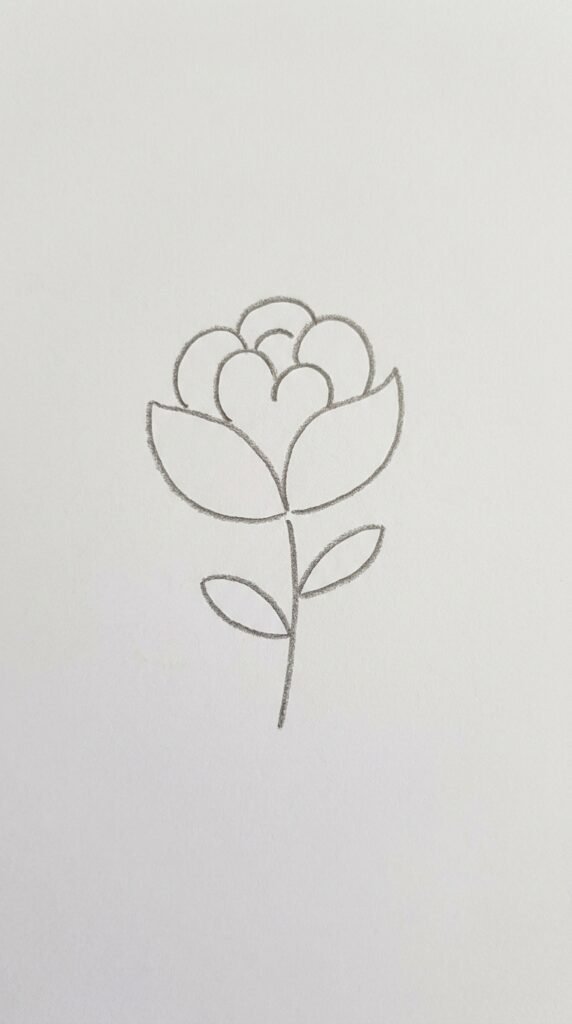
A peony bud is the perfect starting point for beginners. It shows just the beginning of a bloom, with a few rounded petals peeking out from a small, tight center. Because the bud has fewer petals than a fully open flower, it is one of the easiest peony shapes to draw. This idea works great for sketchbook pages, journaling borders, and greeting card designs.
Step-by-Step Instructions:
- Draw a small oval in the center of your paper. This will be the base shape of the bud. Keep it roughly the size of a large coin.
- Around the top of the oval, draw three short, gently curved petal shapes. Each petal should curve inward slightly at the tip, like a cupped hand.
- Below those petals, draw two larger curved shapes on either side of the oval to show the outer protective petals, called sepals.
- At the bottom, draw a short, narrow stem going straight down. Add two or three small leaf shapes on either side of the stem using a long oval with a pointed tip.
- Review the entire outline and gently erase any guide lines from the oval shape so only the clean bud outline remains.
Full Bloom Peony Drawing
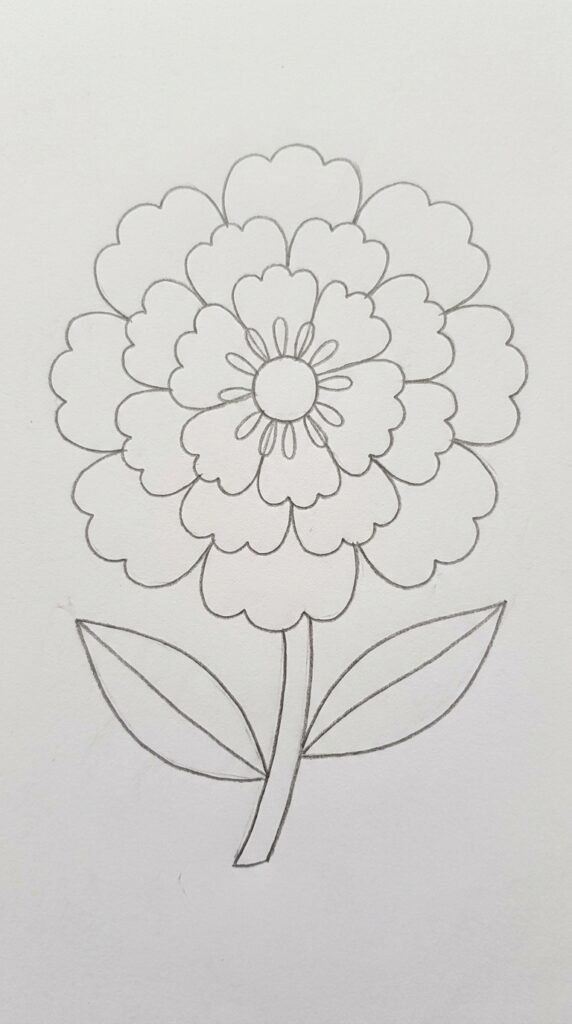
A fully open peony is the classic image most people picture when they think of this flower. It has many rounded petals layered from a tight center outward. This version teaches you to build petals in rings, which is a skill that will help you draw many other flowers as well. The result looks impressive but is built from simple oval and cup shapes repeated in layers.
Step-by-Step Instructions:
- Start by drawing a small circle in the center of your paper. This is your flower center or core. Make it about the size of a marble.
- Around the circle, draw five or six small rounded petal shapes, each one touching or slightly overlapping the center circle. These are your innermost petals and should look like small cupped ovals.
- Add a second ring of petals around the first. These petals should be slightly larger and overlap the gaps between the first ring of petals.
- Add a third and final outer ring of petals. These should be the largest and widest, with gentle curves at their tips. They can look slightly open and relaxed, not as tightly cupped.
- Draw a short, thick stem below the flower and add two large leaf shapes on either side of the stem. Each leaf should have a slightly pointed tip and a central vein line drawn lightly down the middle.
- Erase the small center circle guideline so the innermost petals take its place cleanly.
Peony Flower Side View Drawing
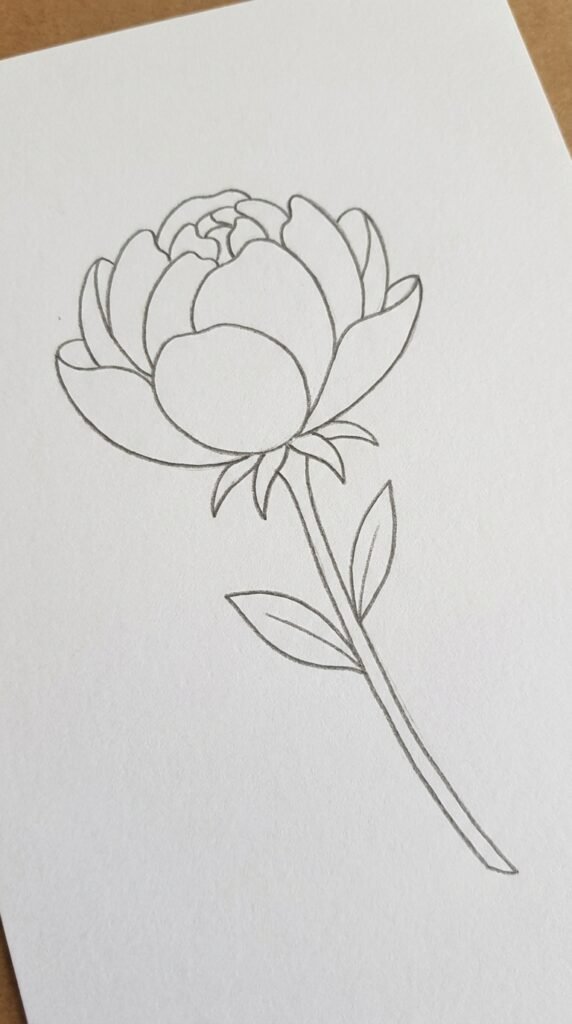
Drawing a flower from the side is a skill that makes your art look more dynamic and varied. A side-view peony shows the petals fanning out from one central point, with the stem and sepals clearly visible below. This view is especially popular in botanical illustration styles and looks beautiful in sketchbooks and art journals.
Step-by-Step Instructions:
- Draw a small half-circle or dome shape slightly left of center on your paper. This is the base of the bloom as seen from the side.
- From the top of the dome, draw five to seven curved petal shapes fanning outward and upward. The petals near the center should be smaller and more upright, while the outer petals should be wider and curve outward gently.
- Below the dome shape, draw a small cluster of narrow pointed shapes. These are the sepals, which are the green leaf-like parts that hold the flower in place.
- Draw a long, slightly diagonal stem extending downward from the sepals. Add one or two oval leaves along the stem.
- Clean up your guide lines and review the overall shape. The flower should look like it is being viewed from a 45-degree angle with petals fanning out to one side.
Mini Peony Doodle Drawing
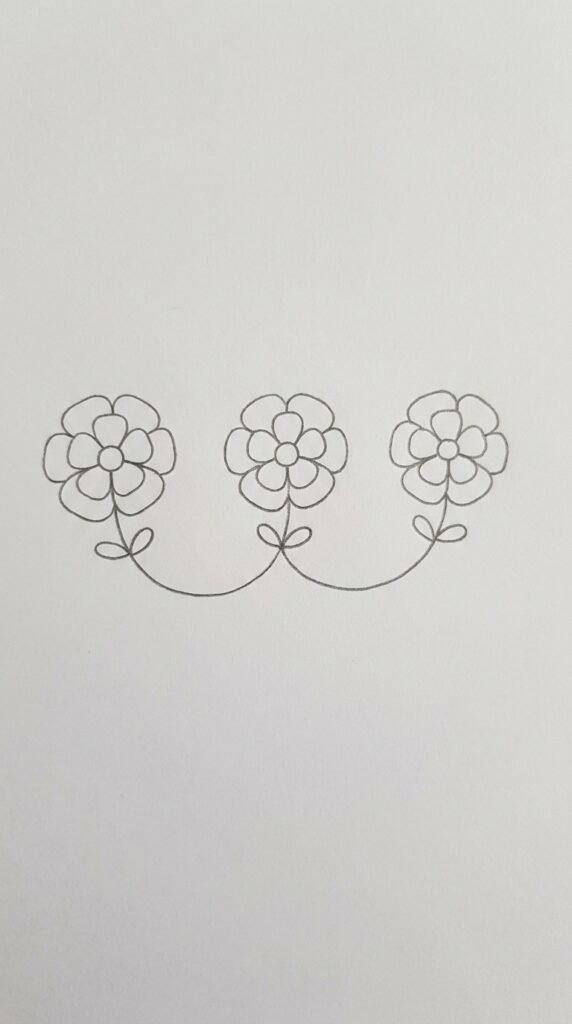
Mini peony doodles are small, simplified versions of the full flower that are perfect for decorating bullet journal pages, borders, cards, and planner spreads. Because they are small, they do not require much detail, which makes them beginner-friendly and quick to draw. You can repeat them in rows or scatter them across a page for a charming decorative effect.
Step-by-Step Instructions:
- Draw a tiny circle about the size of a pea in the center of your drawing space.
- Around the circle, draw four or five small rounded petal shapes, each one like a tiny teardrop pointing outward from the center circle.
- Add one more ring of slightly larger petals around the first layer. At this small size, two rings of petals are enough to suggest a full bloom.
- Draw a very short stem below the flower, just a few millimeters long. Add two tiny leaf shapes on either side of the stem.
- If you are making a border or pattern, repeat this mini peony three to five times across your page, spacing them evenly or connecting them with a thin curving vine line.
Peony With Leaves Drawing
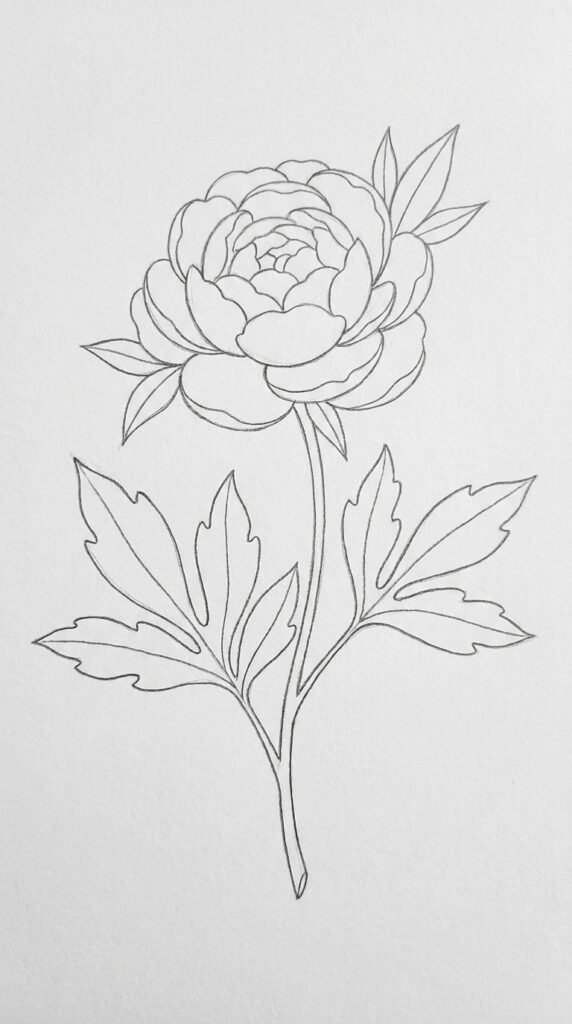
Adding detailed leaves to a peony drawing creates a more complete and realistic-looking composition. Peony leaves are large, lobed, and have pointed tips, which makes them interesting to draw on their own. This tutorial focuses on drawing a single peony bloom with a generous arrangement of leaves surrounding and framing it.
Step-by-Step Instructions:
- Draw your peony flower in the center of the page using the full bloom method: a small circle center, two or three rings of rounded petals building outward.
- Draw a medium-length stem extending from the base of the flower downward and slightly to one side.
- Along the stem, draw two branches extending to the left and right at slight angles. These branches will hold the leaf clusters.
- On each branch, draw three large lobed leaf shapes grouped together. Each leaf should have a pointed tip, a gently wavy edge, and a single center vein line drawn lightly from base to tip.
- At the base of the flower, add two or three smaller leaves peeking out from behind the petals to give the drawing more depth and a natural, botanical look.
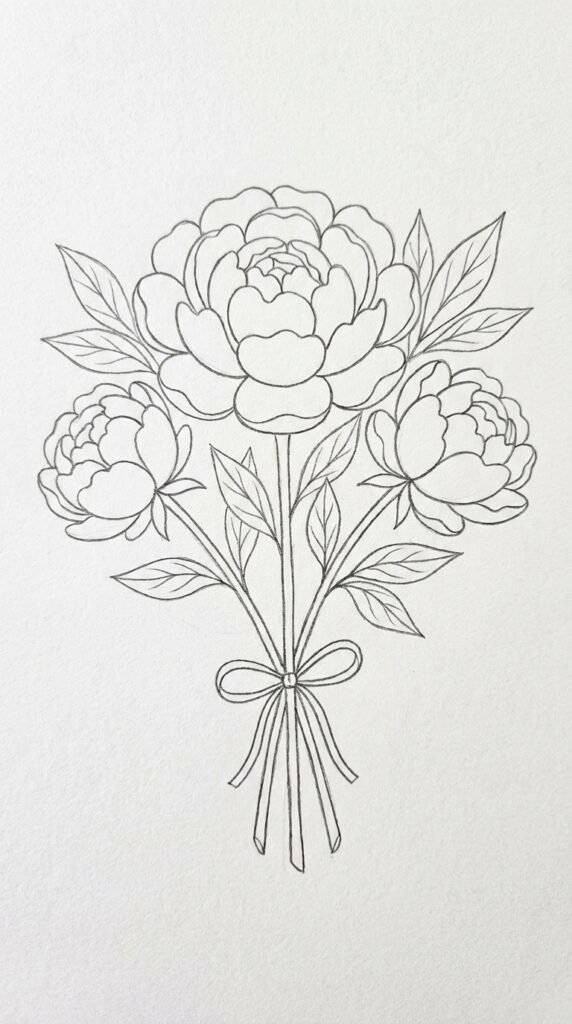
Peony Bouquet Drawing
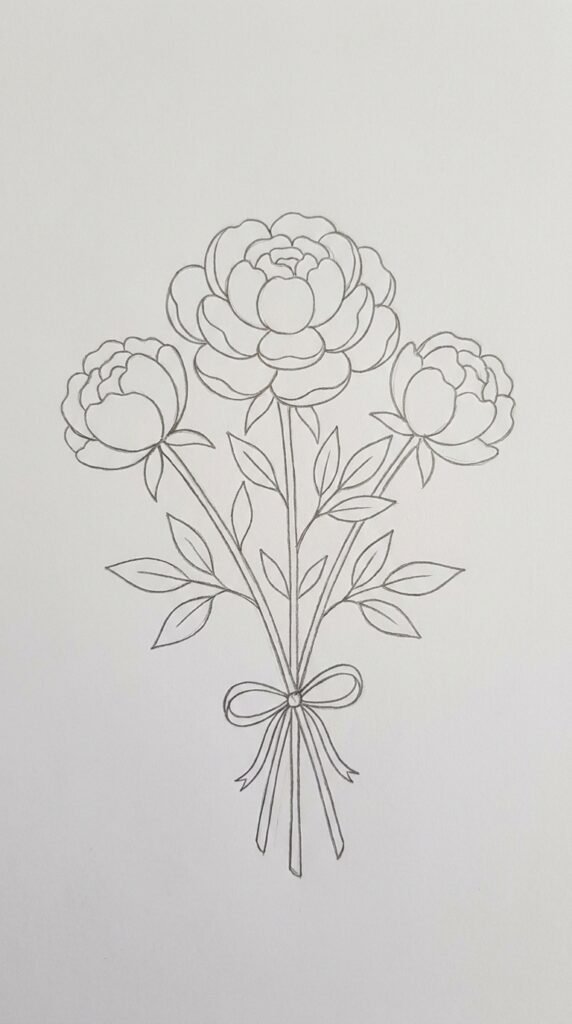
A simple peony bouquet drawing groups two or three blooms together, which creates a lush, romantic composition. Bouquets look great on greeting cards, journal pages, and as standalone art pieces. The key to drawing a bouquet is varying the size and angle of each flower so they do not all look identical.
Step-by-Step Instructions:
- Lightly sketch three circle guides on your paper in a loose triangular arrangement. Make one circle larger in the center and two smaller ones on either side and slightly lower or higher.
- Turn each circle into a peony bloom by drawing rings of petals around the center. The largest circle gets three rings of petals; the smaller ones get two rings each.
- Draw stems extending downward from each flower and gather them together at the bottom into a single bundle point.
- Add a few leaf shapes along the stems and between the flowers to fill in the composition naturally.
- Optionally, draw a simple bow or ribbon where the stems meet at the base to complete the bouquet look.
- Erase all circle guide lines and review the final composition for balance.
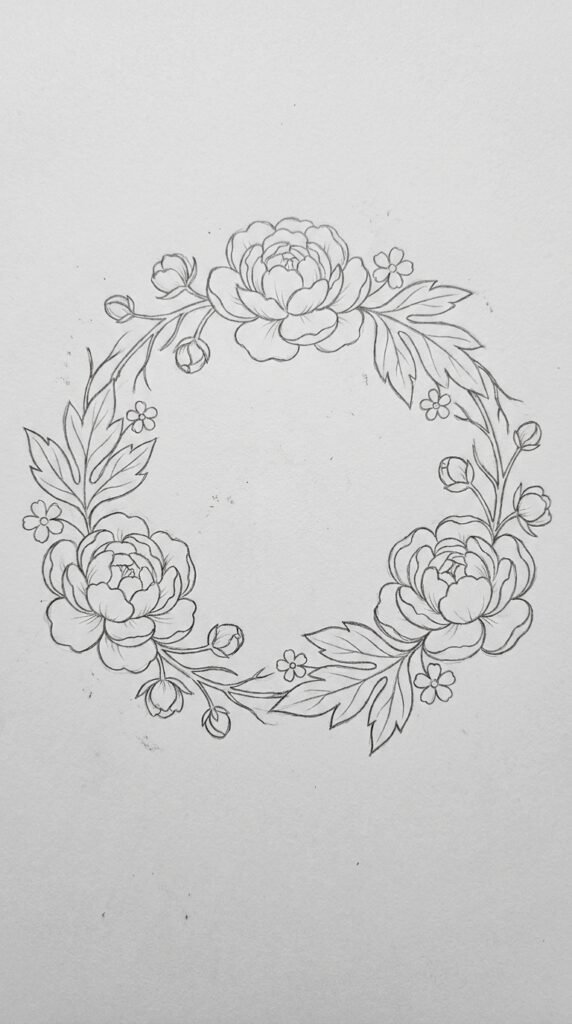
Peony Flower Wreath Drawing
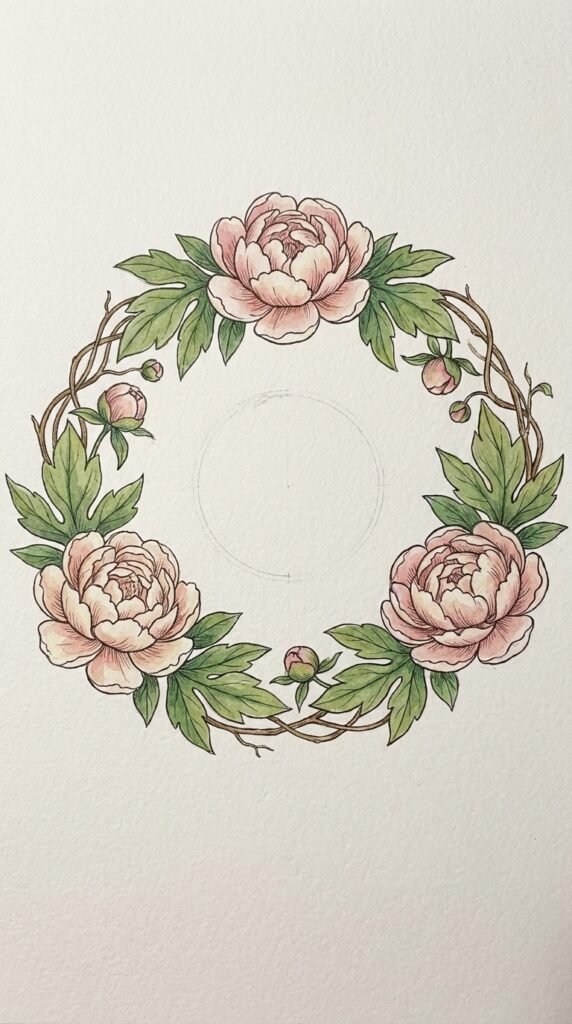
A peony wreath is a circular arrangement of flowers and leaves that makes an elegant decorative frame for text, monograms, or as a standalone illustration. This type of drawing is very popular in bullet journals and hand-lettering layouts. The secret is to draw the circular guide first and then place flowers and leaves evenly around it.
Step-by-Step Instructions:
- Lightly draw a circle in the center of your paper using a compass or by tracing a round object. This circle is your guide and will be erased later.
- Place three peony blooms evenly spaced around the circle at the top, bottom-left, and bottom-right positions.
- Between each bloom, draw clusters of two or three large lobed leaves to fill the gaps and create a sense of fullness.
- Add small scattered details like tiny buds or simple five-petal filler flowers between the leaves to add variety.
- Connect all the elements with thin curving branch or vine lines that follow the circular guide shape.
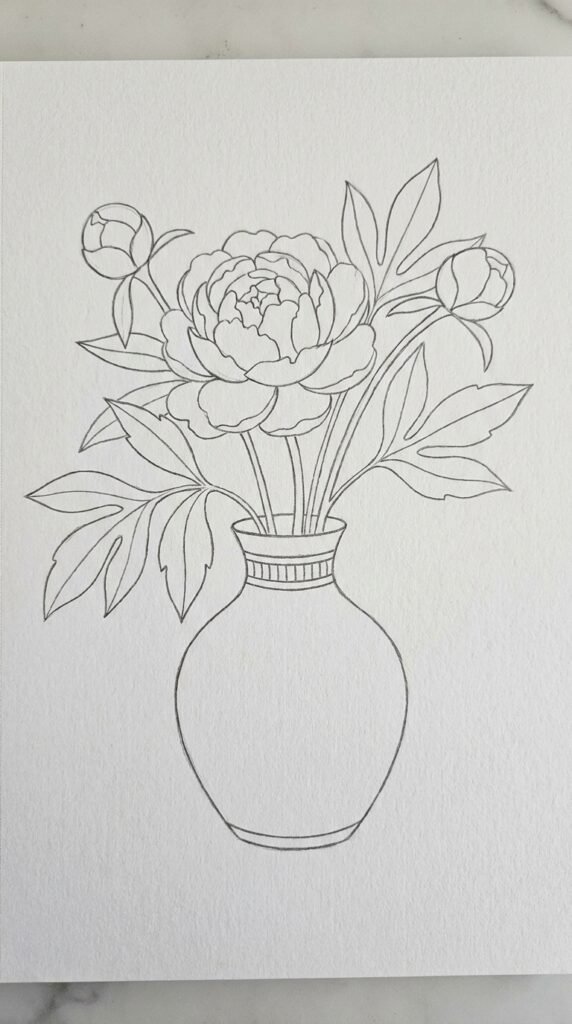
Peony in a Vase Drawing
Drawing a flower in a vase combines two different skills: drawing organic flower shapes and drawing a simple geometric container. This idea is great for beginners because the vase gives the drawing a clear bottom anchor and makes the composition feel balanced and complete. It also looks wonderful as wall art or on greeting cards.
Step-by-Step Instructions:
- Draw a simple vase shape in the lower center of your paper. A classic vase shape has a narrow neck, a wide body, and a slightly flared base. You can simplify this to a wide U-shape with a narrow opening at the top if you prefer.
- Draw one large peony bloom centered just above the opening of the vase, as if sitting inside it. Use the full bloom method with two to three rings of petals.
- Add two or three smaller peony buds on either side of the main bloom, using stems that extend down into the vase opening.
- Draw long leafy stems with lobed leaves filling in around the flowers and extending slightly outward from the vase opening.
- Add a simple decorative line or pattern on the vase body, such as a horizontal stripe or a small repeated dot pattern, to give it character without making it too complex.
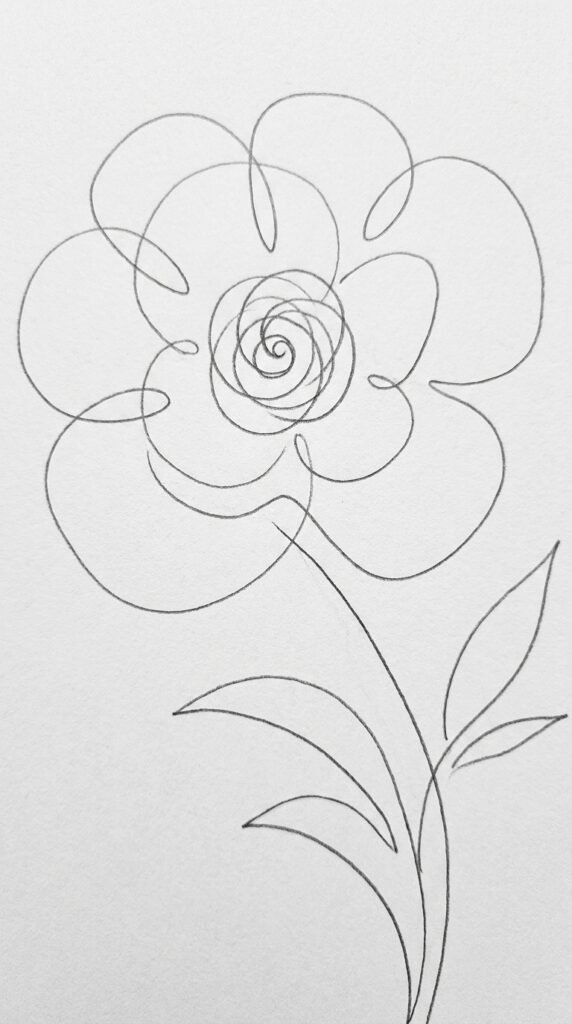
Abstract Peony Line Art Drawing
Abstract peony line art uses flowing, continuous lines to suggest the shape of a peony without drawing every petal individually. This style is popular for minimalist art prints and journal page headers. It requires fewer lines and feels more relaxed and expressive than a detailed botanical drawing.
Step-by-Step Instructions:
- Start at the center of your drawing space and draw a small tight spiral or a few small overlapping curved lines to suggest the inner core of the flower.
- From the center, draw outward-curving lines that loop back on themselves to suggest petals. These lines do not need to close perfectly. Leave some open or overlapping.
- Build the flower outward by adding larger looping lines for the outer petals. The key is that each line flows smoothly from one into the next without sharp corners.
- Add one or two long, sweeping curved lines extending below the flower to suggest a stem.
- On the stem, draw two or three simple leaf outlines using a single curved line for the top edge and a shorter curved line for the bottom edge of each leaf, meeting at a pointed tip.
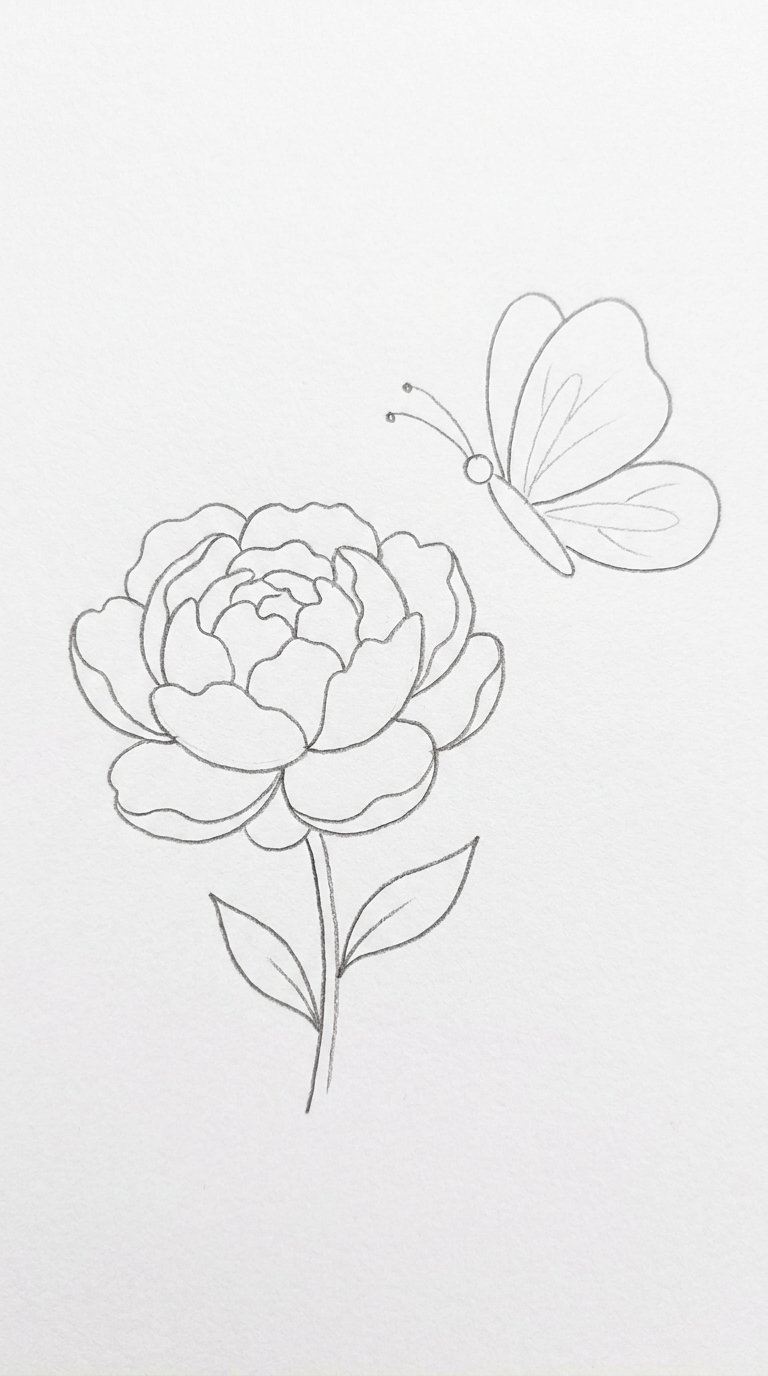
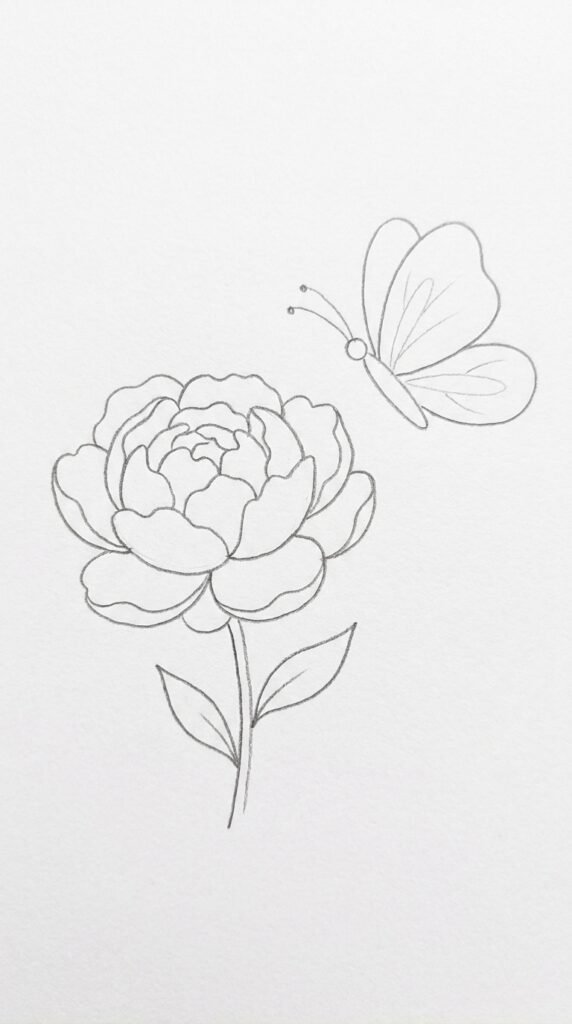
Peony With Butterfly Drawing
Adding a butterfly to a peony drawing creates a charming and popular combination that works beautifully for journal pages, card designs, and Pinterest-style art. The butterfly does not need to be complex. A simple wing shape outline resting on or hovering near a petal is enough to complete the composition.
Step-by-Step Instructions:
- Draw a full peony bloom slightly left of center on your paper using the standard layered petal method.
- Add a stem and one or two leaves below the flower.
- To the right of the flower and slightly above the topmost petals, draw a simple butterfly. Start with a small oval body in the center.
- On either side of the body, draw two upper wing shapes. Each upper wing is a large curved triangle or rounded irregular shape. Then draw two smaller lower wings below them.
- Add two thin antennae lines extending from the top of the oval body, each ending in a tiny circle or teardrop shape.
Peony Flower Mandala Drawing
A peony mandala combines the radial symmetry of a mandala with the layered petal structure of a peony. The result is a circular, meditative design that is both structured and decorative. This is a slightly more advanced idea but is still very achievable for beginners if they follow the steps carefully and use a light guide circle.
Step-by-Step Instructions:
- Draw a small dot in the very center of your paper. This is your anchor point for symmetry.
- Around the dot, draw a ring of eight small rounded petal shapes evenly spaced in a circular arrangement.
- Around those petals, draw a second ring of slightly larger and wider petals, again evenly spaced so each new petal falls between two petals of the inner ring.
- Add a third outer ring of the largest petals, following the same alternating pattern.
- Outside the outermost ring of petals, draw a ring of simple pointed leaf shapes, alternating with small circular dot details between each leaf.
Peony Corner Design Drawing
A peony corner design is a decorative arrangement of flowers and leaves placed in one or two corners of a page, making it ideal for journaling, stationery, and page border designs. This is one of the most practical drawing ideas for people who use their art for functional page decoration.
Step-by-Step Instructions:
- Choose one corner of your paper or journal page. Draw one medium-sized peony bloom about two centimeters in from the corner, using the standard two-ring petal method.
- Draw a curving branch line extending from beneath the flower toward the top edge of the paper and another branch curving toward the side edge.
- Along the branch going toward the top, add two or three large lobed leaves at intervals. Along the branch going toward the side, add more leaves and a small closed peony bud.
- Scatter two or three small five-petal filler flowers along the branches to add variety between the larger peony elements.
- Keep the entire design contained within the corner area, roughly forming an L-shape that frames the corner neatly.
Drawing Tips for Peony Flowers
Start every peony drawing with a light pencil sketch. Do not press hard at the beginning because you will want to erase guide lines like circles, ovals, and branch lines once your flower outline is complete.
Work from the center outward when building petals. This helps you maintain a natural circular shape and prevents the flower from looking lopsided.
Vary the size of your petals slightly within each ring. Petals in real life are not all exactly the same size, so small variations will make your drawing look more natural.
Keep your pencil sharp for clean, consistent lines. A dull pencil creates uneven line thickness and makes small details like leaf veins harder to control.
Practice individual peony petals on a separate piece of paper before attempting the full flower. Once you can draw a single rounded cup-shaped petal confidently, assembling the full flower becomes much easier.
Use curved lines everywhere on a peony. Straight lines have no place in peony drawings because this flower is entirely defined by soft, flowing curves.
Common Mistakes to Avoid
Drawing all petals the same size makes a peony look mechanical and unnatural. Vary your petal width and height slightly from one petal to the next.
Starting with too much detail before establishing the basic shape is a common beginner mistake. Always draw the circular guide and the petal rings in outline first, then refine the shapes.
Pressing too hard with the pencil from the beginning makes guide lines impossible to erase cleanly. Use very light pressure for all preliminary guide shapes.
Making stems too thin relative to the flower can make the drawing look unbalanced, as if the stem could not support the bloom. Peony stems are sturdy, so draw them with reasonable thickness.
Forgetting to add leaves makes a peony drawing look incomplete. Leaves frame the flower and give it context, so always include at least two or three leaf shapes in your composition.
Placing the flower at the very edge of the paper leaves no room for the stem and leaves. Always plan the full composition before you start drawing, leaving adequate space for all elements.
Frequently Asked Questions
How do you draw a peony flower step by step for beginners?
Start by drawing a small circle in the center of your paper. Around that circle, draw a ring of five or six small cup-shaped petals. Add a second ring of larger petals around the first, then a third even larger ring for the outermost layer. Draw a short stem below the flower and add two or three leaf shapes on either side. Erase your center circle guide and you have a complete beginner peony drawing.
What basic shapes are used to draw a peony?
Peony drawings are built from circles, ovals, and curved lines. The flower center begins as a small circle. Each petal is an oval or teardrop shape with a gently curved tip. Leaves are long ovals with pointed ends. Stems are slightly tapered rectangular shapes. All of these are simple forms that beginner artists can practice quickly.
Can kids draw a peony flower? Yes, absolutely. A simple peony with two rings of petals and a short stem is easy enough for children aged seven and older. The mini peony doodle version and the simple bud version are the most child-friendly starting points in this list. Using a regular HB pencil and starting with light guide circles makes the process very manageable for young artists.
What pencil is best for drawing peony flowers? A standard HB pencil is the best choice for drawing peony flowers as a beginner. HB pencils produce medium-dark lines that are easy to see clearly but light enough to erase guide shapes without damaging the paper. For slightly darker final outlines, a 2B pencil works well. Avoid very hard pencils like 4H because they produce lines that are too faint, and avoid very soft pencils like 6B because they smudge easily.