If you have ever looked at a pansy and thought, “I wish I could draw that,” you are not alone. Pansies are one of the most expressive and recognizable flowers in the world. Their rounded petals, bold face-like center markings, and cheerful shape make them a favorite subject for artists of every level. But many beginners feel intimidated when they sit down to draw them. The petals seem complex. The markings look difficult. Where do you even start?
The good news is that pansy flowers are actually one of the easiest flowers to draw once you break them down into simple shapes. Every pansy starts with a few ovals and circles. The petals are rounded and soft. There is no need for complex shading techniques or advanced art skills. If you can draw a rounded shape, you can draw a pansy.
This article gives you 15 unique pansy flower drawing ideas, each with clear step-by-step instructions written in easy, everyday language. Whether you are a complete beginner, a parent looking for activities to do with your kids, or someone who loves floral art and wants fresh ideas, these tutorials are made for you.
Every drawing in this guide uses simple pencil techniques. No shading is required unless you choose to add it. Just pick up a pencil, start with basic oval shapes, and follow each step. By the time you finish this article, you will have a full collection of pansy drawing ideas to practice, combine, and make your own.
These ideas are also perfect for Pinterest boards, art journals, greeting card designs, and classroom drawing projects. So grab your pencil and a clean sheet of white paper, and let us get started.
Classic Single Pansy Face
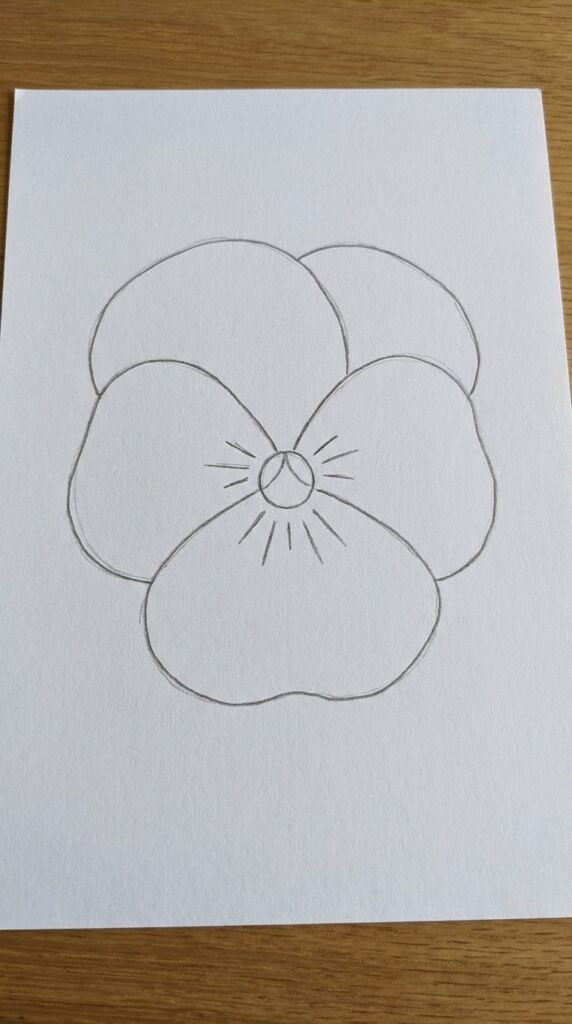
The classic pansy face drawing is the best place to start because it teaches you the basic structure of the flower. A pansy has five petals arranged in a specific pattern: two petals on top and three petals on the bottom. The bottom center petal is the largest and often carries the face-like markings. Once you understand this arrangement, every other pansy idea becomes easier.
Step-by-Step Instructions:
- Draw a small circle in the center of your paper. This is the flower’s eye, which will guide the placement of all five petals.
- Draw two large rounded ovals above the circle, slightly overlapping it. These are the two upper petals. Make them wide and soft at the top.
- Below the center circle, draw one wide rounded petal that fans out toward the bottom of the paper. This is the largest petal.
- On either side of the bottom petal, draw two medium-sized petals that angle slightly outward. These complete the five-petal arrangement.
- Inside the center circle, draw three or four short curved lines radiating outward from a tiny dot. These are the petal veins and give the pansy its characteristic face-like look.
- Add a small pair of curved lines on the upper petals for additional vein detail.
Pansy With Detailed Petal Veins
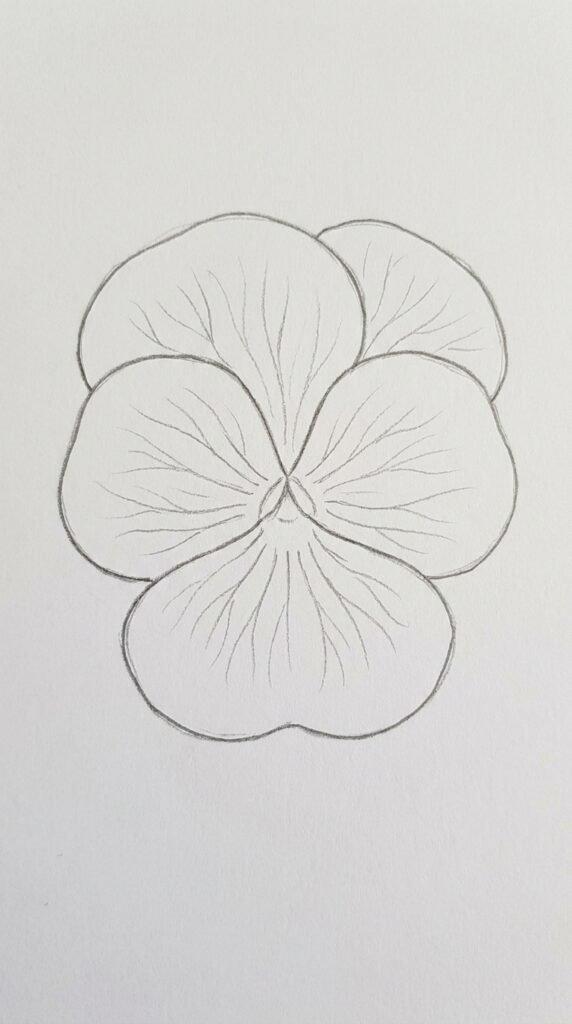
Adding vein lines to pansy petals gives your drawing texture and character without requiring any shading. Veins are simply curved lines that radiate from the center of the flower outward toward the petal edges. This style works beautifully in pencil and gives the drawing a more botanical illustration feel. It is still very beginner-friendly because the lines are freehand and do not need to be perfect.
Step-by-Step Instructions:
- Begin with the same five-petal pansy structure from the classic pansy tutorial above. Draw your center circle and five petals before adding any detail.
- On the two upper petals, draw three to four gentle curved lines starting near the center and curving outward toward the top edge of each petal.
- On the large bottom petal, draw five to six lines that fan outward from the center base of the petal toward its outer edge.
- On the two side petals, draw two to three curved lines pointing toward their outer corners.
- Keep all vein lines thinner and lighter than the petal outline lines. Press slightly less hard on your pencil for the veins.
- Draw the center circle details last, adding the tiny radiating marks that create the pansy’s face.
Three Pansies in a Row
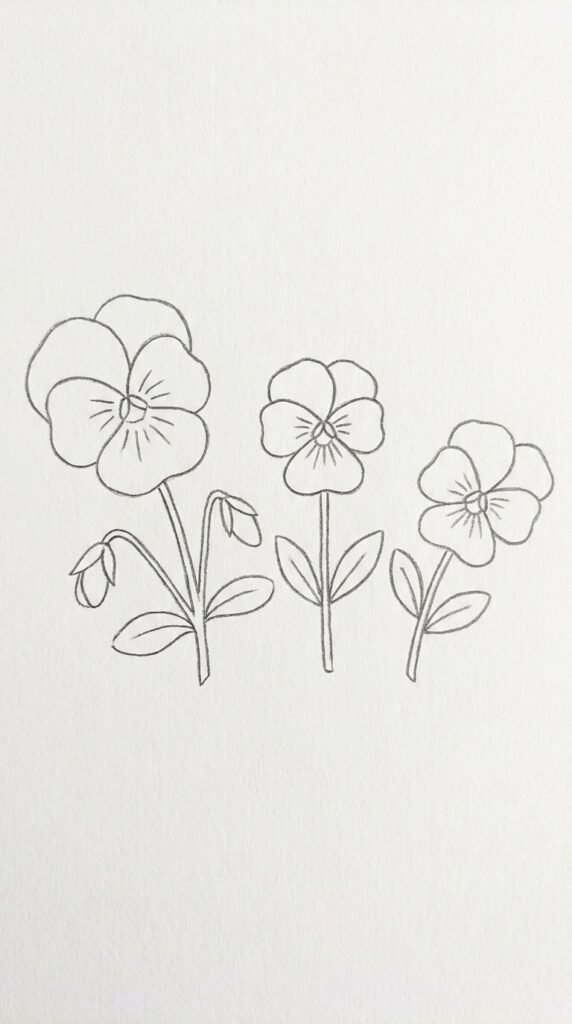
Drawing three pansies in a row creates a lovely composition that works perfectly for greeting cards, art journal pages, and Pinterest-worthy drawings. This idea teaches you how to vary the size and angle of each flower so the arrangement looks natural and not stiff. You will use the same five-petal structure for each flower, just adjusting the size and tilt slightly for each one.
Step-by-Step Instructions:
- Lightly mark three evenly spaced dots across your paper in a horizontal line. These mark the center of each flower.
- Around the first dot, draw a full five-petal pansy using the classic method. Make this flower a medium size.
- Around the second dot, draw a slightly smaller pansy. Tilt this one very slightly to the right so it does not look identical to the first.
- Around the third dot, draw a pansy similar in size to the first but tilted slightly to the left.
- Connect all three flowers with a shared stem at the bottom, using gentle S-curves that meet at a single base point.
- Add two or three simple oval leaves along the shared stem. Add center detail lines to each flower.
Pansy Flower Bud on a Stem
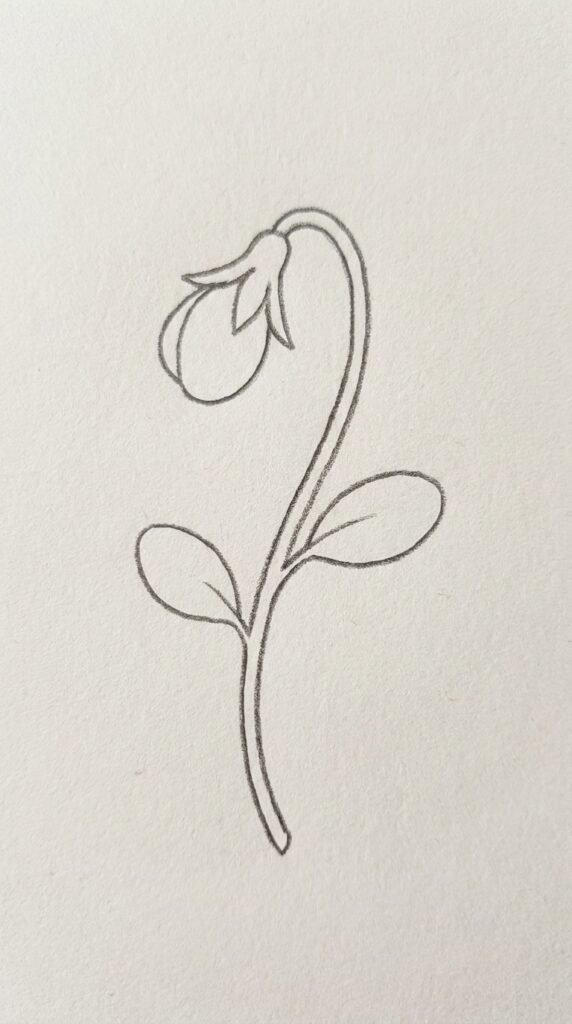
A pansy bud is one of the most charming pansy flower drawing ideas because it tells the story of a bloom that is just about to open. The bud shape is even simpler than a full flower, using a small oval as its base, which makes it very accessible for younger artists. Adding a bud to any pansy composition also creates a sense of natural variety and growth. Buds look especially beautiful when paired with one or two full blooms in the same drawing.
Step-by-Step Instructions:
- Draw a small oval shape in the upper center of your paper, slightly narrower at the top than the bottom, like a rounded egg pointing upward.
- At the base of the oval, draw two or three pointed sepal shapes fanning outward. Each sepal should look like a narrow leaf hugging the sides of the bud.
- Draw a long gently curved stem below the sepals, approximately three inches long. Let the stem curve slightly to one side for a natural feel.
- On the middle section of the stem, draw one small rounded leaf on the left side. Give it a pointed tip and a single thin vein line running down its center.
- Add one more small leaf lower on the stem on the right side, slightly smaller than the first.
Pansy Flower Viewed from the Side
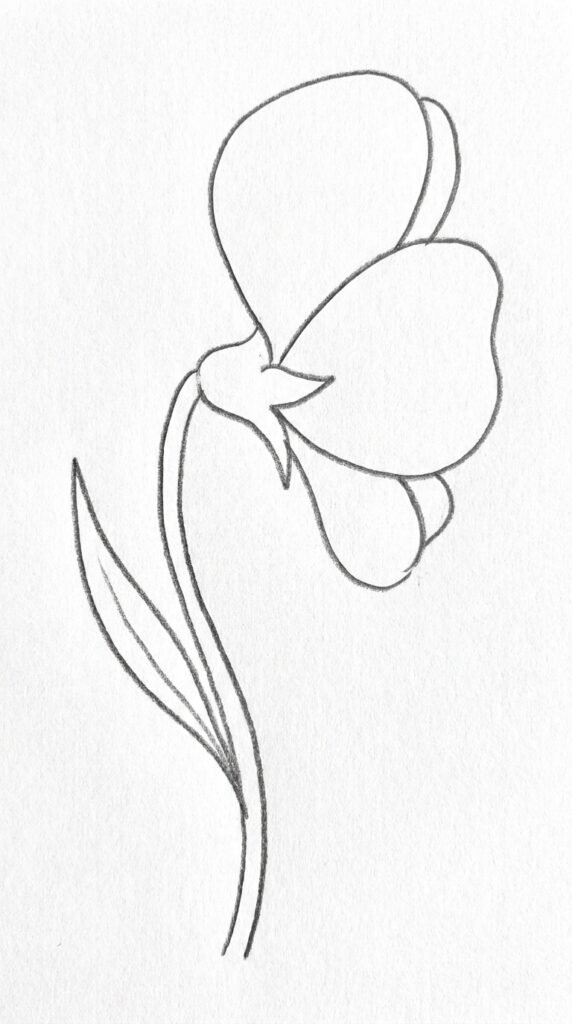
Drawing a pansy from the side profile creates a graceful, flowing composition that feels different from the standard forward-facing view. In this perspective, only two or three petals are fully visible, which actually simplifies the drawing while giving it a more dynamic and elegant quality. The side view works especially well when drawing pansy flowers along a branching stem or within a bouquet arrangement. It is a useful technique to learn early because it adds variety to your pansy drawing compositions.
Step-by-Step Instructions:
- Draw a small shallow cup or funnel shape on the center of your paper, opening to the right. This represents the base of the flower head where the petals attach.
- From the opening of the cup, draw one large rounded petal extending upward and to the right. Make it wide and gently curved at the tip.
- Draw a second large rounded petal extending forward from the front edge of the cup, slightly overlapping the first.
- Add a third smaller petal tucked behind the other two to suggest the back of the flower that is partially hidden from this angle.
- Draw a short curved stem coming downward from the back of the cup, bending slightly, and add a single narrow pointed leaf partway along the stem.
Three Pansies Grouped in a Cluster
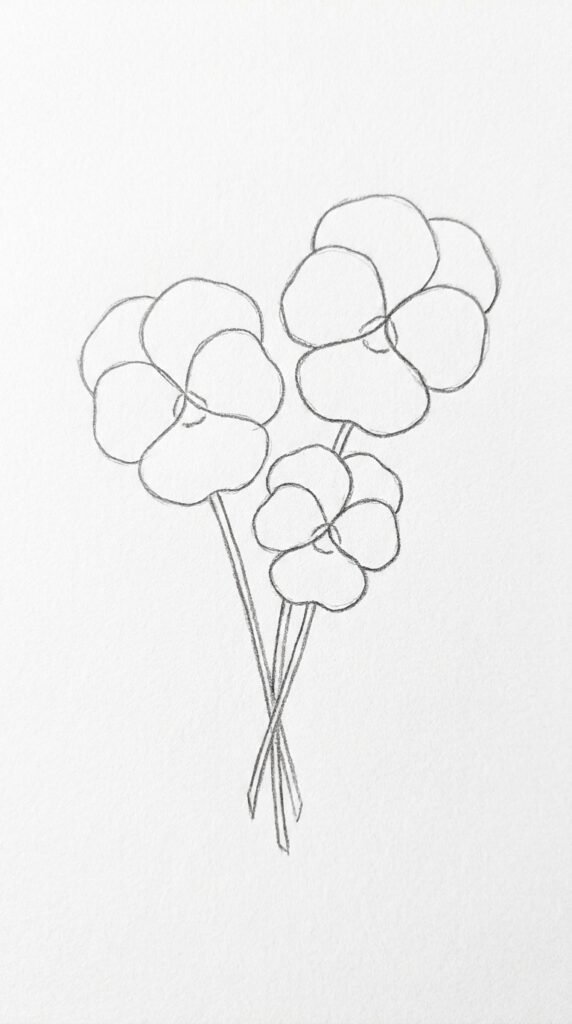
Grouping three pansies together in a cluster is one of the most satisfying pansy flower drawing ideas because the result looks full and impressive while still using the same basic five-petal method for each individual bloom. The trick to making a cluster look natural is allowing the flowers to overlap slightly at their edges and positioning them at slightly different heights rather than lining them up evenly. This creates a sense of depth and organic growth without requiring any complex technique.
Step-by-Step Instructions:
- Lightly mark three positions on your paper in a loose triangular arrangement. One flower will sit at the top center, one to the lower left, and one to the lower right.
- Draw the top center flower first using the full five-petal method. Keep it slightly smaller than you might normally draw.
- Draw the lower left flower next, making it slightly larger than the first and letting one of its upper petals tuck behind the stem of the top flower.
- Draw the lower right flower at a similar size to the second flower, letting one petal overlap slightly with the right side of the center flower.
- Draw individual stems from each flower converging downward to a single point, as if the three stems are being held together at the base
Pansies Growing in a Round Flower Pot
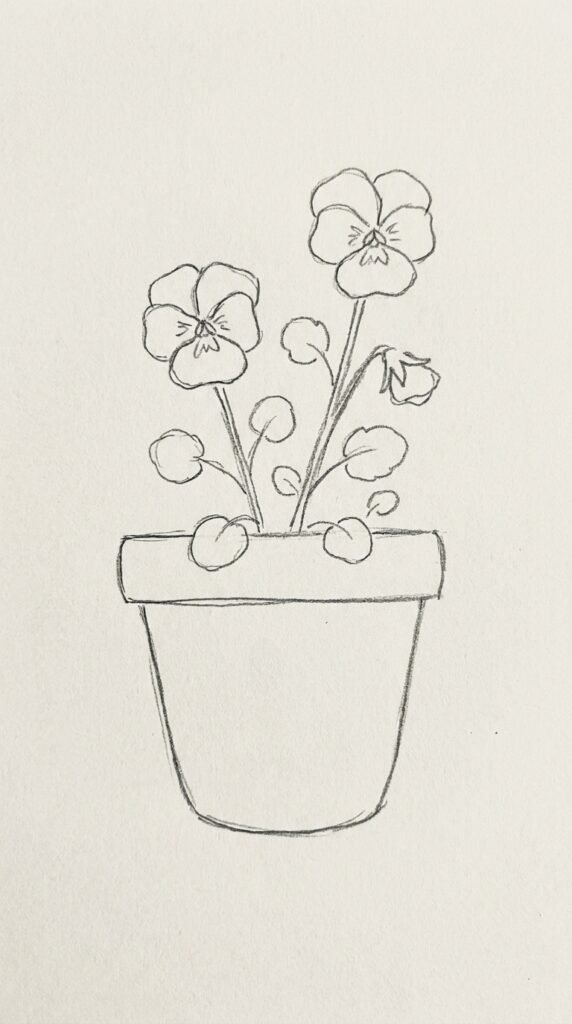
Drawing pansies in a flower pot creates a complete, satisfying still-life composition that works beautifully as standalone art or as part of a larger botanical illustration series. The flower pot shape is made from simple geometric lines, making it very beginner-friendly. This is one of the most popular pansy flower drawing ideas on Pinterest because the finished result looks detailed and polished even though every element is made from basic shapes.
Step-by-Step Instructions:
- Near the bottom of your paper, draw a rounded trapezoid shape for the pot. Make the top edge wider than the bottom, and give the base a slightly curved flat line.
- Add a narrow horizontal rectangle along the very top edge of the pot to represent the rim. This small detail makes the pot look realistic.
- Draw two or three short thick stems rising from the center of the pot opening, spacing them slightly apart.
- At the top of each stem, draw one full pansy bloom using the five-petal method. Vary the heights slightly so they are not all at the same level.
- Add two or three small rounded leaves scattered between the stems and at the base where the stems meet the pot rim.
Cartoon pancy with a Friendly Face
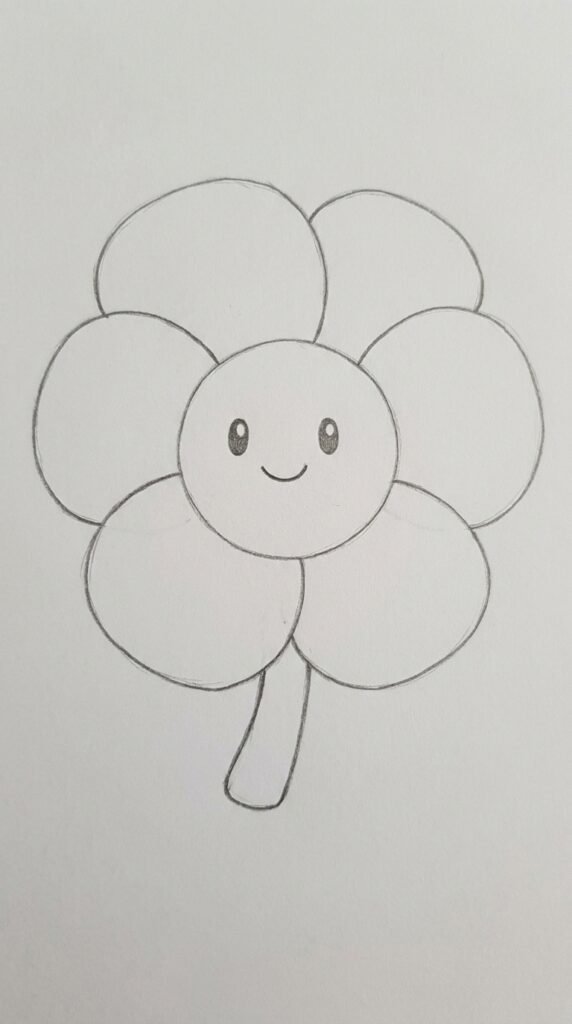
Turning a pansy into a cute cartoon character with a smiling face is one of the most entertaining pansy flower drawing ideas for younger children. The face is drawn inside the center circle of the flower using only basic oval shapes for eyes and a simple curved line for the smile. This style is very forgiving and works well even if proportions are slightly off, making it a stress-free drawing activity for kids of all ages.
Step-by-Step Instructions:
- Draw a large circle in the center of your paper, about the size of a large coin. This is both the face and the center of the flower.
- Around the circle, draw five large puffy rounded petals. Make them wider and rounder than a realistic pansy petal, almost like soft cloud shapes.
- Inside the center circle, draw two small oval shapes in the upper half for eyes. Leave a small white dot inside each oval to give them a bright, lively look.
- Below the eyes, draw a simple upward-curved line for the mouth. You can add two small lines at each end of the smile to make it wider.
- Draw a short chunky stem below the flower, slightly wider than a normal stem to match the bold, friendly proportions of the cartoon style.
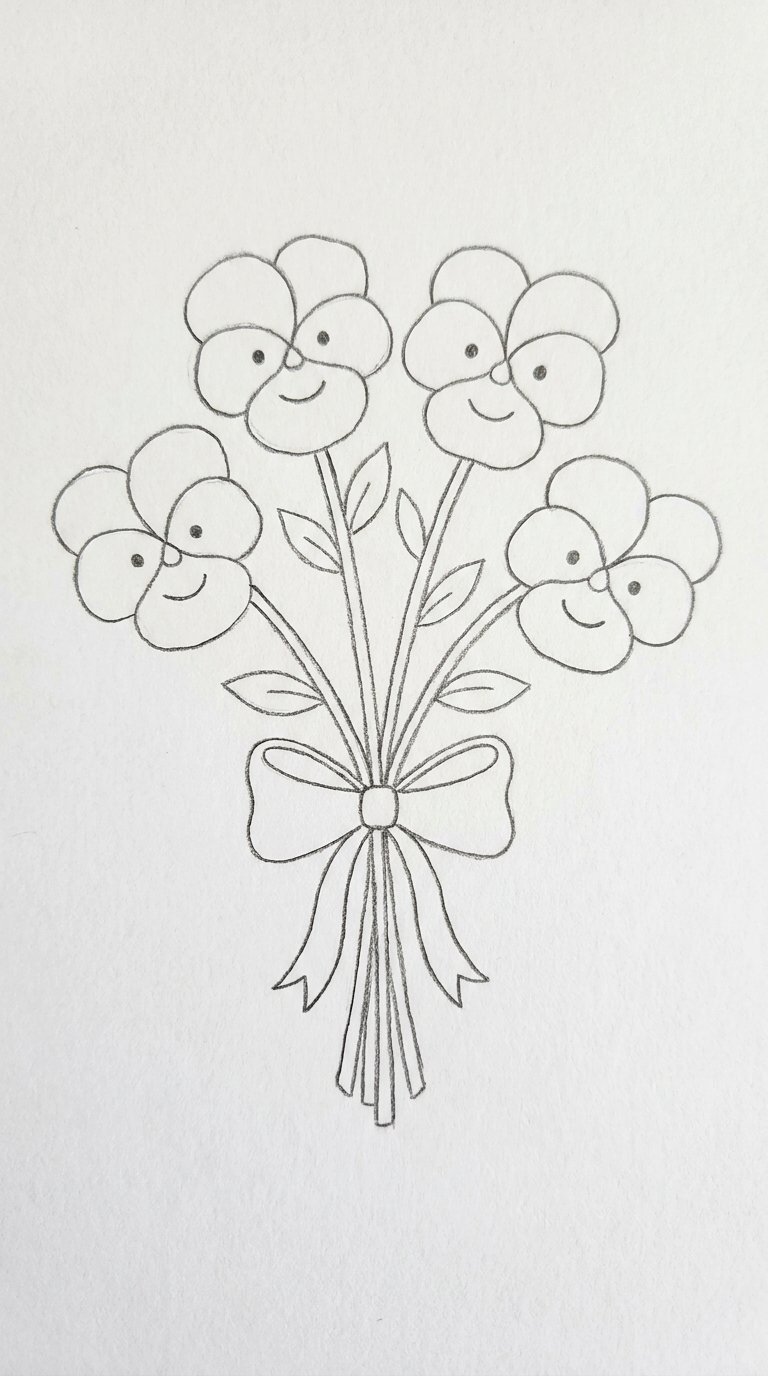
Pansy Bouquet Tied with a Bow Ribbon
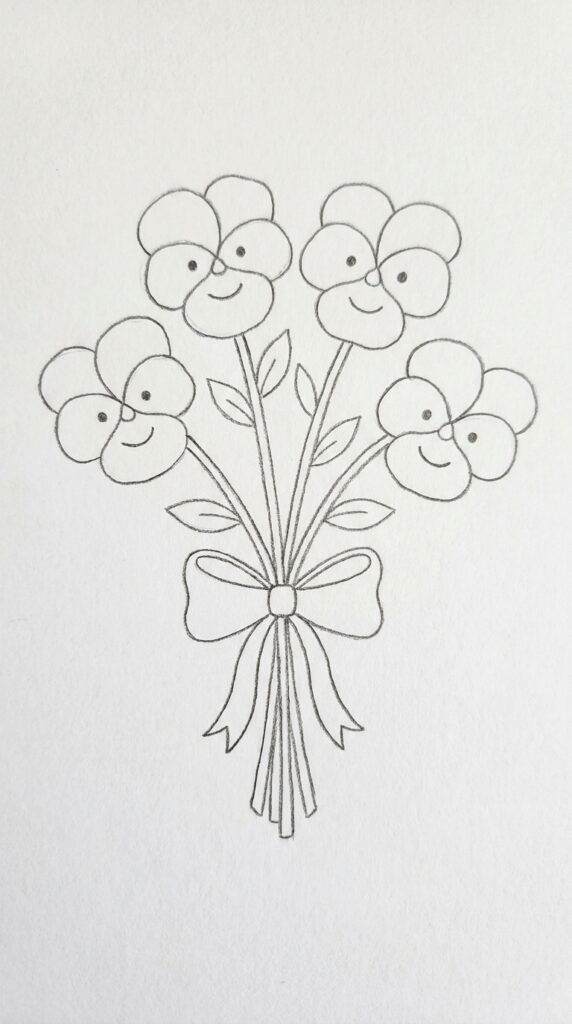
A hand-tied pansy bouquet is a classic among pansy flower drawing ideas and creates a very gift-worthy, finished-looking composition. The ribbon bow at the stem gathering point adds an elegant decorative detail that takes only a few simple lines to draw. This type of drawing is widely used in greeting card art, journal decoration, and Pinterest floral content.
Step-by-Step Instructions:
- In the upper portion of your paper, draw four to five pansy blooms arranged in a loose upward-spreading fan shape. Let them overlap slightly at the edges.
- From the base of each flower, draw a stem that curves gently downward, guiding all stems toward a single gathering point in the middle of the paper.
- At the gathering point, draw a simple ribbon bow. Start with two small triangular loop shapes, one on each side of the stem bundle. Add two short ribbon tail lines hanging downward from the center of the bow.
- Below the bow, draw the stems continuing as a single tight bundle for about one inch before ending with a clean horizontal cut line.
- Tuck two or three small rounded leaves into the spaces between the flowers and upper stems.
Pansy Flower Wreath
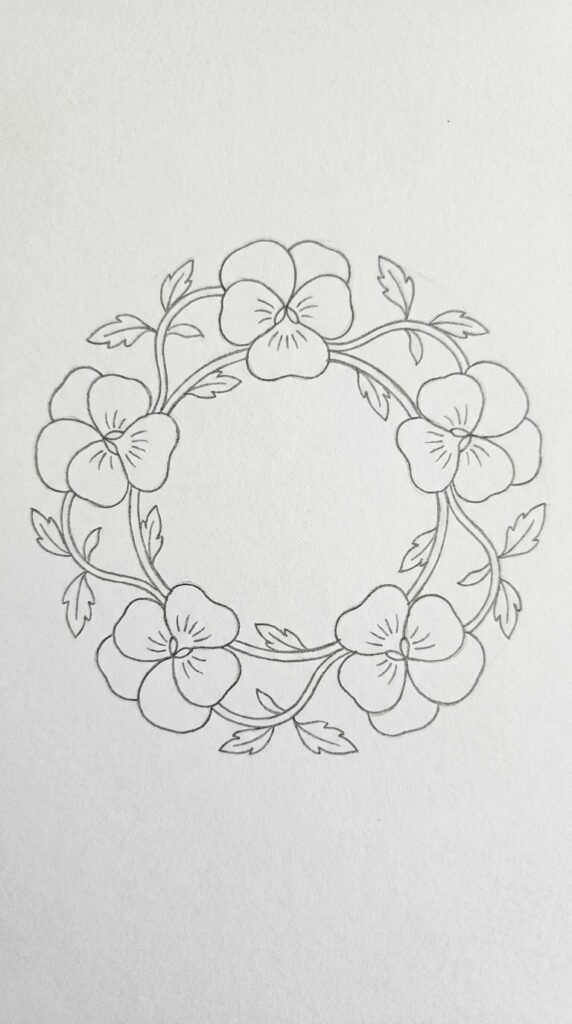
A circular pansy wreath is one of the most stunning pansy flower drawing ideas in this collection and one of the most shareable on Pinterest. The wreath format places multiple pansy blooms and connecting leaves in a ring formation, creating a composition that feels festive, full, and balanced. Using a light guide circle to plan your placement before drawing takes almost all of the difficulty out of this seemingly complex design.
Step-by-Step Instructions:
- Using light pencil pressure, draw a large circle on your paper approximately five to six inches in diameter. This is your guide ring and will be erased later.
- At the top of the guide circle, draw three pansy blooms spaced evenly apart, each sitting just inside the circle line. Face two of them forward and tilt one very slightly to the side.
- On the left and right sides of the circle, draw one pansy bloom each. These side blooms can be drawn in slight side-profile view for natural variety.
- In all the gaps between the blooms, draw stems and small rounded leaves that connect the flowers to each other, following the curve of the guide circle.
- Once all flowers and leaves are placed, carefully erase the guide circle and clean up any overlapping pencil lines.
Pansy Corner Border Decoration
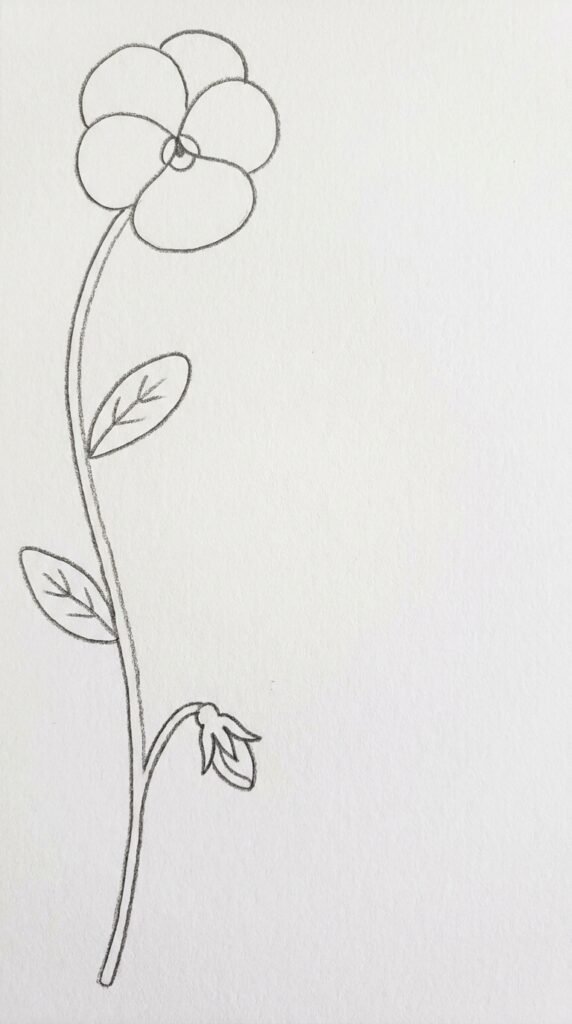
A pansy corner decoration is one of the most practical pansy flower drawing ideas in this collection because it can be applied directly to journal pages, handmade cards, stationery, and sketchbook covers. The design anchors one pansy bloom in a corner of the page and flows a trailing stem with leaves and a bud down and across the edge. The result looks elegant and organic while remaining entirely simple to draw.
Step-by-Step Instructions:
- Position your paper in portrait orientation. In the top left corner, draw one full pansy bloom approximately one inch in from each edge.
- From the base of the bloom, draw a gently curved stem that flows downward along the left margin of the page. Let the stem curve slightly inward toward the page center as it descends.
- At approximately one third of the way down the stem, draw one small rounded leaf pointing outward to the left. Add a thin center vein.
- Continuing down the stem, add a second small leaf pointing to the right at about two thirds of the way down.
- Near the bottom of the stem, draw one small pansy bud using the oval and sepal method, facing slightly upward.
Large Close-Up Pansy Filling the Page
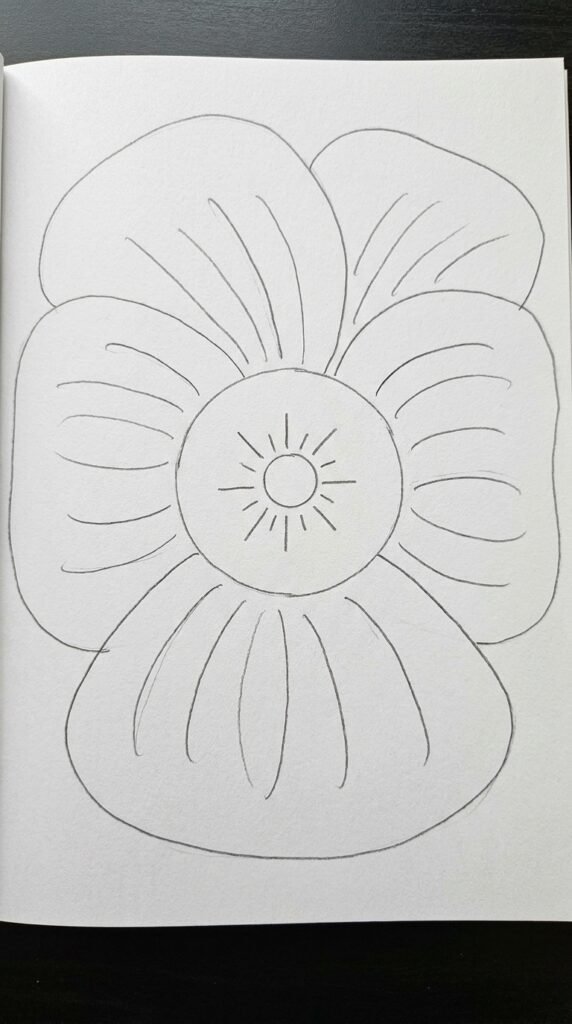
Drawing a single pansy at a large scale so it fills most of the page is one of the boldest and most striking pansy flower drawing ideas in this guide. The oversized close-up format forces you to slow down and pay attention to each individual petal shape, the way they overlap at the edges, and the flowing quality of the vein lines inside each one. The result is a confident, graphic drawing that looks impressive framed on a wall or shared on Pinterest.
Step-by-Step Instructions:
- In the center of your paper, draw a circle approximately three to four inches in diameter for the pansy center. This large size anchors the composition.
- Draw two large rounded upper petals filling the top half of the page. Each petal should be wide enough that its outer edge approaches within half an inch of the paper border.
- Draw three very wide lower petals filling the bottom half of the page. The bottom center petal should be the largest shape in the entire drawing, and the two lower side petals should tuck slightly behind the upper petals where they overlap.
- Inside every petal, draw five to seven curved vein lines starting from the inner edge near the center circle and flowing outward to the petal tip. Space them evenly.
- Inside the large center circle, draw a small inner circle and add six or eight tiny short lines around its edge to suggest the stamens of the flower.
Pansy Growing from a Cracked Clay Pot
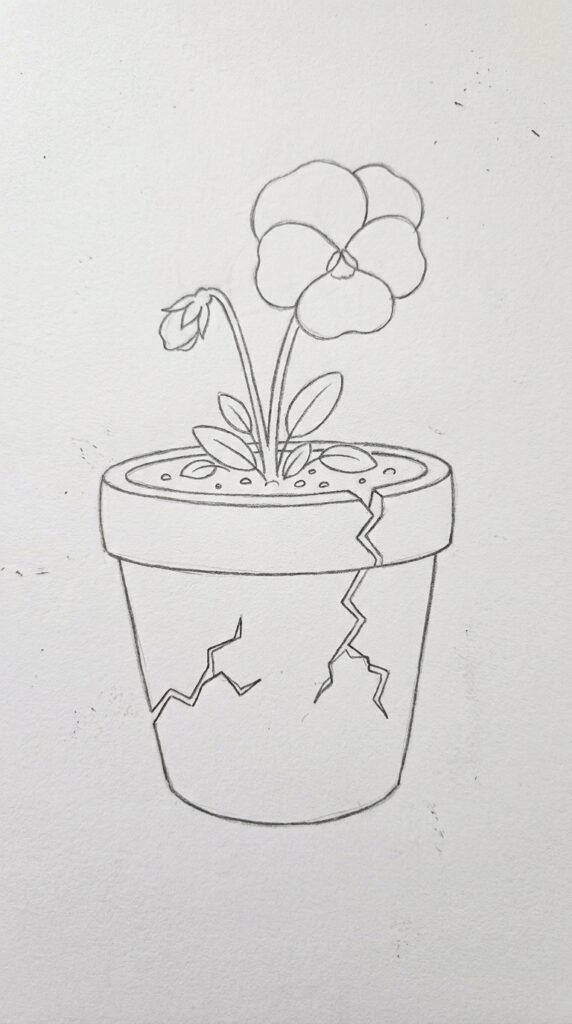
This whimsical composition shows a pansy plant growing vigorously from a decoratively cracked clay pot. The crack lines on the pot surface add visual interest and a storytelling quality to the drawing without requiring any complex technique. Simple jagged lightning bolt shapes are all you need to suggest the cracks. This is one of the most original pansy flower drawing ideas in this collection and performs well as Pinterest content because of its unique and memorable character.
Step-by-Step Instructions:
- Draw a standard rounded trapezoid flower pot shape in the lower center of your paper, wider at the top than the bottom, with a flat base.
- Add a narrow horizontal rim band at the top of the pot.
- On the front surface of the pot, draw two or three irregular jagged crack lines. Each crack should start at a point and zigzag downward or sideways for about one inch before ending.
- From the center of the pot opening, draw one or two stems rising upward and branching slightly apart at the top.
- Draw one full pansy bloom at the top of each stem and add two or three small rounded leaves at the base of the stems where they emerge from the pot. Add a few small dots along the pot rim to suggest visible soil.
Pansy on a Branching Stem
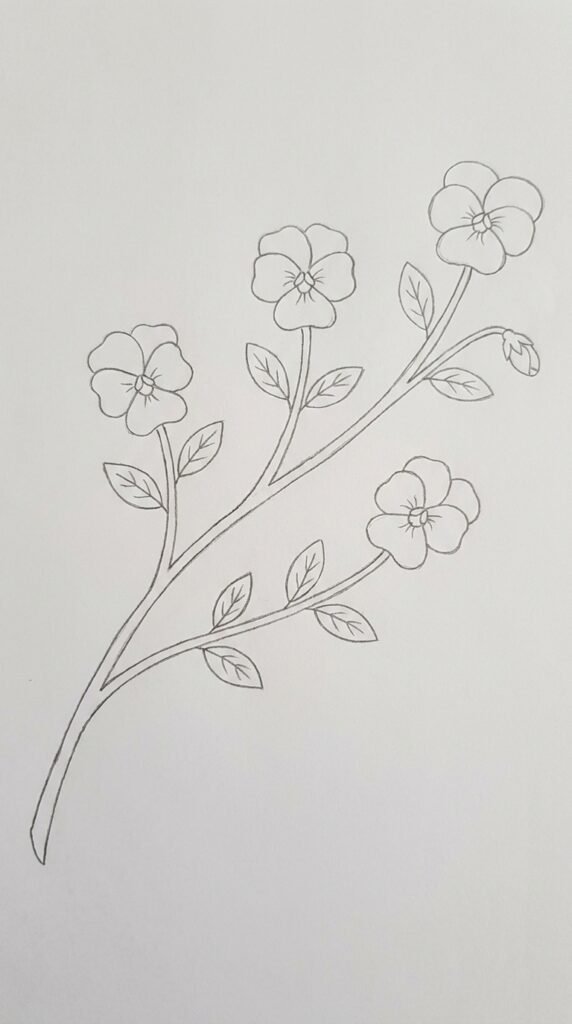
This composition draws multiple pansy blooms growing naturally along a single branching woody stem. The branching structure gives the drawing a botanical illustration quality and provides a clear linear framework that makes placing each bloom very straightforward. This is one of those pansy flower drawing ideas that looks quite complex in the finished result but is actually very organized and logical to construct step by step.
Step-by-Step Instructions:
- Draw one long diagonal main branch running from the lower left to the upper right of your paper. Give it a slight gentle curve rather than making it perfectly straight.
- From the main branch, draw three or four smaller side branches growing upward at varying angles. Space them unevenly along the main branch for a natural look.
- At the tip of each side branch, draw one full pansy bloom using the forward-facing five-petal method.
- Along each side branch between the bloom and the main branch, draw one or two small oval leaves. Add a center vein line to each leaf.
- At the tip of one side branch, draw a pansy bud instead of a full bloom to add variety to the composition.
Pansy Decorating an Initial Letter
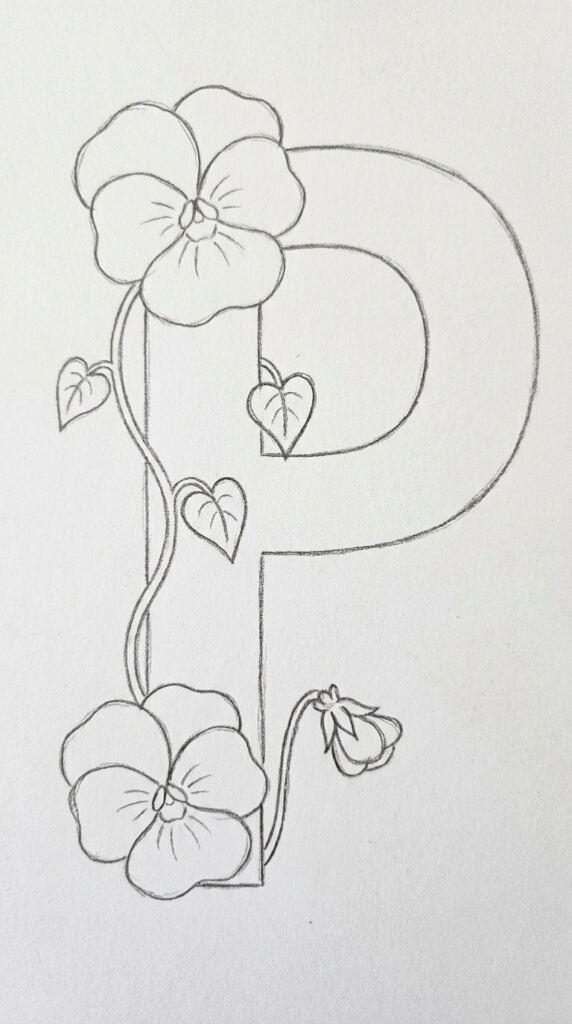
Decorating a capital letter with pansy flowers and leaves creates a personalized and creative drawing that is very popular for stationery, art journals, and Pinterest boards. The letter provides a clear structure and framework while the pansies, stems, and leaves wind naturally around it. This is one of the most flexible pansy flower drawing ideas because it can be applied to any letter of the alphabet and customized to any individual.
Step-by-Step Instructions:
- In the center of your paper, draw one large capital letter using wide, clear outline strokes. The letter should be at least three to four inches tall to give you room to add floral detail around it.
- At the top of the letter, draw one full pansy bloom resting just above or along the upper edge, as if the flower is growing out of the letter itself.
- Draw a trailing curved stem that flows from the base of that bloom and winds along the outside of the letter, following its shape loosely.
- Along the trailing stem, draw two or three small rounded leaves at irregular intervals, each with a center vein.
- At the base of the letter, draw one more small pansy bloom anchoring the lower part of the composition, and add a small bud on one of the stems.
Pansy Flower in a Teacup
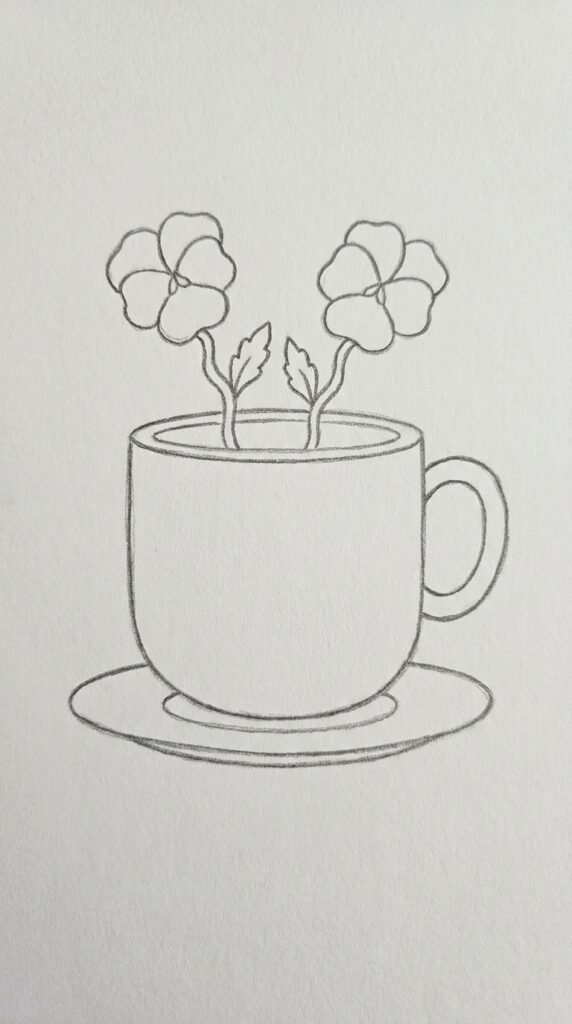
Drawing a small pansy plant growing from a decorative teacup is a charming and delightfully original composition. The teacup shape is made from simple rounded rectangles and curves, and the small pansy bloom growing from it creates a whimsical miniature garden effect. This is one of those pansy flower drawing ideas that generates very strong engagement on Pinterest because of its unique and cozy character.
Step-by-Step Instructions:
- Draw a simple teacup shape in the lower center of your paper. Start with a slightly rounded rectangle for the cup body, then add a gentle curve at the base and a small flat saucer shape below it.
- Add a small C-shaped handle on the right side of the cup.
- Draw the cup opening as a shallow oval at the very top of the cup body.
- From the center of the cup opening, draw two short stems rising upward. Let them branch apart slightly.
- Draw one full pansy bloom at the top of each stem, and add two small leaves between the stems near the cup opening.
Drawing Tips for Pansy Flowers
Starting every pansy drawing with very light planning lines is the single most important habit you can build as a beginner. Use the lightest possible pressure when first sketching the center circle and the general petal positions. These planning lines are only there to guide your final strokes and should be invisible or nearly invisible when you press lightly enough. Once you are satisfied with the placement, increase your pressure to draw the final clean outlines over the top.
Always draw the center circle before any of the petals. The center is the anchor of the entire pansy, and every petal radiates from it. Getting the center in the right position on your paper first ensures that the flower ends up where you want it and that the petals are balanced.
Think of each petal as a rounded teardrop or soft oval. Many beginners make the mistake of drawing petals with sharp or pointed tips, which results in a flower that looks more like a star than a pansy. Keep your petal tips soft and your petal sides gently curved at all times.
Work on one petal at a time rather than trying to sketch all five at once. Complete each petal fully before moving to the next. This focused approach produces much cleaner and more even results than trying to rough in all the petals simultaneously.
Vary your pencil pressure naturally within a single line. A line that starts slightly lighter, becomes darker in the middle, and lightens again at the tip looks far more organic and hand-drawn than a perfectly uniform machine-like stroke. This subtle variation gives pencil drawings a lifelike quality that makes them more appealing.
Common Mistakes to Avoid
Making all five petals exactly the same size is the most common structural mistake in pansy flower drawing. Real pansies have two slightly smaller upper petals and three wider lower petals, with the bottom center petal being the largest of all. Pay attention to this hierarchy of sizes from your very first stroke.
Drawing petals with pointed tips rather than rounded ones will consistently make your pansies look like generic flowers rather than pansies specifically. The rounded softness of the petal tips is one of the defining characteristics of the pansy shape.
Forgetting to overlap the petals flattens the drawing and removes the sense of natural layering. The upper two petals should sit slightly in front of or behind the lower three petals where they meet near the center. This simple overlap creates immediate visual depth.
Placing the vein lines too close together or making them too dark overwhelms the delicate structure of the petal and makes the drawing look heavy. Vein lines should always be lighter than the outer petal edge lines and spaced evenly from each other.
Drawing the stem too thick in proportion to the flower head is a sizing mistake beginners frequently make. The stem of a pansy is always thinner than the narrowest point of the flower petals. Keep stems lean and proportional to the bloom sitting above them.
Frequently Asked Questions
How do you draw a pansy flower step by step for beginners?
To draw a pansy flower as a beginner, start by drawing a small circle in the center of your paper for the flower’s eye. Then draw two rounded teardrop-shaped petals above the circle and three wider rounded petals below it, making the bottom center petal the largest. Add four or five curved vein lines inside each petal radiating from the center outward, then draw a short curved stem below the flower. Using an HB pencil with light pressure and always working from the center outward makes this process simple and manageable for anyone new to drawing flowers.
What shapes make up a pansy flower drawing?
A pansy flower is made up of a small circle for the center and five rounded oval or teardrop shapes arranged symmetrically around it. The two upper petals are narrower and the three lower petals are wider, with the bottom center petal being the largest. The stem is a simple gently curved line. Every element in a pansy drawing can be reduced to one of these basic rounded shapes, which is exactly why pansies are such an ideal flower for beginners and children to draw.
What is the easiest pansy drawing idea for kids?
The easiest pansy drawing idea for kids is the cartoon pansy with a friendly face. In this version, the center circle of the flower is made larger than usual and given two oval eyes and a curved smile, transforming the flower into a character. The five petals are drawn extra large and puffy, which is much more forgiving of small size variations than a realistic flower. The friendly face also makes the drawing process feel like a fun character design activity rather than a technical art exercise.
What pencil should I use for pansy flower drawings?
An HB pencil is the best choice for drawing pansy flowers, particularly for beginners. HB sits in the exact middle of the pencil hardness scale, producing lines that are dark enough to see clearly but light enough to erase cleanly during the planning stages. For the finished outline lines, simply apply slightly more pressure to make them stand out from any remaining planning marks. Avoid very soft pencils such as 4B or 6B when you are starting out because they smudge easily and make it harder to keep delicate floral drawings clean and precise.