Want to draw beautiful jasmine flowers but don’t know where to start? Though they look complex, breaking them down into simple shapes makes them easy for beginners. No natural talent or expensive supplies are needed—just basic pencil outlines.
This guide offers 15 step-by-step drawing ideas, from single blooms to lovely wreaths. Grab a pencil and paper, and let’s begin!
Single Jasmine Flower Facing Front
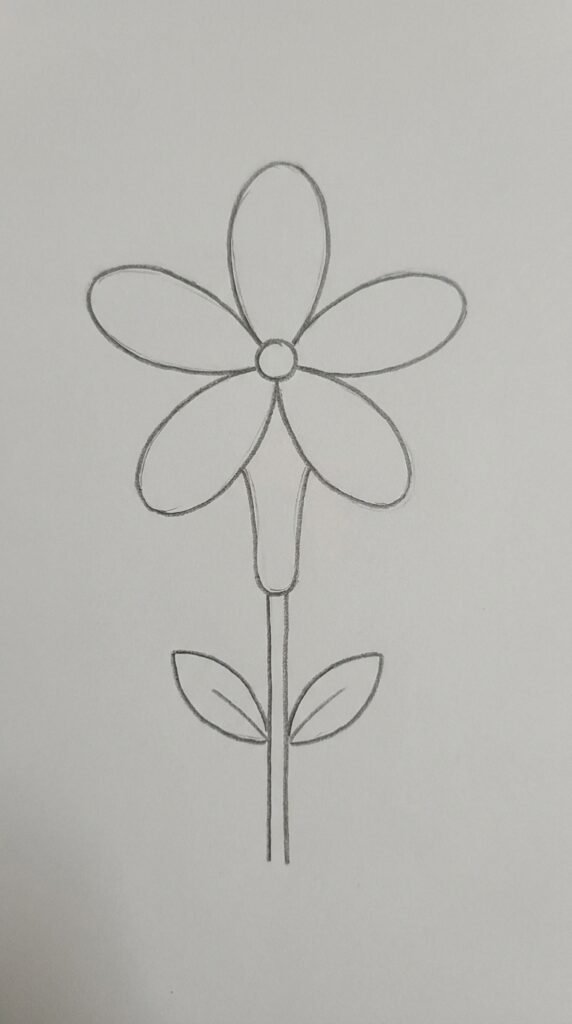
A single front-facing jasmine flower is the ideal starting point for any beginner. This classic view shows all five petals spread evenly around a small circular center, making it easy to practice symmetry and petal spacing. The simplicity of this composition means you can focus entirely on getting the flower shape right before adding more complex elements. It is a clean, satisfying drawing that works well as a standalone doodle or as the base for more detailed designs.
Step-by-Step Instructions:
Step 1: Draw a tiny circle in the center of your paper. This will be the flower center. Keep it small, roughly the size of a pea.
Step 2: Draw five evenly spaced oval petals radiating outward from the center circle. Each petal should be about twice the length of the center circle. Aim for smooth, slightly rounded tips.
Step 3: Add a narrow tubular shape below the flower center. This is the corolla tube that connects the petals to the stem. It should be thin and about the same length as one petal.
Step 4: Draw a single straight stem extending downward from the base of the tube. Add two small oval leaves on either side of the stem near the bottom.
Step 5: Go over your lines lightly to clean up any uneven edges. Keep all lines consistent in weight.
Jasmine Flower Side View
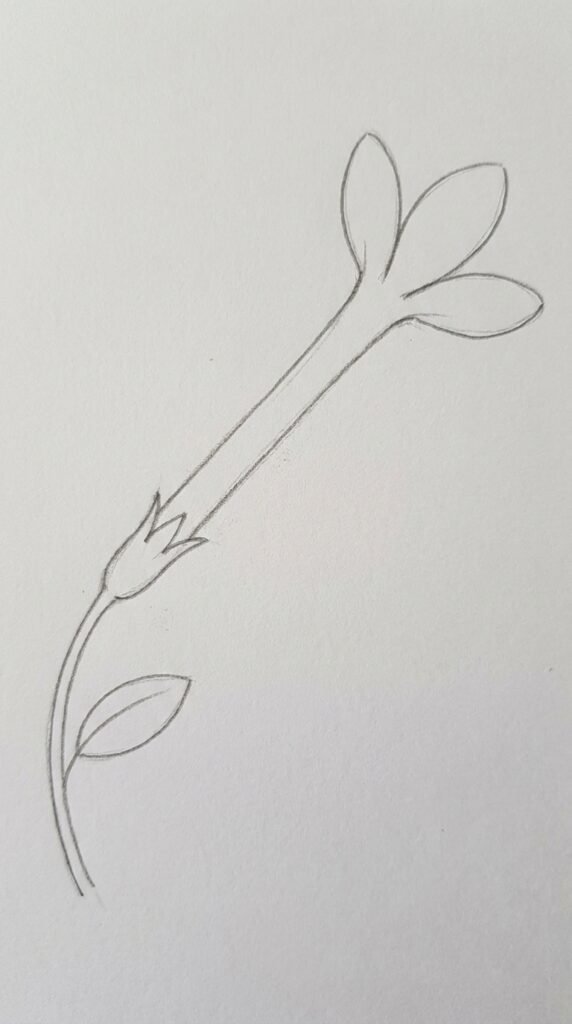
Drawing jasmine from the side gives you a completely different perspective that is just as important to learn as the front view. The side view reveals the long narrow tube and shows only two or three petals fanning out to one side. This view is excellent for understanding the three-dimensional structure of the flower even in a flat drawing. It is also the natural pose you would see on a drooping vine, making it very useful for composition work.
Step-by-Step Instructions:
Step 1: Draw a long, slightly curved narrow tube shape in the center of your paper, positioned at a gentle diagonal angle.
Step 2: At the top end of the tube, draw two or three oval petals fanning outward to the right side. The petals should look like they are spreading away from the tube in a fan shape.
Step 3: Add a small sepal at the base of the tube where it meets the stem. The sepal is a tiny star-shaped or pointed leaf that wraps around the flower base.
Step 4: Draw a curved stem extending from the base of the tube downward and to the left. Add one small oval leaf on the stem.
Step 5: Review your proportions. The tube should be clearly longer than the petals, and the petals should not overlap the tube heavily.
Jasmine Branch with Multiple Flowers
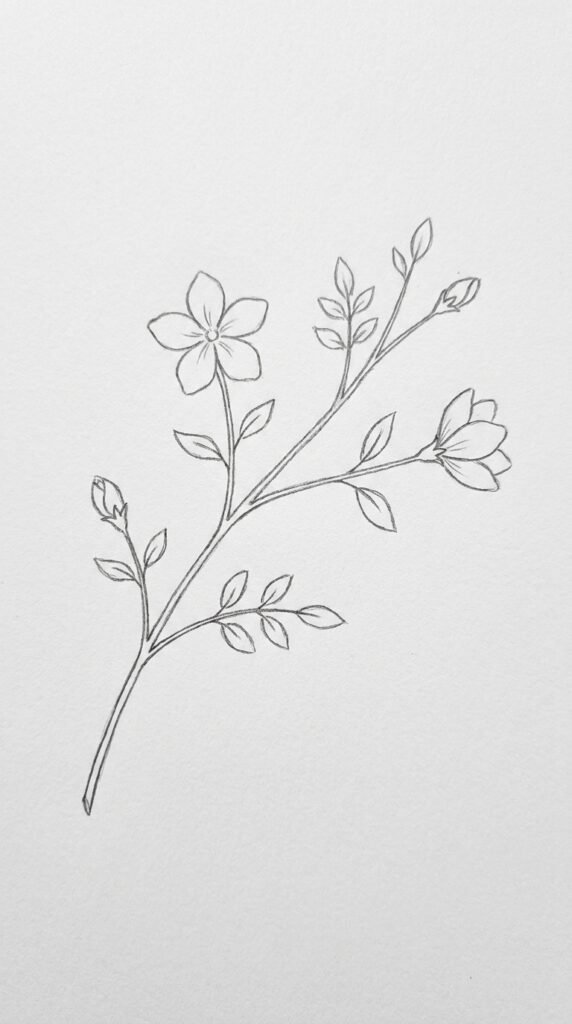
Once you can draw individual blooms and buds, the next step is combining them on a single branch to create a more realistic and visually interesting composition. A jasmine branch with multiple flowers is a favorite subject for Pinterest floral art, botanical sketchbooks, and greeting card designs. The key to making this look natural is varying the sizes of the blooms and mixing open flowers with closed buds.
Step-by-Step Instructions:
Step 1: Draw a gently curving main branch running diagonally from the bottom left to the upper right of your paper. The branch should have a slight natural curve, not a perfectly straight line.
Step 2: Add three to four smaller side stems branching off the main branch at natural intervals. These side stems should spread in different directions and vary slightly in length.
Step 3: Place a fully open jasmine flower at the end of two of the side stems, drawing them using the front-view technique from the first idea.
Step 4: Add a closed bud at the tip of one side stem, and a side-view flower on another.
Step 5: Draw small oval leaves in pairs along the main branch and at the base of each side stem.
Jasmine Bud Drawing
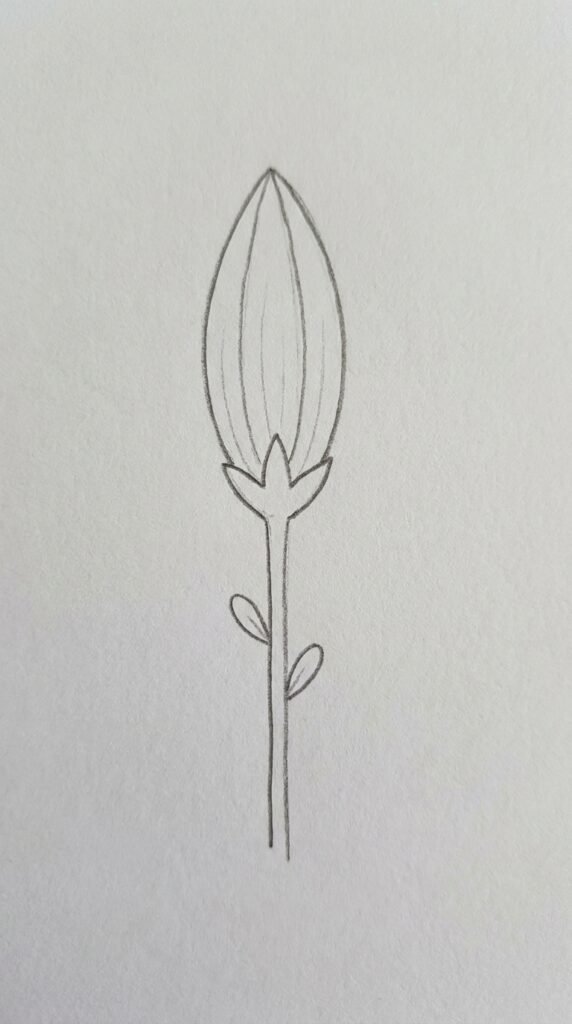
Flower buds are one of the most charming elements of jasmine drawings and they appear frequently in botanical illustrations and Pinterest-worthy art journal pages. A jasmine bud is essentially a tightly closed tube with pointed tips, which makes it one of the simplest shapes in all of floral drawing. Learning to draw buds accurately will dramatically improve your overall jasmine compositions.
Step-by-Step Instructions:
Step 1: Draw a narrow oval shape that is slightly pointed at the top. This is the closed bud body. Make it about the height of a thumbnail.
Step 2: Add a series of faint vertical lines or a slight spiral twist pattern on the bud surface to suggest tightly wound petals. These lines should be very light and close together.
Step 3: Draw a small pointed sepal at the base of the bud. The sepal has three to five tiny pointed tips that grip the bud from below.
Step 4: Add a thin stem extending straight down from the sepal. Keep the stem slender and slightly shorter than the bud body itself.
Step 5: Draw one or two tiny oval leaves on the stem to complete the composition.
Jasmine Vine Wrapping Around a Stem
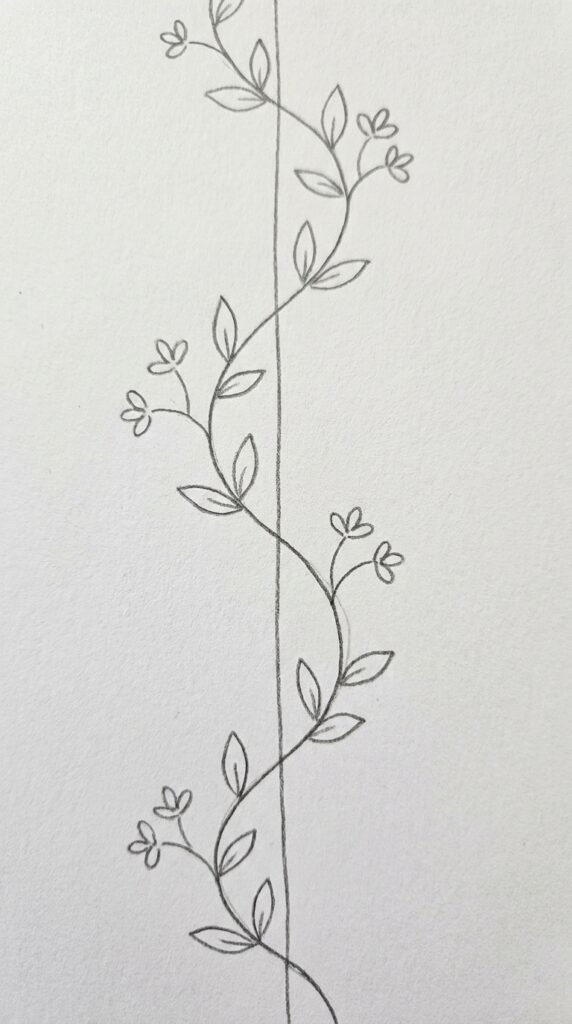
Jasmine is a climbing vine by nature, and drawing it wrapping around a vertical stem or post is a dramatic and beautiful composition that looks impressive but is still very manageable for beginners. This type of drawing is extremely popular on Pinterest botanical art boards and works beautifully as a page border element in art journals.
Step-by-Step Instructions:
Step 1: Draw a straight vertical line down the center of your paper. This is the main post or stem the jasmine will wrap around.
Step 2: Draw a thin curved vine wrapping around the post in a loose spiral. The vine should cross behind and in front of the post at alternating points as it climbs upward.
Step 3: At each point where the vine crosses in front of the post, add a small cluster of jasmine flowers or buds. Draw one or two flowers per crossing point.
Step 4: Add small oval paired leaves along the vine at regular intervals between the flower clusters.
Step 5: Add tiny curling tendrils at the vine tips to give a sense of natural, living growth.
Jasmine Flower Circle Wreath
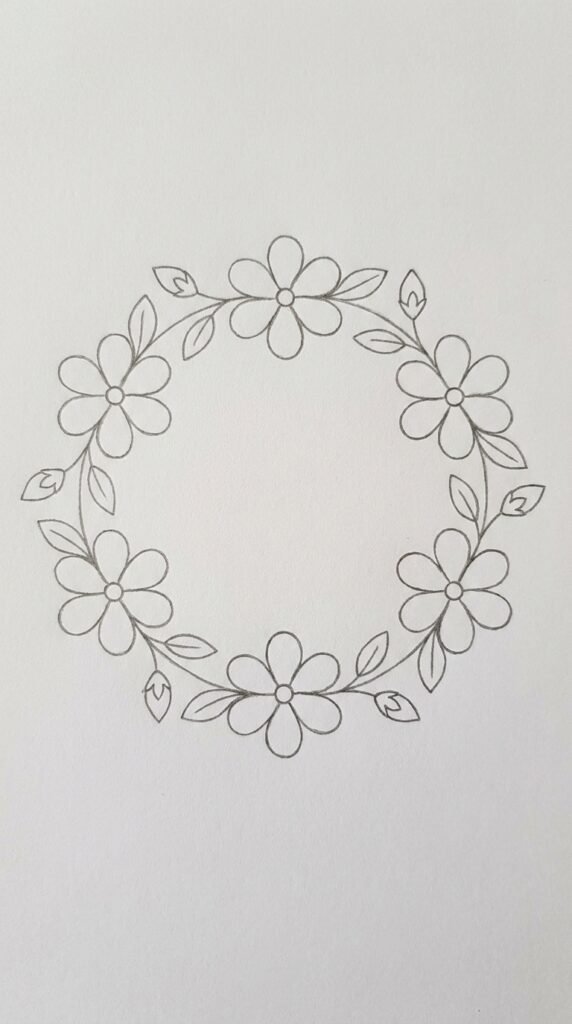
A jasmine wreath is a circular arrangement of flowers and leaves that forms a complete ring. This is one of the most popular floral drawing styles on Pinterest and works beautifully on greeting cards, wall art prints, and art journal covers. The circular format is surprisingly forgiving for beginners because small imperfections in individual flowers are barely noticeable in the completed wreath.
Step-by-Step Instructions:
Step 1: Lightly draw a large circle in pencil as a guide. This will define the outer edge of your wreath. You can use a round object as a stencil if needed.
Step 2: Draw a smaller circle inside the first one to define the inner edge of the wreath ring. The ring itself should be wide enough to comfortably fit a jasmine flower.
Step 3: Place five or six open jasmine flowers evenly spaced around the ring, centered on the guide circle line. Draw each flower using the front-view technique.
Step 4: Fill the spaces between the flowers with pairs of oval leaves and closed buds. Alternate between leaves and buds to create a natural, varied rhythm.
Step 5: Erase the guide circles once the design is complete. Go over all the flower and leaf outlines to ensure they are clear and consistent.
Jasmine Corner Border Design
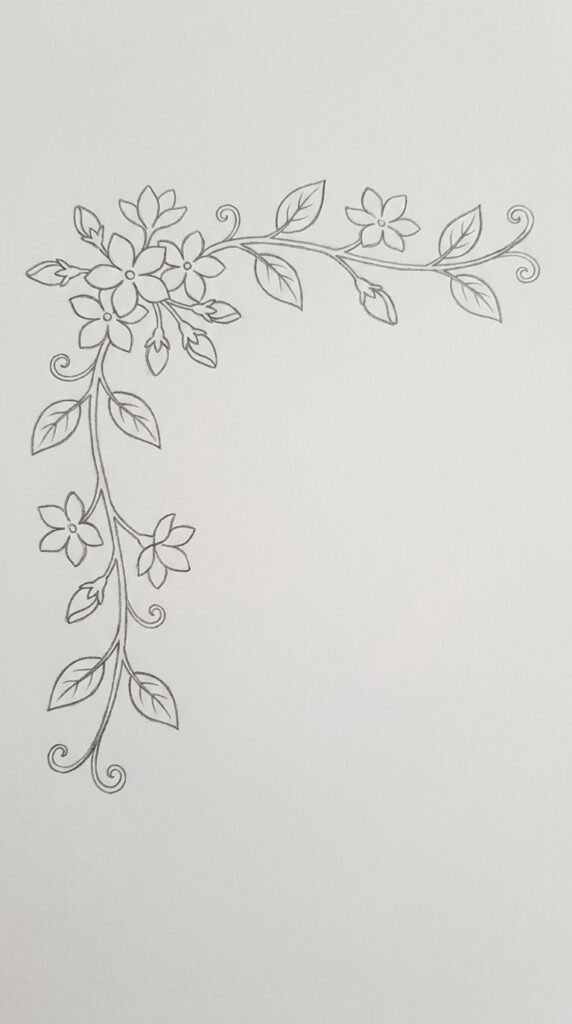
Corner borders are a practical and beautiful addition to greeting cards, bullet journals, and scrapbook pages. A jasmine corner border starts at one corner of the page and spreads outward along two adjacent edges. This asymmetrical composition is elegant and very popular in hand-lettered stationery designs on Pinterest.
Step-by-Step Instructions:
Step 1: Draw a curved vine starting at the bottom left corner of your paper. Let it curve gently upward along the left edge and then branch outward to the right along the top edge.
Step 2: At the corner where the two vines meet, draw a small cluster of two or three open jasmine flowers as the focal point of the border.
Step 3: Along both vine arms, add alternating open flowers and closed buds at natural intervals. Space them about two to three finger-widths apart.
Step 4: Add pairs of oval leaves between each flower or bud grouping to fill the vine and make it look lush.
Step 5: Add small curling tendrils at the tips of the vine to give a natural trailing effect.
Jasmine Flower with Detailed Petals
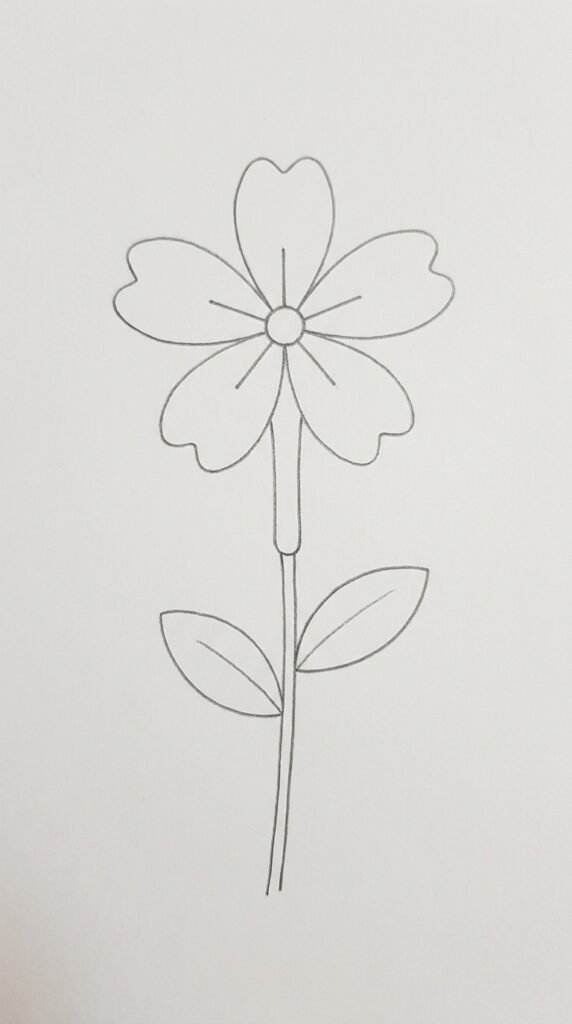
Once you are comfortable with basic jasmine shapes, adding a little more detail to the individual petals is a great way to elevate your drawings. Real jasmine petals have a slightly pinched or narrow base that widens gently toward a rounded or slightly notched tip. This detailed petal version is ideal for botanical illustration practice and art journal spreads.
Step-by-Step Instructions:
Step 1: Draw a small circle for the flower center as usual.
Step 2: Instead of drawing simple oval petals, draw each petal with a narrow base that connects to the center circle and then widens gently toward the tip. The tip should have a very slight notch or rounded indent.
Step 3: Draw all five petals with this same shape, ensuring they radiate evenly and do not overlap too heavily at the center.
Step 4: Inside the center circle, draw three to five tiny lines radiating outward to suggest the stamens. Keep these lines short and light.
Step 5: Add the tube, stem, and two oval leaves as in the basic version. The detailed petals should make the flower feel more realistic without adding complexity to the rest of the drawing.
Jasmine Leaf Study Drawing
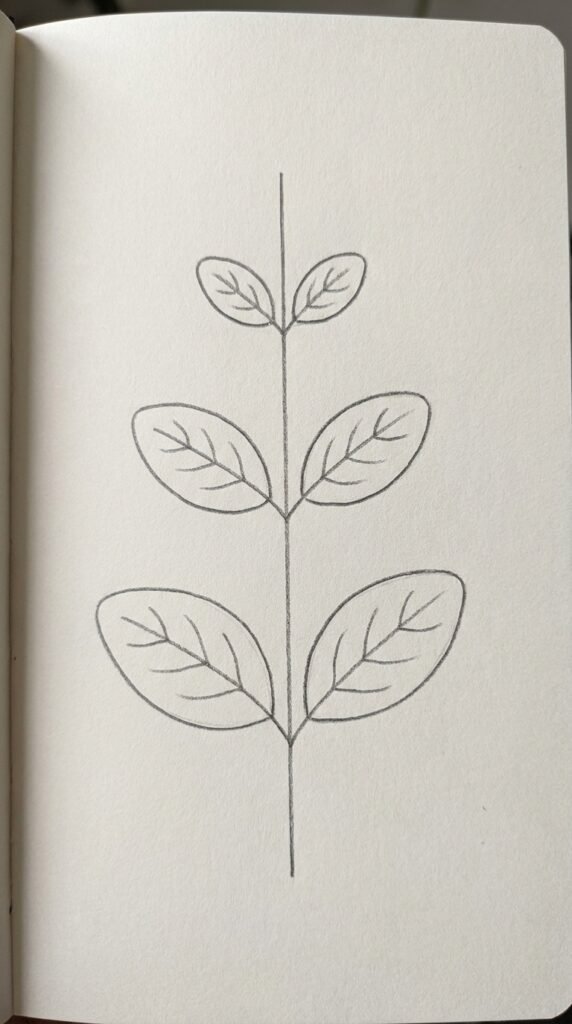
Dedicated leaf studies are an often-overlooked part of floral drawing practice. Jasmine leaves are small, oval, and arranged in opposite pairs along the stem. Drawing a focused leaf study helps you understand the specific proportions and vein structure of jasmine foliage, which makes all of your complete flower drawings look more accurate and believable.
Step-by-Step Instructions:
Step 1: Draw a straight vertical stem running down the center of your paper.
Step 2: At the top of the stem, draw the first pair of leaves. Each leaf is an oval shape with a slightly pointed tip. The leaves in each pair should mirror each other on opposite sides of the stem.
Step 3: Move about two finger-widths down the stem and draw the second pair of slightly larger leaves in the same opposite arrangement.
Step 4: Add a third pair lower on the stem that is slightly larger again, creating a gradual increase in leaf size from top to bottom.
Step 5: On each leaf, draw a single central midrib line from base to tip. Add three or four short lateral vein lines branching off the midrib on each side.
Jasmine Flower Bouquet Drawing
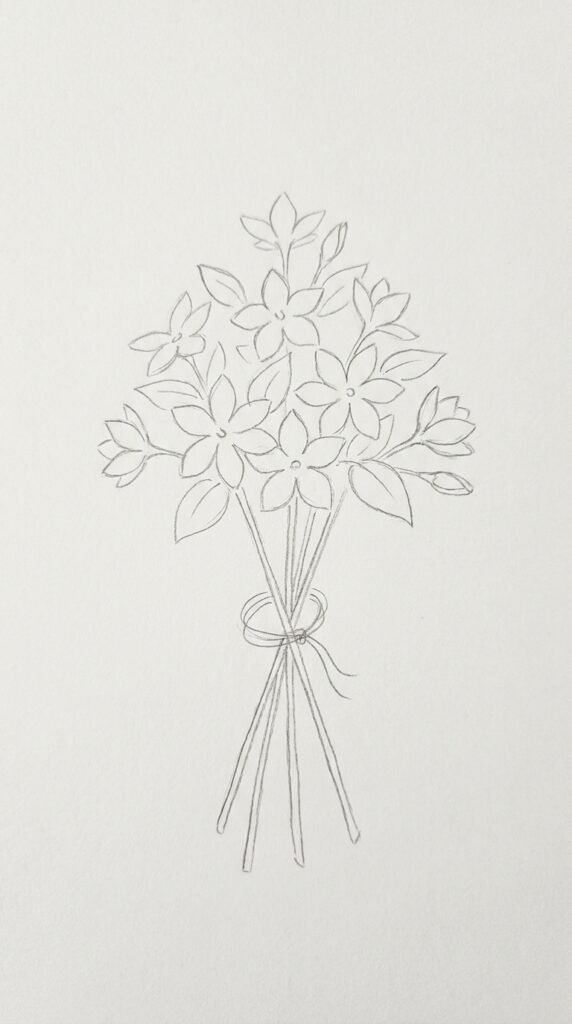
A small hand-tied bouquet of jasmine is a romantic and elegant drawing subject that is very popular on Pinterest wedding and floral art boards. The bouquet format groups several stems together at the base and fans the flowers out at the top, creating a natural triangular or dome-shaped silhouette that is easy to construct with simple guidelines.
Step-by-Step Instructions:
Step 1: Lightly draw a triangle guideline on your paper. The wide end should be at the top and the narrow point at the bottom. This is the basic bouquet shape.
Step 2: Draw five or six jasmine stems crossing each other at the lower third of the triangle. The stems should converge toward the bottom point and fan outward toward the top.
Step 3: At the top of each stem, draw an open jasmine flower or a bud. Vary between front-view flowers and side-view flowers for a natural look.
Step 4: Fill any visible gaps between the flowers with small oval leaves and closed buds.
Step 5: At the crossing point of the stems, draw a small tied ribbon or band to suggest the bouquet is hand-tied. Erase the triangle guideline.
Jasmine Flower in a Simple Vase
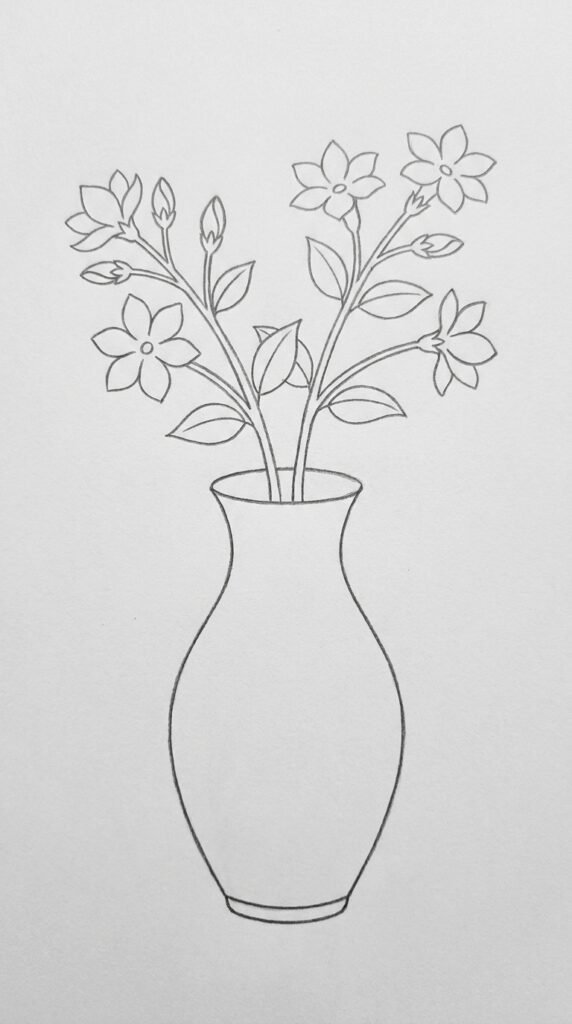
Placing jasmine in a vase is a wonderful way to practice combining a flower drawing with a simple still life object. This composition is popular for art journal pages, Pinterest home decor content, and beginner drawing practice because the vase provides a grounding structure that makes the looser floral elements feel organized and intentional.
Step-by-Step Instructions:
Step 1: Draw a simple vase shape in the lower half of your paper. A classic vase shape is wider at the middle, narrower at the neck, and slightly wider again at the rim. Keep the shape symmetrical.
Step 2: Draw two or three jasmine stems emerging from the vase opening. Let the stems curve gently and spread outward in different directions.
Step 3: At the end of each stem, draw an open jasmine flower using the front-view or side-view technique.
Step 4: Add a few closed buds at shorter stems emerging between the main stems.
Step 5: Fill the visible stems with pairs of small oval leaves. Make sure some leaves appear inside the vase opening area to suggest depth.
asmine Flower Hair Accessory Sketch
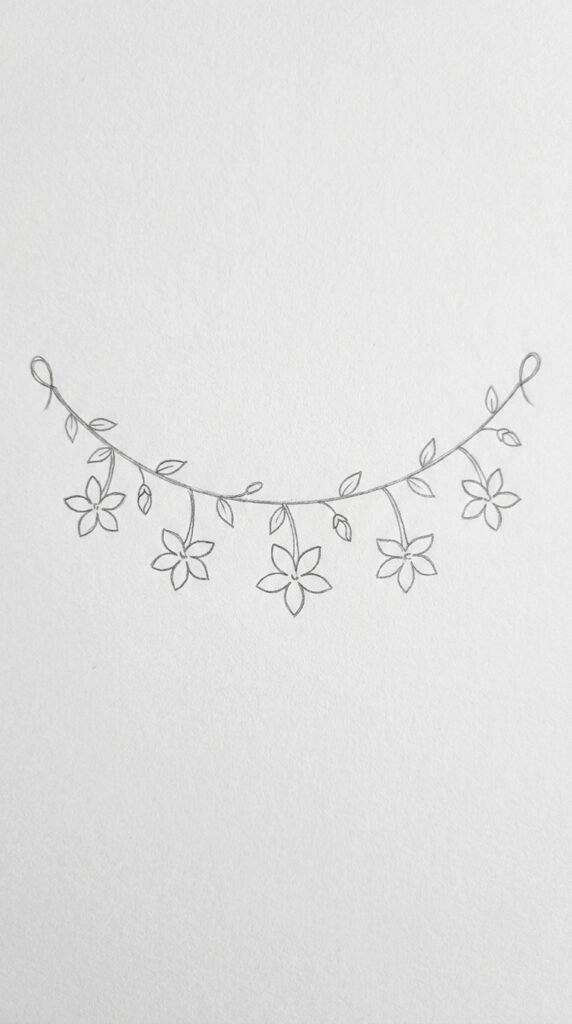
Jasmine flowers are traditionally worn in hair across South Asian cultures, and this charming drawing idea captures a small cluster of jasmine blooms strung together as a hair ornament. This subject is particularly meaningful and distinctive, making it stand out beautifully on culturally inspired Pinterest boards and botanical art collections.
Step-by-Step Instructions:
Step 1: Draw a gentle curved thread or string running horizontally across the center of your paper with a slight natural sag.
Step 2: Draw five to six jasmine flowers hanging from the string at evenly spaced intervals. Each flower should be attached to the string by a tiny stem or tied directly to it.
Step 3: Draw each flower using the side-view or front-view technique, allowing them to hang naturally downward from the string.
Step 4: Between each flower, add a tiny closed bud or small leaf to fill the string composition and make it look complete.
Step 5: At each end of the string, draw a small loop or knot to suggest how the garland is finished.
Jasmine Flower Mandala Drawing
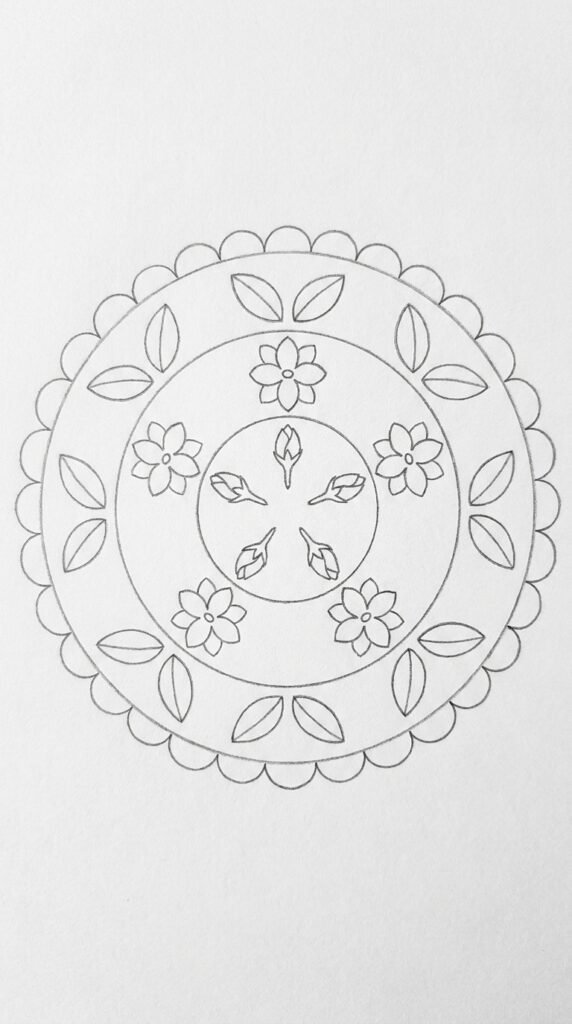
A jasmine mandala places jasmine flowers in a radially symmetrical circular design, combining floral drawing with the meditative geometry of mandala art. This is a highly engaging drawing project for intermediate beginners and is enormously popular on Pinterest as a mindfulness and art therapy activity.
Step-by-Step Instructions:
Step 1: Draw a small circle in the center of your paper. Then draw three increasingly larger concentric circles around it, each spaced about one finger-width apart.
Step 2: In the innermost ring, draw five small jasmine buds evenly spaced around the circle, all pointing outward from the center.
Step 3: In the second ring, draw five open jasmine flowers aligned with the gaps between the buds in the first ring.
Step 4: In the third ring, draw ten small oval leaves arranged in pairs, with each pair positioned between and aligned with the flowers in the second ring.
Step 5: In the outermost ring, draw a series of small petal or scallop shapes to create a decorative border that completes the mandala circle.
Jasmine Flower with Butterfly
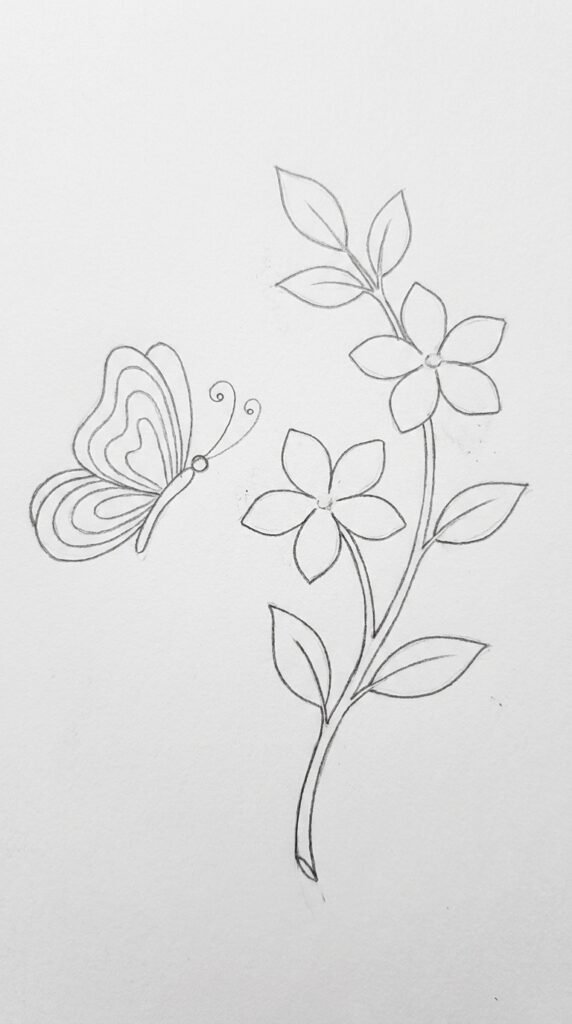
Adding a butterfly to a jasmine flower drawing creates a lively and dynamic composition that suggests pollination and the natural world. This is a crowd-pleasing subject for Pinterest nature art boards, children’s illustration practice, and educational drawing guides. The butterfly provides an interesting contrast in shape against the soft, rounded jasmine petals.
Step-by-Step Instructions:
Step 1: Draw a jasmine branch with two or three open flowers positioned on the right side of your paper using the branch technique from earlier.
Step 2: In the open space on the left side of the paper, draw the body of a butterfly as a small narrow oval shape.
Step 3: Draw two large upper wings and two smaller lower wings on either side of the body. Keep the wings symmetrical and use simple curved lines for the wing edges.
Step 4: Add a simple curved line pattern inside each wing consisting of two or three concentric rounded shapes near the wing edges.
Step 5: Draw two thin antennae extending from the top of the butterfly body with a tiny circle at the tip of each. Position the butterfly so it appears to be hovering near one of the jasmine flowers.
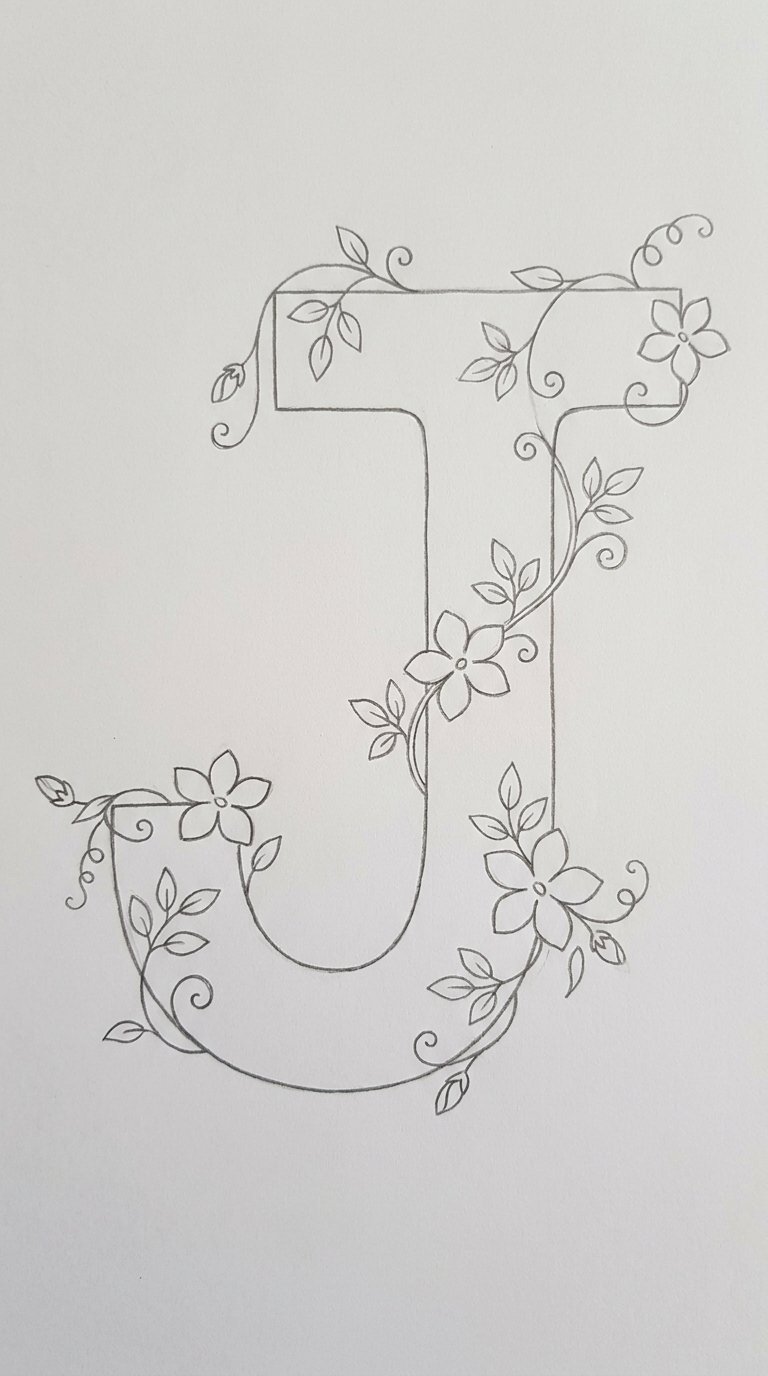
Jasmine Flower Alphabet Letter Art
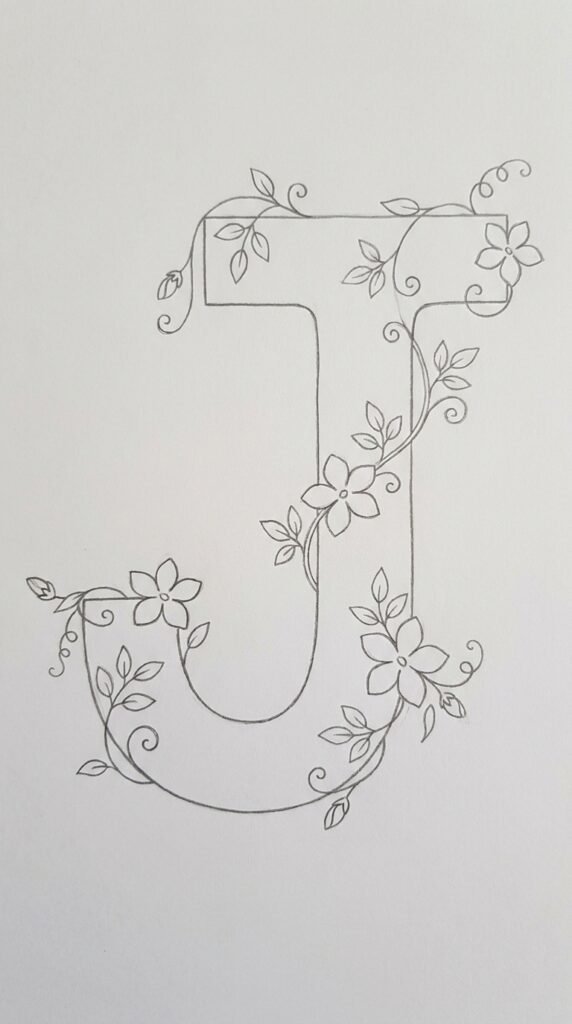
This creative idea combines jasmine flower drawing with letterform design, making it ideal for personalized artwork, monogram drawings, and educational art projects for children. The concept involves drawing a large capital letter and then growing a jasmine vine with flowers and leaves along the edges and curves of the letter shape.
Step-by-Step Instructions:
Step 1: Draw a large capital letter of your choice in simple block or outline style. Letter J is an obvious and charming choice given the jasmine theme. Leave the interior of the letter hollow so the vine can wrap around it.
Step 2: Draw a thin jasmine vine tracing along the outside edge of the letter from the bottom upward. Let the vine follow the curves and lines of the letter closely.
Step 3: At natural intervals along the vine, draw open jasmine flowers at the outer edges of the letter where there is enough space.
Step 4: Add pairs of oval leaves between the flowers along the entire length of the vine.
Step 5: Place two or three closed buds at the vine tips
Helpful Drawing Tips for Jasmine Art
Start with very light pencil strokes when you are laying out the basic shapes of your jasmine composition. Light guidelines are easy to erase or ignore once you have the structure right, and they prevent you from committing too early to a placement that does not work.
Always draw the main stem or vine first before adding flowers and leaves. The stem is the backbone of the composition and everything else hangs from it. Drawing flowers before the stem often results in awkward proportions and poor spacing.
Practice drawing the basic five-petal flower shape separately on scrap paper before you begin your main drawing. Even five minutes of isolated petal practice will dramatically improve the smoothness and confidence of your finished flower shapes.
Vary the size of your flowers slightly within a single composition. Not every bloom needs to be exactly the same size. Slight variation looks more natural and gives the drawing a sense of depth without needing any shading.
Keep your pencil sharp throughout the drawing session. A sharp pencil gives cleaner, crisper lines that read as confident and intentional. A blunt pencil creates fuzzy, uncertain strokes that are harder to control.
When drawing leaf pairs, always draw both leaves before moving to the next set. It is easy to lose track of leaf placement if you draw all the leaves on one side first.
Common Mistakes to Avoid
Petals that are too long relative to the flower center are one of the most common problems beginners face with jasmine drawings. Jasmine petals are relatively short and rounded. If your petals look more like a daisy, scale them down closer to the center.
Drawing stems that are too thick makes jasmine look heavy and woody when it should appear delicate and light. Use a single thin line for most stems and only slightly thicken the main branch in branch compositions.
Placing all flowers at exactly the same angle and size creates a repetitive, unnatural look. Rotate some flowers slightly, tuck a few behind stems, and mix open blooms with buds to create variety.
Forgetting to include buds is a very common oversight. In nature, jasmine almost always has a mix of open flowers, partially open flowers, and fully closed buds on the same stem. Including buds adds realism and compositional interest.
Pressing too hard with the pencil early in the drawing makes it very difficult to erase guidelines and corrections cleanly. Always start with light pressure and only darken the final outlines once you are satisfied with the shapes.
Overcrowding the composition by drawing too many flowers in a small space makes the individual flowers hard to read and the drawing look cluttered. Give each flower enough breathing room to be recognizable on its own.
Frequently Asked Questions About Jasmine Drawing
How do I draw a jasmine flower for beginners? Start with a small circle for the center, then draw five evenly spaced oval petals radiating outward from the circle. Add a narrow tube shape below the petals connecting to a thin stem, then finish with two small oval leaves on the stem. Use light pencil pressure and practice the petal shape a few times on scrap paper before drawing on your main page.
What shapes are used to draw jasmine flowers? Jasmine flowers are built from very simple shapes. The flower center is a small circle. The petals are narrow ovals that widen slightly toward rounded tips. The corolla tube is a long narrow rectangle or cylinder. The leaves are oval shapes with pointed tips, and the stems are thin curved or straight lines. Mastering these five basic shapes gives you everything you need to draw jasmine in any style.
Can kids draw jasmine flowers easily? Yes, jasmine flowers are excellent for kids to draw because the shapes are simple and repeat predictably. The five-petal arrangement is easy to count and space, and the oval leaf pairs follow a clear pattern along the stem. Most children between the ages of six and twelve can successfully draw a basic jasmine flower with a little guidance and practice.
What pencil is best for jasmine drawings? A medium HB pencil is the best choice for jasmine drawing tutorials and sketches. It produces lines that are dark enough to see clearly but light enough to erase easily during the early stages of drawing. An HB pencil also gives you a good range of line weight by simply adjusting the pressure you apply, from very light guide strokes to darker final outlines.