If you have ever looked at a daisy and thought, “I really want to draw that, but I have no idea where to start,” you are in exactly the right place. Daisies are one of the most beloved flowers in the world, and the good news is they are also one of the easiest flowers to draw. Their shape is simple, their petals follow a clear pattern, and they look beautiful even when drawn with just a pencil on plain white paper.
This article is packed with 15 daisy flower drawing ideas that are perfect for beginners, kids, and anyone who wants to add more floral art to their sketchbook. Every single idea in this list starts from basic shapes like circles and straight lines. You do not need any fancy art supplies, and you do not need shading experience. A regular HB pencil and a sheet of paper are all you need to get started.
Daisy flower drawing ideas are incredibly popular on Pinterest right now, and for good reason. Whether you want to draw a single classic daisy, a full bouquet, a daisy in a pot, or a cute cartoon version, there is something in this guide for every skill level. Each idea comes with easy step-by-step instructions written in plain language so that even a child can follow along without getting confused.
Drawing flowers is one of the best ways to build your pencil control and improve your overall drawing skills. The more you practice drawing petals, stems, and leaves, the more confident you will feel with the pencil. By the end of this guide, you will have a whole collection of daisy flower drawing ideas to choose from, and you will know exactly how to draw each one from start to finish. Pick your favorite, grab your pencil, and let us begin.
Classic Single Daisy with Round Center
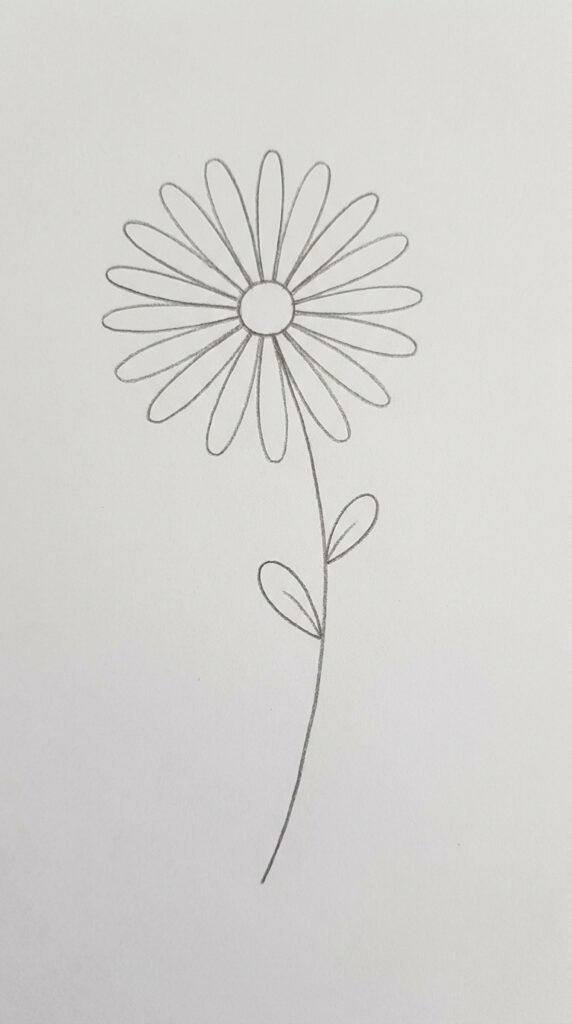
This is the most fundamental of all daisy flower drawing ideas and the perfect place to start if you have never drawn a flower before. The classic single daisy uses a simple circle for the center and long, narrow petals arranged evenly around it. The result looks clean, balanced, and immediately recognizable as a daisy. It is a great exercise for learning how to space petals evenly without measuring.
Even though this design looks simple, it teaches you important skills like oval placement and petal symmetry that you will use in every other drawing in this list. Take your time with the center circle and make sure each petal is roughly the same length and width.
Step-by-Step Instructions
- Draw a small circle in the center of your paper, about the size of a large coin. Press lightly with your HB pencil so the lines are easy to adjust.
- Starting from the top of the circle, draw one long, narrow petal pointing straight up. The petal should be about two to three times the width of the center circle in length.
- Continue adding petals all the way around the center circle, spacing each one as evenly as possible. Aim for about 12 to 14 petals total.
- Draw a thin, slightly curved stem extending downward from the bottom of the flower, about three inches long.
- Add two small oval leaves near the lower part of the stem, one on each side, pointing outward at a slight angle.
Cute Daisy with a Smiley Face Center
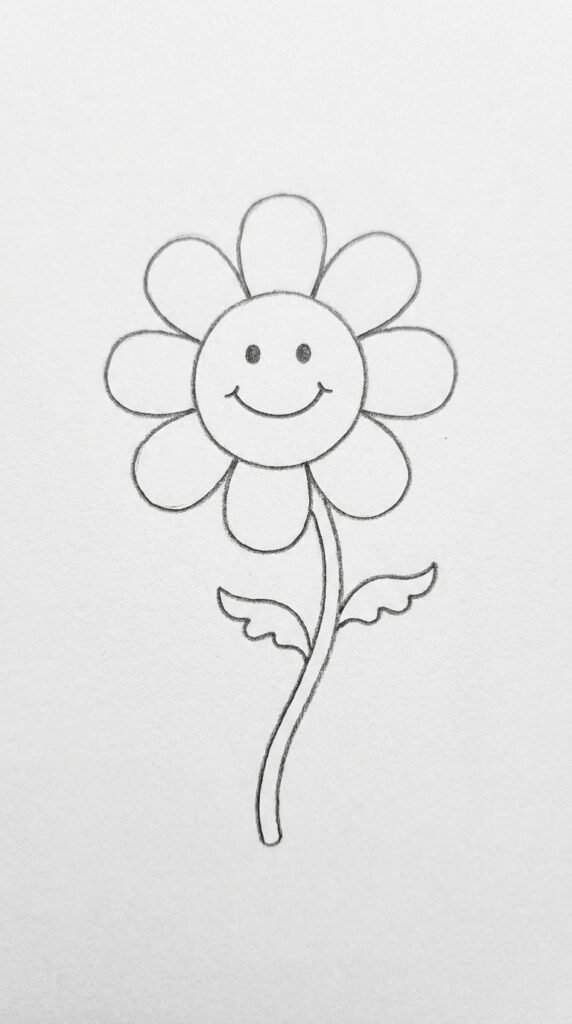
This adorable variation of daisy flower drawing ideas is perfect for kids and anyone who loves cute, fun art. Instead of leaving the center circle plain, you add a simple smiley face inside it, giving the daisy a cheerful personality. This style works beautifully in journals, greeting cards, and bullet journal spreads. The petals for this version are slightly rounder and puffier than the classic style to match the playful mood.
The key to making this look good is keeping the smiley face details very small and simple. Two tiny dots for eyes and a small curved line for the mouth are all you need. Do not overcrowd the center circle.
Step-by-Step Instructions
- Draw a medium-sized circle near the center of your paper. This circle should be slightly larger than the classic daisy center, roughly the size of a quarter.
- Inside the circle, add two tiny dot eyes near the upper half and a small curved smile below them. Keep these very small so they fit naturally inside the circle.
- Draw rounded, slightly wider petals around the outside of the circle, spacing them evenly. Aim for 10 to 12 petals. Each petal should have a slightly rounded tip instead of a pointed one.
- Add a gently curved stem below the flower, then draw two rounded leaves along the lower stem, giving them slightly wavy edges.
- Go over your outline lightly one more time to make the lines clean and consistent in thickness.
Daisy Bouquet Tied with a Simple Bow
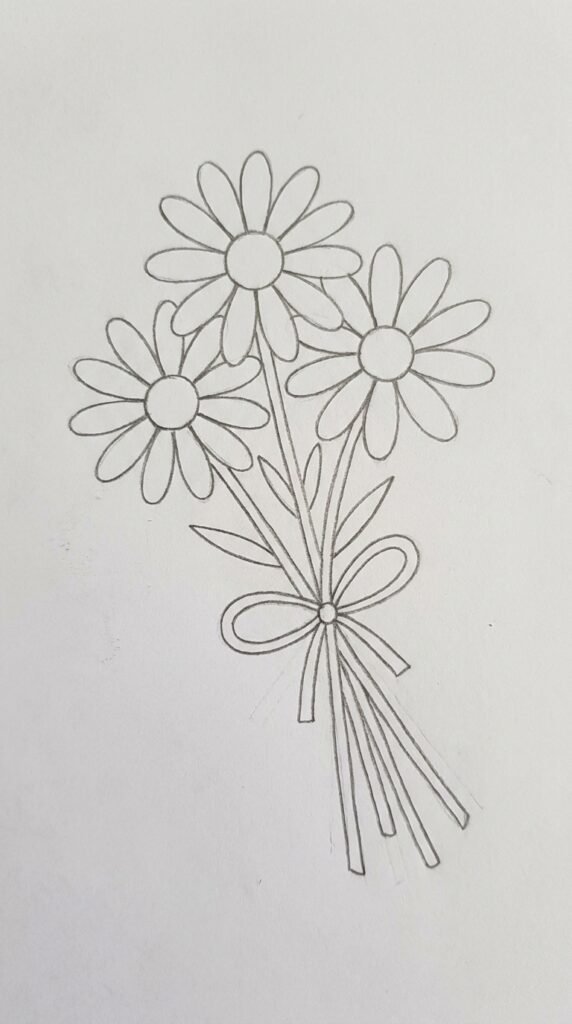
A daisy bouquet is one of the most popular daisy flower drawing ideas on Pinterest, and it is easier to draw than it looks. This design features three to five daisy flowers grouped together with their stems gathered at the bottom and tied with a simple ribbon bow. The overlapping flowers create a sense of depth and fullness, making the drawing look impressive even though each individual flower is simple to draw.
The trick with a bouquet is to draw the flowers at slightly different heights so they do not all look like they are on the same level. Stagger them naturally the way real flowers sit in a bunch.
Step-by-Step Instructions
- Start by drawing three small circles spaced across the upper area of your paper, with the middle one slightly higher than the two on the sides. These are your daisy centers.
- Draw petals around each circle, using 10 to 12 petals per flower. Allow some petals from neighboring flowers to gently overlap each other to create a natural bouquet look.
- Draw three stems extending downward from each flower, angling them so they converge toward a single point at the bottom of the bouquet, like a V shape narrowing at the base.
- Where the stems meet, draw a small horizontal oval to represent where a hand would hold the bouquet, and below that draw a simple bow shape using two triangular loops and two short ribbon tails.
- Add one or two small oval leaves near the upper stems of the bouquet for a natural finish.
Daisy in a Small Round Pot
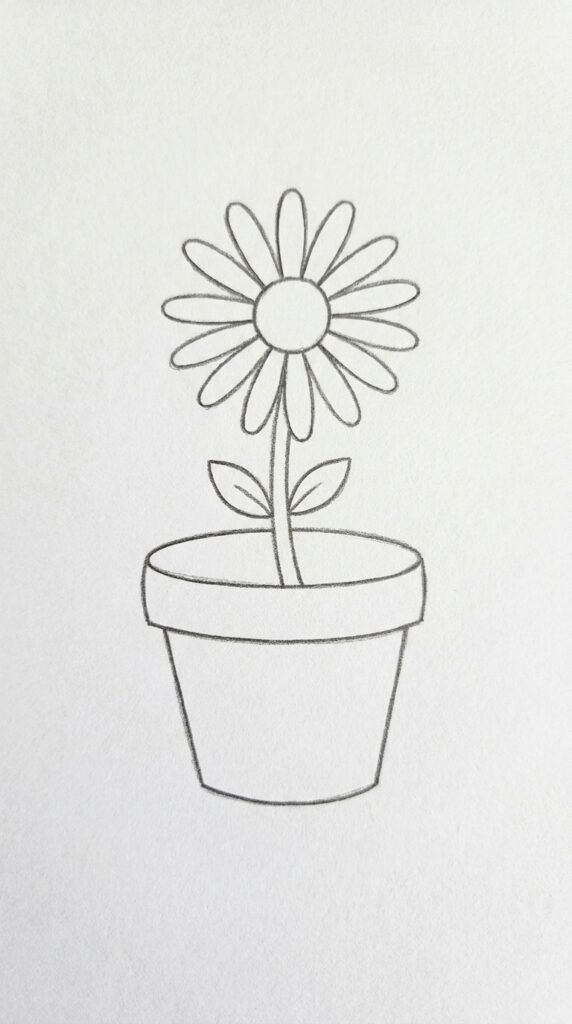
Drawing a daisy in a pot is a charming and widely loved idea among daisy flower drawing enthusiasts. This design combines a classic single daisy with a simple round pot shape at the bottom, creating a complete little scene on the page. It works wonderfully as a decorative element for planners, notebooks, and card designs. The pot shape uses simple curved lines that are easy to draw even for young children.
Keep the pot proportional to the flower. If the pot is too large it will overpower the daisy, and if it is too small the composition will look unstable. A medium-sized pot that is roughly the same width as the flower’s petal span looks best.
Step-by-Step Instructions
- In the lower half of your paper, draw the pot shape. Start with a wide, slightly curved oval for the top rim of the pot, then draw two slightly angled lines going down from the ends of the oval, and connect them at the bottom with a flat curved line.
- Add a small rectangular strip just below the rim of the pot to create the classic flowerpot collar detail.
- Draw a short, straight stem rising up from the center of the pot’s opening, about two inches tall.
- At the top of the stem, draw a small circle for the daisy center, then add 12 petals evenly around it, each petal being narrow and elongated.
- Add two small leaves on either side of the stem, about halfway up, pointing outward at a gentle angle to fill the space naturally.
Small daisy field with Grass
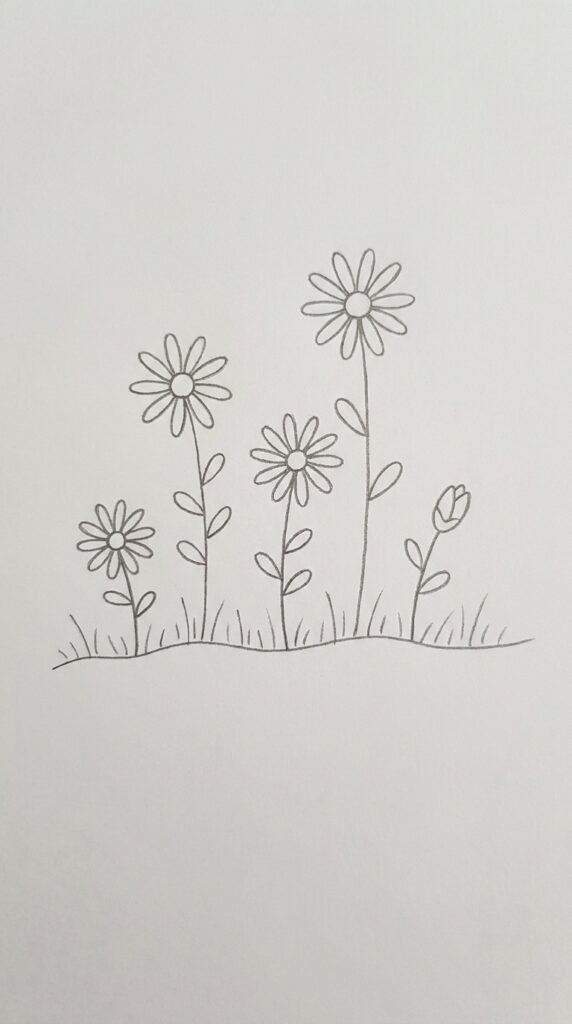
A daisy field scene is one of those daisy flower drawing ideas that looks complex but is actually made up of many simple repeated shapes. This drawing features several small daisies of varying heights growing up from a simple grass line, creating a peaceful meadow scene. Because the flowers are small and slightly varied in size, the drawing has a natural, organic feel that looks lovely in sketchbooks.
The secret is to make the daisies different heights and to not draw them all with identical petal counts. Slight variation in size and petal number makes the drawing look more natural and less mechanical.
Step-by-Step Instructions
- Near the bottom of your paper, draw a slightly wavy horizontal line all the way across to represent the ground. Above this line, add short, upward-pointing V shapes and small blades of grass scattered along it.
- Draw four to six vertical stems of different heights rising up from the grass line. The stems can be very slightly curved to look natural.
- At the top of each stem, draw a small circle and surround it with short petals. Because the flowers are small, aim for just 8 to 10 petals per daisy to keep it clean and readable.
- Add one or two tiny oval leaves on some of the stems, not all, to keep the drawing from looking too crowded.
- Optionally, draw one or two daisy buds on some stems by drawing a small oval at the top instead of an open flower with petals, to suggest flowers that have not yet bloomed.
Daisy with Long Drooping Petals
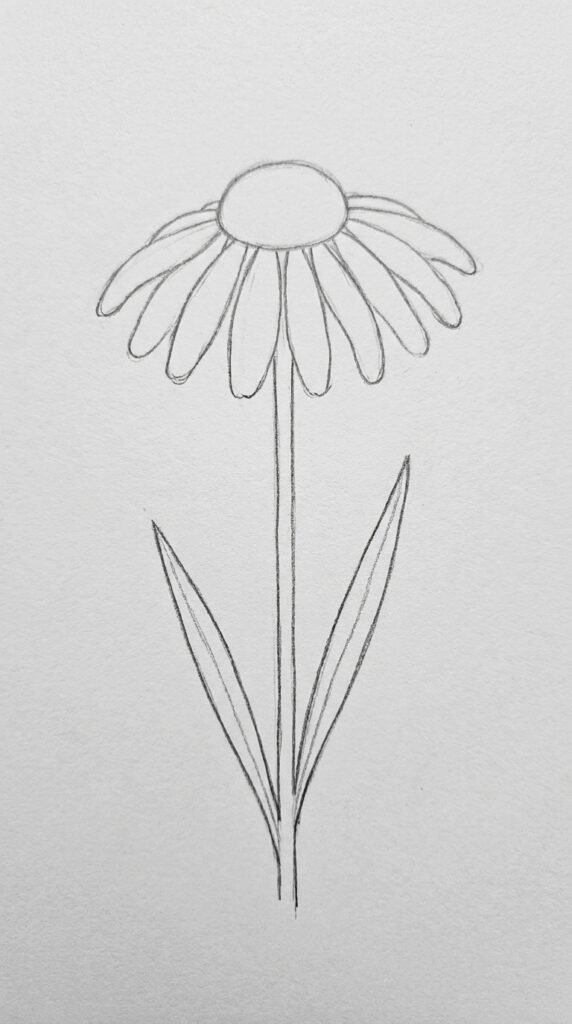
Unlike the classic upright petals, this daisy variation features petals that hang gently downward, giving the flower a softer and more elegant look. This style resembles a Shasta daisy or African daisy and is one of the more striking daisy flower drawing ideas in this collection. The drooping petal effect is achieved simply by curving the petals downward instead of drawing them pointing outward.
This drawing is excellent for practicing curved pencil strokes. Try to make each petal curve in a slightly different direction, the way real flower petals do when they relax and droop naturally.
Step-by-Step Instructions
- Draw a medium circle in the upper half of your paper for the daisy center. This center should be slightly larger than usual, about the size of a nickel coin, to give the drooping petals room to hang from.
- Starting at the top of the circle, draw a petal that points slightly outward and then curves downward, ending in a rounded tip below the center line of the circle.
- Continue adding petals all the way around the circle. The petals at the top should droop downward gently, while the petals at the sides droop toward the paper’s lower corners. Aim for 14 to 16 petals.
- Draw a long, straight stem extending from the bottom of the center circle downward. This stem should be slightly longer than usual to balance the downward-drooping petals visually.
- Add two long, narrow leaves along the lower part of the stem, with each leaf gently curving upward at the tips.
Daisy Wreath Circle Design
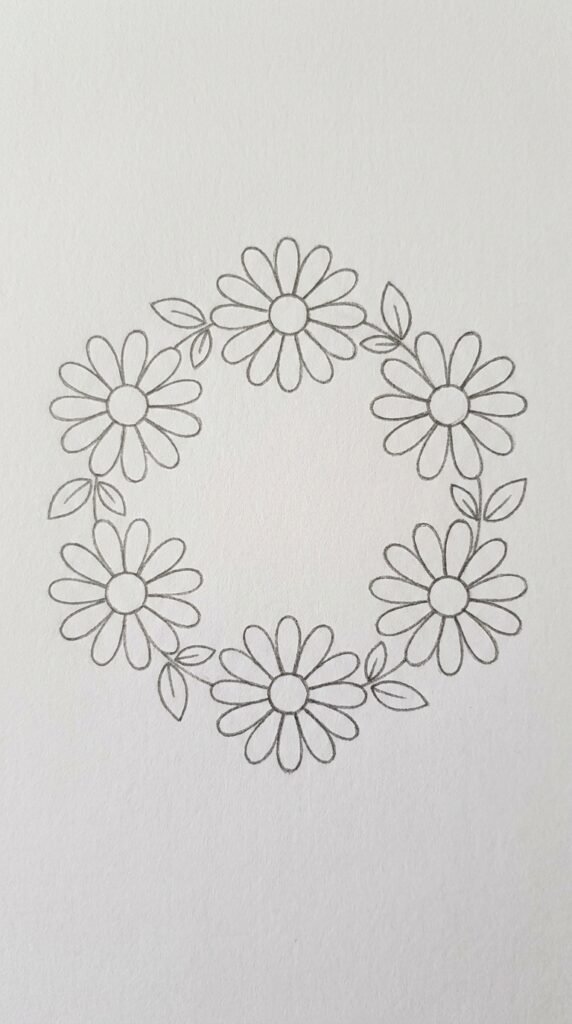
A daisy wreath is a beautiful circular arrangement of daisies that creates a frame-like design, making it one of the most visually satisfying daisy flower drawing ideas in this list. This design works perfectly as a decorative border for text, quotes, or monogram letters. The key is to draw the daisies following the curve of an imaginary circle so that the finished wreath looks evenly distributed and balanced.
Lightly sketching a guide circle in pencil before adding the flowers will make this much easier. You can erase the guide circle afterward so only the daisy wreath remains visible.
Step-by-Step Instructions
- Lightly draw a large circle in the center of your paper using a coin or compass as a guide. This is your wreath framework and will be erased later.
- Place the first daisy at the top of the guide circle, drawing its center directly on the circle line. Add 10 petals pointing outward from the center.
- Continue placing daisies evenly around the guide circle, spacing them so that their stems and leaves touch or slightly overlap the neighboring flowers. Add five to seven daisies total depending on how large your guide circle is.
- Between each pair of daisies, draw small oval leaves pointing outward from the circle line to fill the gaps naturally.
- Carefully erase the guide circle once all the daisies and leaves are drawn. Clean up any smudges and darken any lines that became too faint during erasing.
Daisy Growing Through a Fence
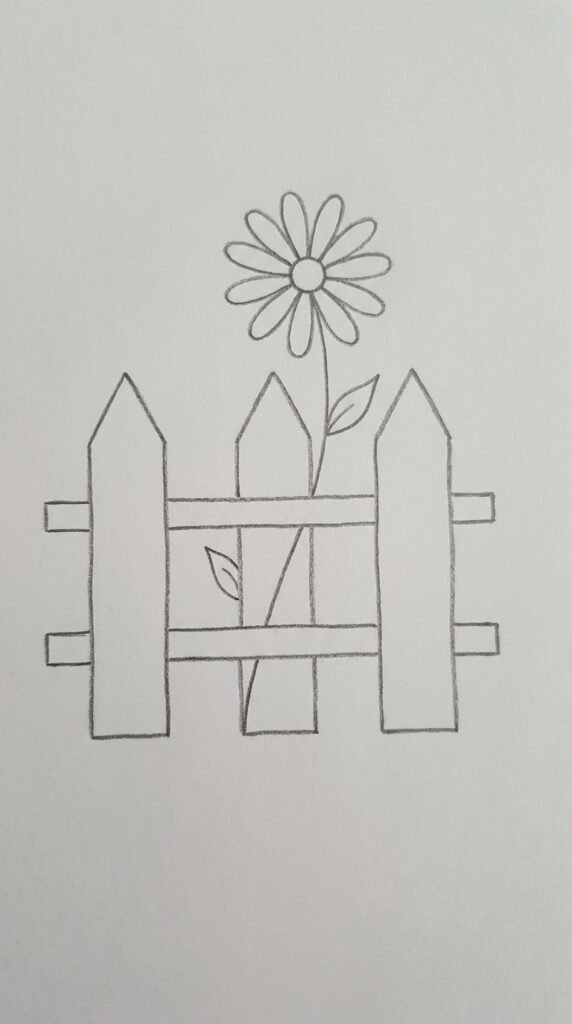
This charming scene shows a single daisy growing through the gaps of a simple wooden fence, creating a storybook-like composition that is surprisingly easy to draw. This is one of those daisy flower drawing ideas that tells a little story through the image, making it especially appealing for sketchbooks and illustrated journals. The fence is made up of simple rectangular shapes, and the daisy peeks through one of the gaps between two fence planks.
Keep the fence lines straight by drawing them lightly first with your pencil held flat. The daisy should look natural and effortless, as if it simply grew there on its own.
Step-by-Step Instructions
- Draw three or four vertical rectangles side by side across the lower middle area of your paper. These are the fence planks. Each plank should have a slightly pointed top to resemble a classic picket fence shape.
- Connect the planks with two horizontal lines across them, one near the top and one near the middle of the planks, to represent the fence rails.
- Between two of the fence planks, draw a thin stem rising up from the bottom of the gap, passing through the space between the rails, and continuing above the top of the fence.
- At the top of the stem, draw the daisy: a small circle center with 12 petals arranged evenly around it. The daisy should sit just above the top of the fence.
- Add a small leaf on the stem where it emerges above the fence top, and optionally one more small leaf peeking through the fence gap for a realistic touch.
Layered Daisy with Double Petal Row
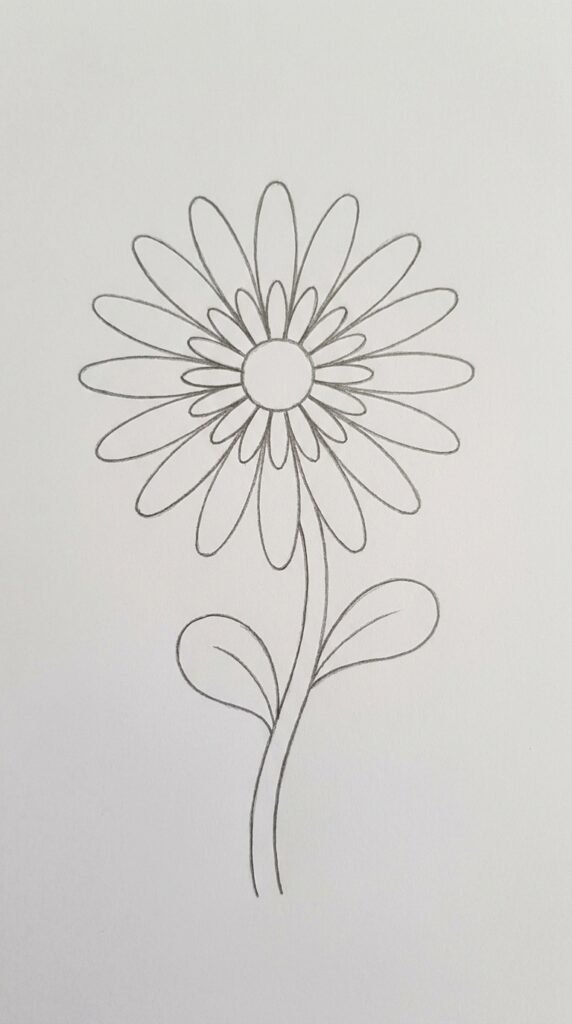
This design adds extra visual interest to the classic daisy by drawing two rings of petals instead of one. The inner ring of petals is shorter and sits close to the center circle, while the outer ring is longer and extends further outward. The result is a fuller, more complex-looking flower that still uses only basic pencil lines and is easy for beginners to achieve.
The key to making this look balanced is keeping the inner petals noticeably shorter than the outer ones. If they are too similar in length, the two rows will blur together and lose the layered effect.
Step-by-Step Instructions
- Draw a medium circle in the center of your paper for the daisy’s center dot. Keep this circle moderately sized, about the width of a small button.
- Draw the inner ring of petals first. These should be short, pointed petals sitting very close to the center circle, about half the length of a standard daisy petal. Place about 12 of them evenly around the circle.
- In the gaps between the inner petals, draw the outer ring of petals. These are longer and slightly wider, extending outward well past the inner petals. Aim for 12 outer petals to match the inner ring count.
- Draw a medium-length stem extending below the flower, with a gentle curve to give it a natural look.
- Add two leaves along the stem. Make these leaves slightly wider and more rounded than in the classic daisy to complement the fuller flower design above.
Daisy doodle corner Border
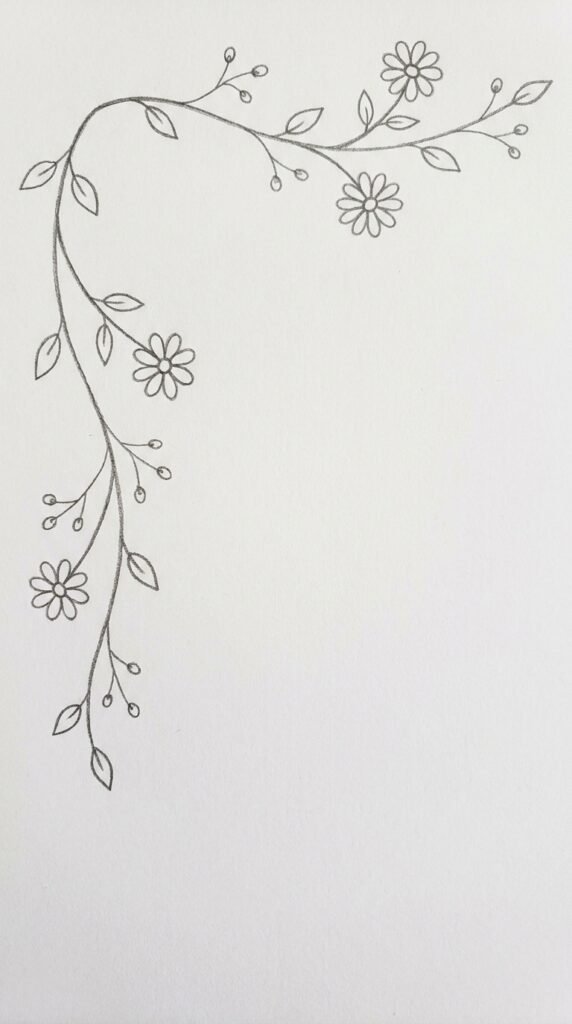
This design transforms the classic daisy into a decorative corner border, making it one of the most practical daisy flower drawing ideas for planners, journal pages, and handmade cards. The design features a curving vine starting from the corner of the page with daisies and leaves arranged along the vine at regular intervals. It is simple, elegant, and endlessly customizable.
Start at the very corner of the page and let the vine curve naturally toward the center of the page edge. You do not need to measure anything; natural hand-drawn curves look more charming than perfectly measured ones.
Step-by-Step Instructions
- Starting from one corner of your paper, draw a gently curving vine line that travels about four to five inches along one edge of the page and then turns and travels another three to four inches along the adjacent edge.
- At three evenly spaced points along the vine, draw short branch lines extending away from the main vine. Each branch should be about one inch long.
- At the end of each branch, draw a small daisy: a small circle center with eight to ten petals radiating outward. These daisies are small, so keep the petals short and neat.
- Add small oval leaves directly on the main vine line at irregular intervals between the daisy branches. Alternate sides so some leaves point left and some point right.
- Add tiny round dot buds on two or three additional short branches along the vine to fill any gaps and add variety to the border design.
Side-View Daisy Profile
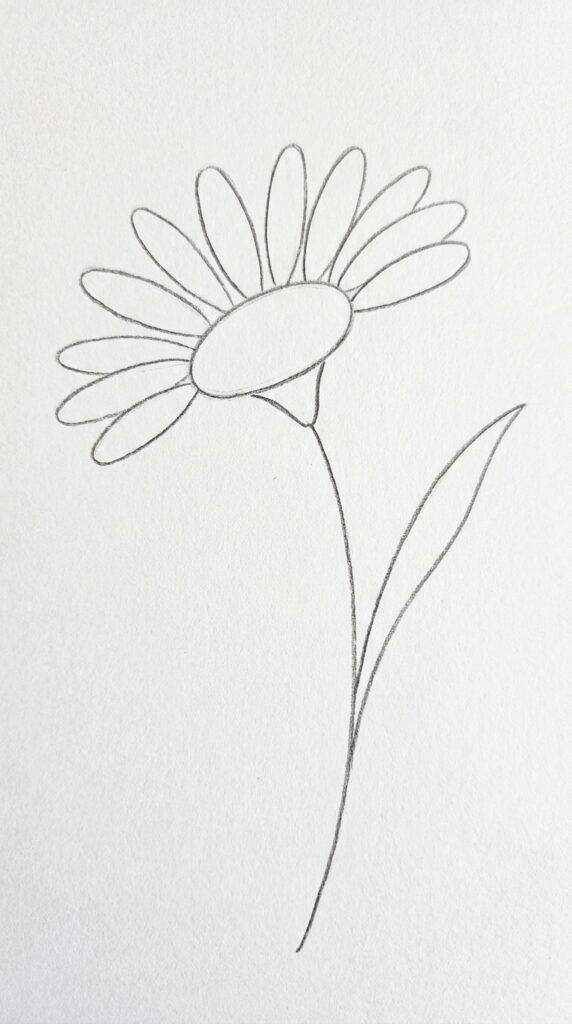
Most daisy drawings show the flower from the front, but drawing a daisy from the side, or in profile, opens up a whole new look that is both elegant and beginner-friendly. In this view, you see the daisy’s petals fanning out from one side of the stem, the center shown as an oval rather than a circle, and the calyx visible at the base of the flower where it meets the stem. This is one of those daisy flower drawing ideas that looks mature and artistic while still using simple shapes.
The side view uses an elongated oval instead of a circle for the center, which creates the illusion of perspective without any complex drawing techniques required.
Step-by-Step Instructions
- Draw a small, slightly flattened horizontal oval near the upper area of your paper. This will serve as the daisy center seen from the side.
- From the far edge of the oval, draw petals that fan outward to one side, curving gently upward and downward from the oval’s edge. Draw about eight to ten petals fanning from left to right, like a half-circle of petals.
- Below the oval, draw a small cup-like shape made of three or four narrow pointed shapes clustered together. This is the calyx, the small green base that holds the flower’s petals in place.
- From the bottom of the calyx, draw a gently curving stem that angles slightly to one side, as a real flower naturally bends under its own weight.
- Add one long, slightly curved leaf near the lower half of the stem, positioned on the side opposite to where the flower faces to create visual balance.
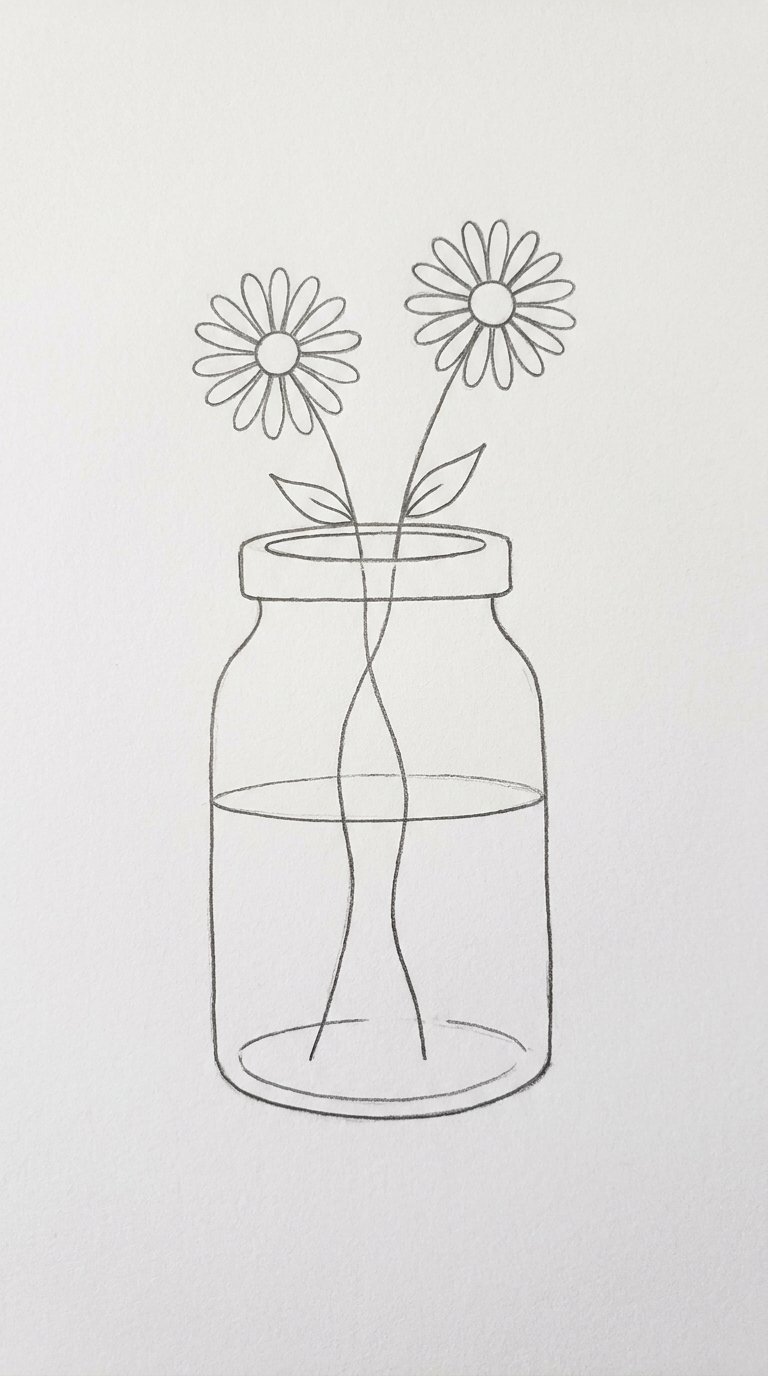
Daisy Inside a Simple Jar Vase
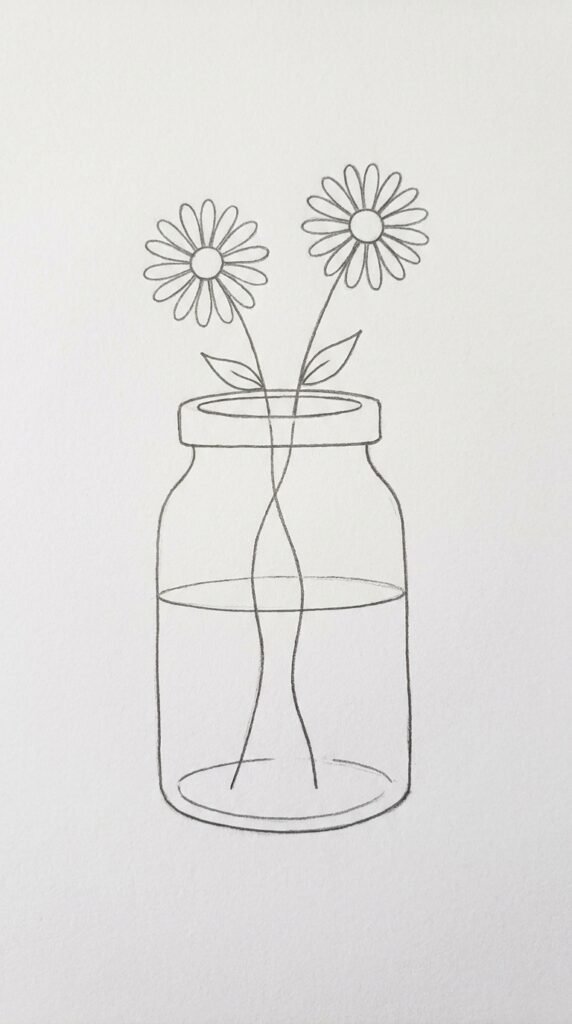
Drawing a daisy inside a glass jar is a cozy, homey concept that translates beautifully onto paper. This scene features a simple jar outline with one or two daisies placed inside it, their stems visible through the jar shape. This is one of the most versatile daisy flower drawing ideas because the jar can be drawn in many different styles, from a simple mason jar to a short round jam jar, and the daisy looks charming in all of them.
To suggest that the jar is glass without adding shading, simply draw the stems and any water line inside the jar using the same pencil lines. The transparency of glass is implied by allowing you to see the stems through the jar walls.
Step-by-Step Instructions
- In the lower portion of your paper, draw the jar shape. Start with a wide oval for the jar opening at the top, then draw two slightly inward-curving lines going down from the oval, and connect them at the bottom with a flat curved line. Add a small rectangular rim at the very top of the oval for the jar’s lip.
- Inside the jar, draw one or two thin vertical stems rising from the bottom of the jar up through the opening and out the top.
- Draw a slight horizontal line inside the jar, crossing both stems, to suggest the waterline inside the jar.
- At the top of each stem above the jar opening, draw a small daisy using a circle center and 12 petals. The two flowers can be at slightly different heights for a natural look.
- Add one or two small leaves on the stems just above the jar opening. Optionally, draw a small oval label shape on the front of the jar as a decorative detail.
Cartoon Daisy Character with Arm and leg
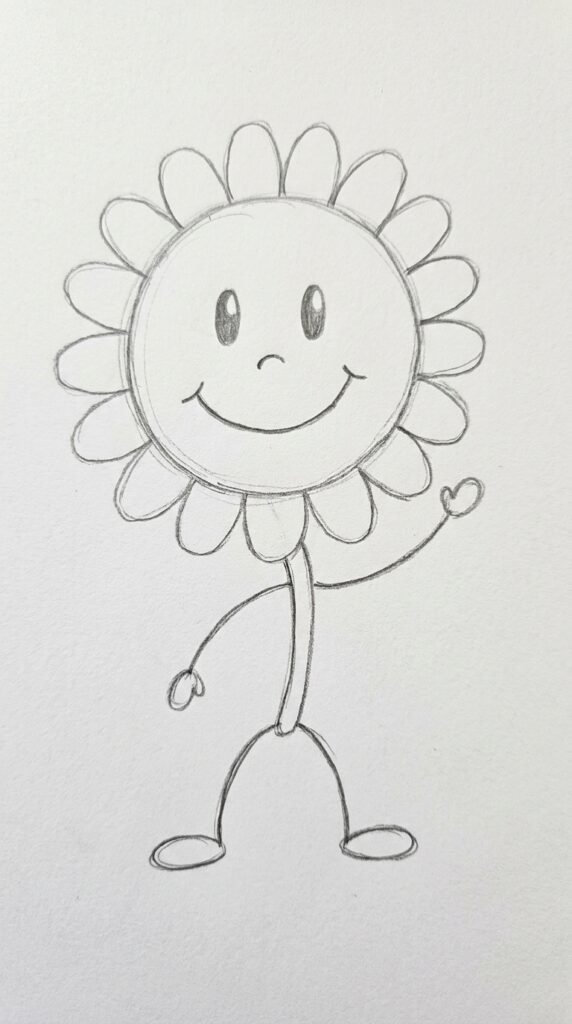
This whimsical idea turns a daisy into a little character by adding simple stick arms, legs, and a facial expression to the flower center. This is by far one of the most kid-friendly daisy flower drawing ideas in this guide and produces a drawing that children absolutely love. The cartoon daisy can be drawn waving, dancing, or simply standing, and every variation looks delightful.
The character works best when the flower center is drawn large enough to fit a clear, expressive face inside it. Do not make the center too small or the face details will be cramped and hard to see.
Step-by-Step Instructions
- Draw a large circle in the middle of your paper. This will be both the daisy center and the character’s face, so it needs to be generously sized, roughly the size of a golf ball.
- Inside the circle, draw two oval eyes with small dot pupils, a small circular nose, and a wide curved smile. Keep the face simple and expressive.
- Add 12 to 14 petals around the outside of the large circle, evenly spaced and each pointing outward.
- Below the circle, draw a short stem that becomes the character’s body, about an inch and a half long. At the bottom of the stem, draw two short curved legs with small oval feet pointing outward.
- On either side of the stem, just below the petal ring, draw two thin stick arms. Bend one arm upward as if the daisy character is waving, and let the other rest slightly downward. Add small round hands at the end of each arm.
Daisy with Decorative Patterned Center
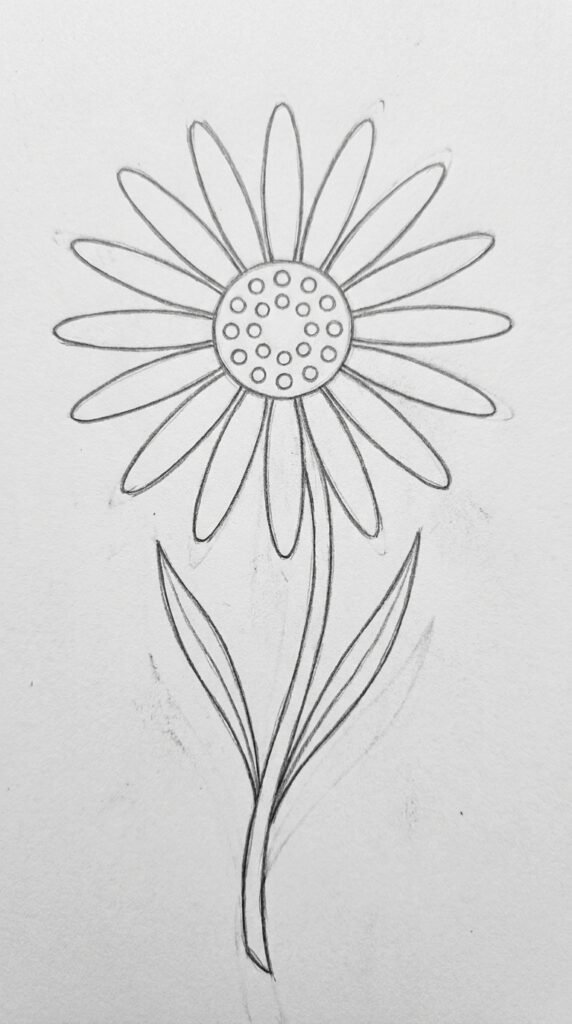
This more creative version of the classic daisy replaces the plain circle center with a center filled with small decorative patterns, making it a wonderful option for more advanced beginners who want to add extra detail to their daisy flower drawing ideas. The patterns inside the center can be tiny circles, small dots arranged in rings, hatched lines, or a honeycomb pattern. Each pattern creates a different mood and visual texture without needing any shading.
The patterns should be drawn very small and neatly. Because you are working inside a circle, lightly penciling the patterns before committing to them is a smart approach to avoid overcrowding.
Step-by-Step Instructions
- Draw a large circle in the center of your paper for the daisy center. Make this circle slightly larger than usual, about the size of a large button, to give yourself enough room for the interior pattern.
- Inside the circle, fill the space with a simple decorative pattern. A good beginner option is to draw five or six small circles arranged in a ring just inside the outer edge of the center circle, with one small circle in the very middle.
- Around the outside of the large center circle, draw 14 to 16 long, narrow petals. These petals should be slightly more elongated than usual to balance the visually busy center.
- Draw a stem of medium length below the flower, with a very slight curve to the right or left to give the flower a natural lean.
- Add two long, narrow leaves with pointed tips along the stem, positioned on opposite sides and at slightly different heights from each other.
Two Daisies Intertwined with Overlapping Stems
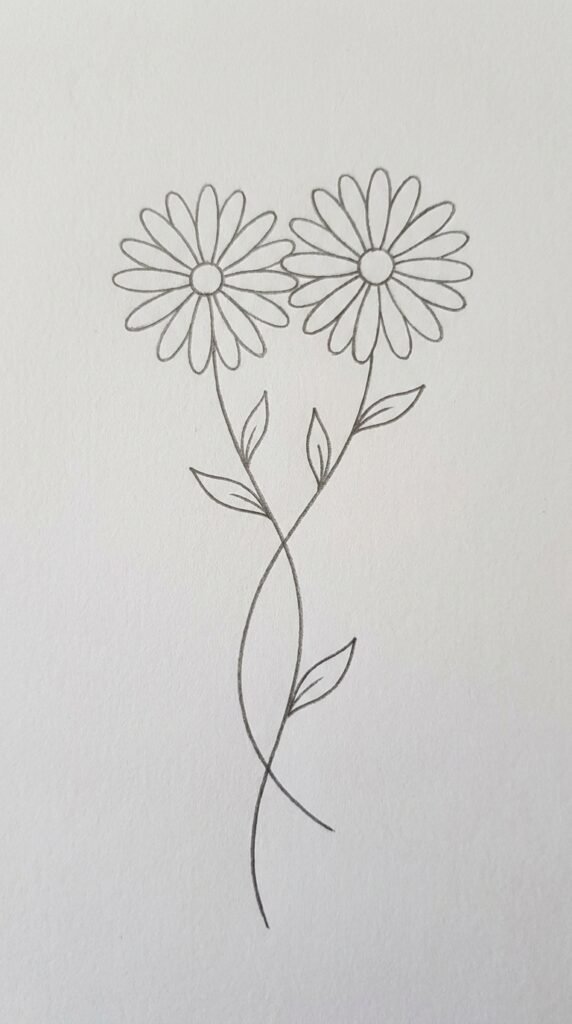
This final design in our daisy flower drawing ideas collection features two daisies growing close together with their stems gently intertwined in a graceful twist. This composition is beautiful and romantic-looking while still being entirely made from simple shapes. The intertwined stems add a sense of motion and connection between the two flowers, making the overall drawing feel dynamic and alive.
The stems do not actually need to be knotted or complicated. Simply crossing them once and having them spiral gently around each other for an inch or so is all it takes to create the intertwined effect.
Step-by-Step Instructions
- Draw two daisies at the top of your paper, side by side and slightly overlapping. The daisy on the left should face slightly left and the one on the right should face slightly right, giving them a natural diverging look. Each daisy has a small circle center and 12 petals.
- Below each daisy, begin drawing the stem downward. For the first inch or two, the stems should remain separate and distinct.
- Where the two stems meet, draw them crossing over each other once, so they form an X shape. Then bring them back together and intertwine them by drawing them spiraling gently around each other for about an inch, like loosely twisted vines.
- Below the twist, bring the two stems back together into a single stem that continues downward. This creates the look of one stem that splits into two at the top.
- Add leaves along the upper portions of each stem before they intertwine, and optionally one or two leaves along the single combined lower stem as well.
Drawing Tips for Better Daisy Flower Sketches
These practical tips will help you get cleaner, more confident results every time you pick up your pencil for daisy flower drawing.
- Always start with a light pencil sketch
- . Press very lightly when drawing your initial shapes so you can erase and adjust easily. You can always darken your lines later once you are happy with the overall composition and proportions.
- Use a light circle guide for the petal ring
- . Before drawing petals, lightly sketch a second circle around the center circle. Use this outer circle as a guide for where the tips of your petals should end. This keeps all your petals at the same length automatically without any measuring.
- Draw opposite petals first to check symmetry
- . Instead of drawing petals one after another going around the circle, try drawing one petal at the top, then one at the bottom, then one on the left, then the right. This cross pattern helps you check that the petals are evenly distributed before you fill in the remaining gaps.
- Hold your pencil further back for smoother strokes
- . When drawing the long petals, hold your HB pencil closer to the eraser end rather than near the tip. This reduces hand tension and produces smoother, more flowing petal strokes that look more natural.
- Vary stem thickness slightly for a natural look
- . Real flower stems are not perfectly uniform in thickness. Allow the stem to be very slightly thicker at the base and thinner as it approaches the flower. This tiny detail makes the drawing look noticeably more natural and less mechanical.
Common Mistakes to Avoid When Drawing Daisies
Even the most enthusiastic beginners make these mistakes. Being aware of them before you start will save you time and frustration.
- Making petals all different sizes.
- Wildly inconsistent petal lengths are the most common issue in beginner daisy drawings. Using the outer circle guide technique described above virtually eliminates this problem and dramatically improves the look of your finished drawing.
- Pressing too hard with the pencil from the star
- t. Heavy pencil pressure at the sketch stage makes it very difficult to erase mistakes cleanly. Always begin with the lightest touch you can manage, then darken your lines only at the final stage when you are sure everything is in the right place.
- Drawing too many petals in too small a space
- . If your center circle is small but you try to fit 20 petals around it, the petals will end up too thin and cramped together. Match your petal count to the size of your center circle. Larger center means more petals can fit comfortably. Smaller center means fewer petals, drawn with more generous spacing.
- Ignoring the stem and leaves
- . Many beginners focus all their energy on the flower head and then rush the stem and leaves. The stem and leaves make up roughly half the visual weight of a daisy drawing. Taking the same care with them as you do with the petals will significantly improve your finished results.
- Giving up after one imperfect attemp
- t. Daisy flower drawing, like any skill, improves dramatically with repetition. Your fifth daisy will look noticeably better than your first. Draw the same design multiple times on a practice sheet before attempting your final piece. The repetition is where the real learning happens.
Frequently Asked Questions
What is the easiest daisy flower drawing idea for absolute beginners?
The classic single daisy with a round center is the easiest starting point for complete beginners. It uses just a circle for the center and long narrow petals arranged around it, both of which are extremely simple shapes that require no special skills. Once you can draw this comfortably, all the other daisy flower drawing ideas in this list become much easier to attempt because they all build on the same foundation.
How do I make daisy petals look even without a ruler?
The best method is to lightly sketch two circles before you begin drawing petals: a small circle for the center and a larger circle at the distance you want your petal tips to reach. Then draw your petals between these two guide circles. Using the cross-pattern approach, where you draw petals at the top, bottom, left, and right first before filling in the gaps, also helps maintain even spacing without any measuring tools.
Can young children follow these daisy flower drawing ideas?
Yes, absolutely. Most of the ideas in this guide are suitable for children aged 6 and up, and some, like the cartoon daisy character and the cute smiley face daisy, are specifically designed with children in mind. The step-by-step format breaks each drawing into very small actions so that young artists can follow along at their own pace without feeling overwhelmed. A regular HB pencil and plain white paper are all they need.
Do I need to use shading to make my daisy drawing look good?
Not at all. Every single daisy flower drawing idea in this guide is designed to look beautiful using clean pencil outlines only, with no shading required. Simple outline drawings with consistent line thickness and good proportions can look just as impressive, and often more charming, than shaded versions. Shading is an additional skill you can explore later once you are comfortable with the basic drawing structures.