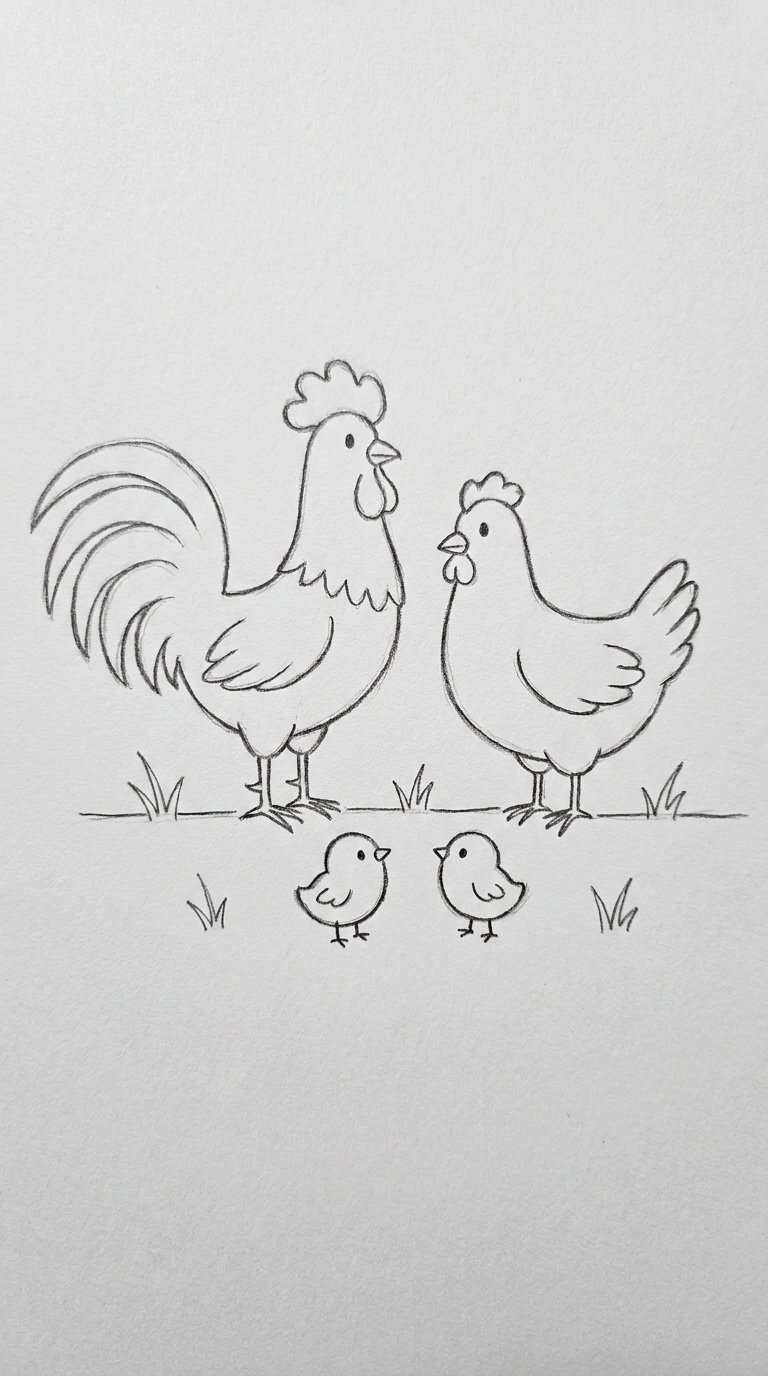
If you have ever wanted to draw a chicken but did not know where to start, you are in exactly the right place. Chickens look complicated at first because of their feathers, beaks, and funny little bodies, but the truth is that they are one of the most beginner-friendly animals you can draw once you break them down into simple shapes. A chicken body is mostly made of ovals and circles. The tail is a cluster of curved lines. The beak is a small triangle. That is really all you need to get started.
This collection of 12 chicken drawing ideas is designed for complete beginners, including kids, students, and adult hobbyists who want a fun and relaxed sketching session. Every idea on this list uses simple shapes as the foundation. You do not need to know how to shade, blend, or use color to complete any of these drawings. A standard HB pencil and a blank piece of paper are all the supplies required.
Each drawing idea comes with a clear step-by-step guide that explains where to place each part of the drawing and how large each shape should be. Whether you want to draw a cartoon rooster, a baby chick, a hen sitting on eggs, or a whole flock walking around a farm, this list has something for every skill level and interest.
These chicken drawing ideas are also great for Pinterest sketchbook pages, art class warm-ups, greeting cards, journal doodles, and nature study notebooks. Chickens are expressive, charming, and full of personality, which makes them incredibly fun to draw in many different poses and styles.
Work through the list one drawing at a time, and by the end you will have a full sketchbook page of beautiful, simple chicken illustrations you can feel proud of. Let us get started.
MAIN CONTENT
Simple Side View Hen
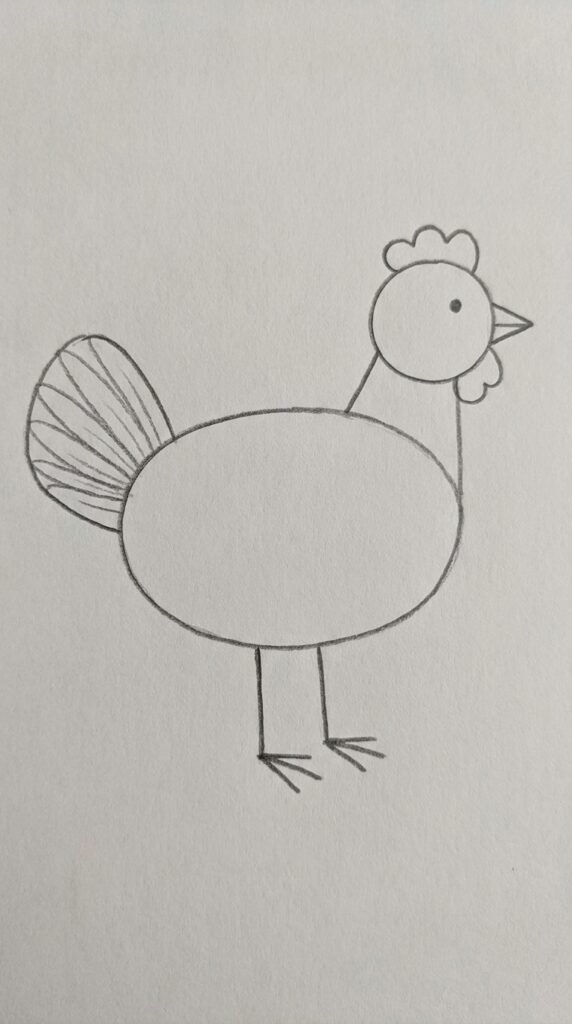
A side view hen is the most classic chicken pose and the best starting point for any beginner. This drawing captures the round, plump shape of a laying hen at rest. It looks impressive on the page but only requires three basic shapes to build. This is a good first drawing if you are new to sketching animals because the proportions are forgiving and easy to adjust.
Step-by-Step Instructions:
- Draw a large oval in the center of your paper, slightly tilted so the left side sits lower than the right. This is the body. Make it about 4 inches wide and 3 inches tall.
- Add a smaller circle at the upper right end of the oval, overlapping slightly, for the head. The head should be about one-third the size of the body oval.
- Draw a short curved neck connecting the head to the body using two gently curving lines on each side.
- Add a small pointed triangle for the beak on the right side of the head, pointing outward. Draw a small circle inside the head for the eye, just above the beak.
- Draw two thin, slightly spread legs descending from the bottom center of the body. Add three forward-pointing toes and one small back toe on each foot.
Cartoon Rooster Standing Tall
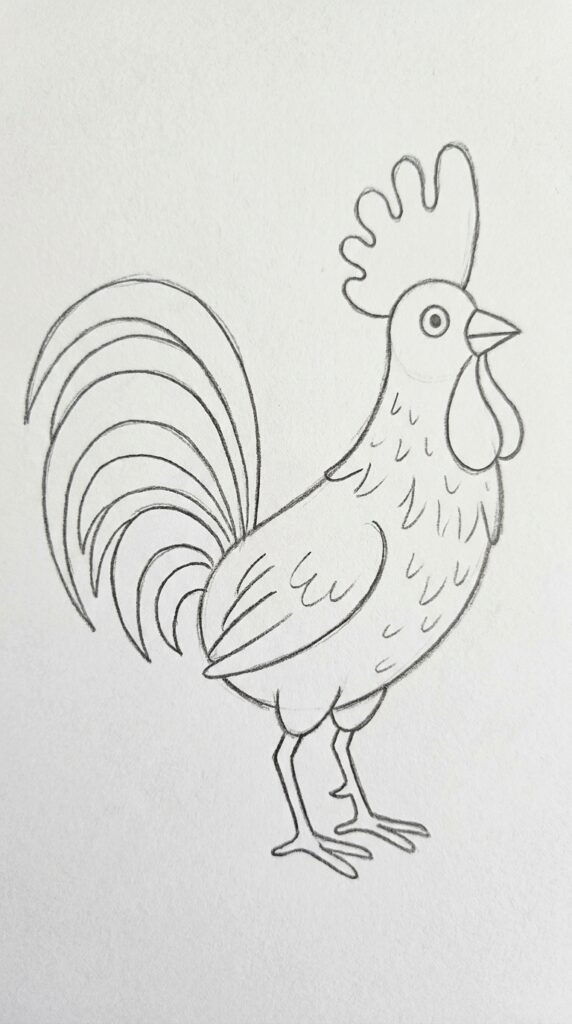
A rooster standing upright is a bold and fun drawing that beginners love because the large dramatic tail makes the finished piece look very detailed even though the steps are simple. The upright posture and big fan tail give this drawing a lot of visual personality.
Step-by-Step Instructions:
- Draw a medium oval in the lower center of the paper for the body. Tilt it so it leans slightly forward, with the top edge angled toward the right.
- Draw a small circle above and slightly to the right of the body for the head. Leave a small gap between the head and body, then connect them with two short curved lines for the neck.
- Add a sharp triangular beak on the right side of the head. Draw a small circle for the eye just behind the beak, and add a curved line below the eye to suggest a slightly puffed cheek.
- Draw a large, dramatic comb on top of the head using four or five tall rounded bumps. Add a long flowing wattle under the beak, shaped like a curved teardrop.
- On the left side of the body, draw a large fan-shaped tail made of several long curved feather lines spreading upward and outward. Make the tail feathers longer than the body for a dramatic look.
Baby Chick Hatching from Egg
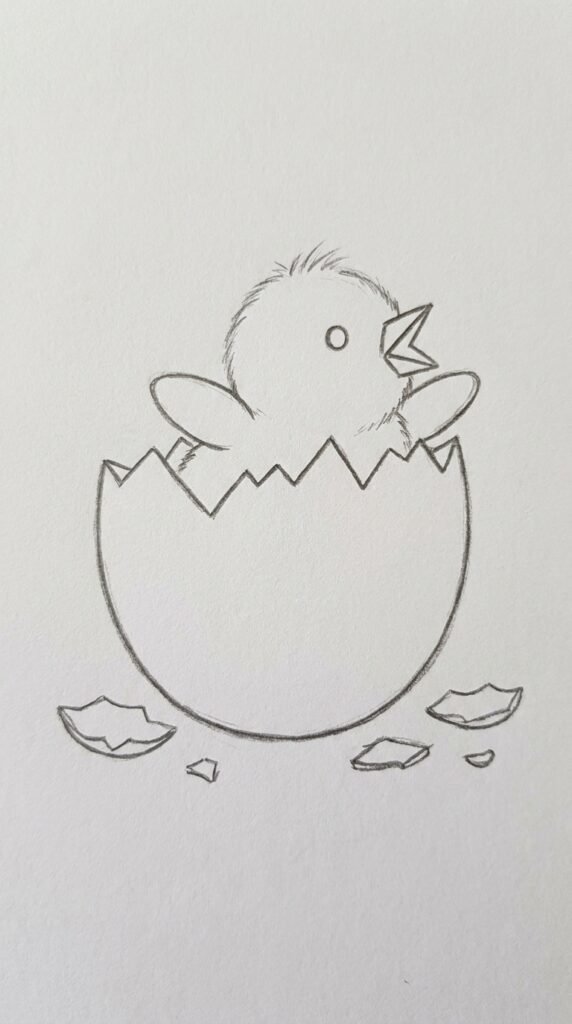
This drawing is a fan favorite for kids and adult beginners alike. A baby chick peeking out of a cracked eggshell is expressive, simple, and adorable. The egg shape is one of the easiest forms to draw, and the tiny chick only requires a circle and a beak.
Step-by-Step Instructions:
- Draw a large egg shape in the center of your paper. An egg shape is like an oval but slightly narrower at the top and rounder at the bottom. Make it about 3 inches tall.
- Draw a zigzag crack line across the upper third of the egg. The crack should be uneven and jagged to look natural.
- Above the crack, draw the top half of a small circle peeking out. This is the chick’s head emerging from the shell.
- Add two small oval wings on either side of the chick’s body, just barely visible above the crack line, as if the chick is pushing itself out.
- Draw a small open beak on the front of the chick’s head. Use two short angled lines meeting at a point to form the beak in an open position.
Fluffy Bantam Hen in Three-Quarter View
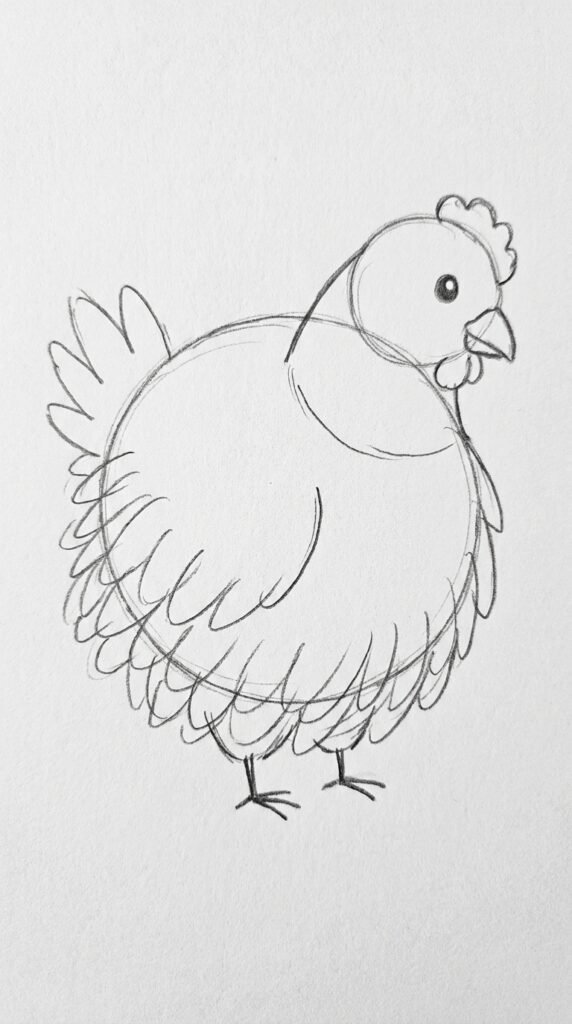
A bantam hen is a small, round, fluffy chicken breed that translates beautifully into a simple drawing. The three-quarter view gives the drawing a bit more depth than a flat side view, making it look more interesting and lively on the page.
Step-by-Step Instructions:
- Draw a large round circle slightly off-center on your paper. This will be the body. Because bantams are fluffy and compact, the body is rounder than a regular hen.
- Draw a smaller circle at the upper right area of the body, overlapping slightly, for the head. Make it about one-quarter the size of the body.
- Connect the head and body with two short curved neck lines. Because of the three-quarter view, the neck should be slightly wider on the left than the right.
- Add a small stubby beak angled slightly downward and to the right. Draw a round eye above the beak. Add a small round comb and a tiny wattle.
- Draw several overlapping curved lines around the lower body to suggest layers of fluffy feathers spreading outward like a puffed skirt.
Hen Sitting on a Nest
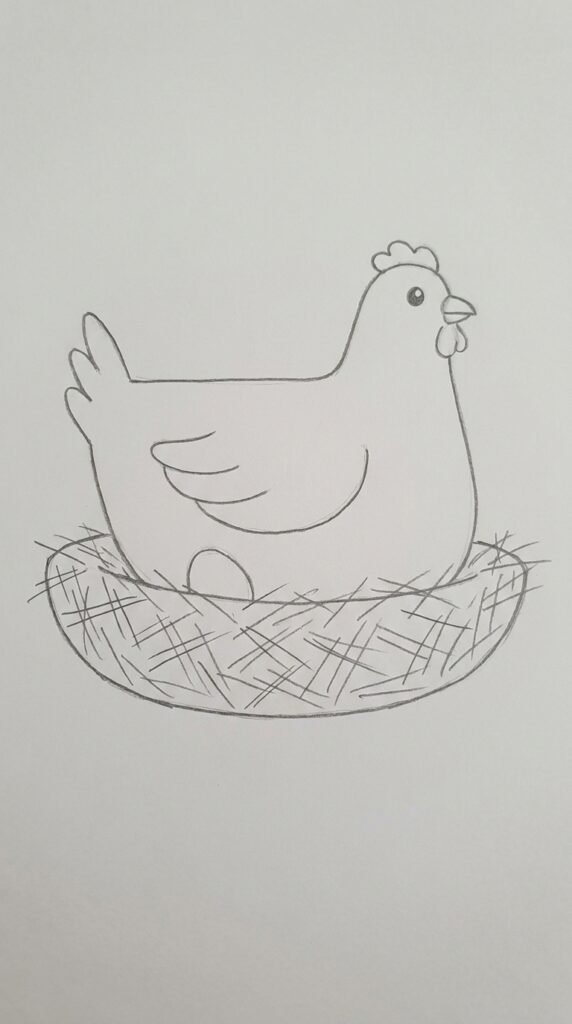
This peaceful and charming drawing shows a hen settled comfortably on top of a round nest. It is a very recognizable scene and a wonderful addition to any farm-themed sketchbook page. The nest itself is drawn using simple oval and cross-hatch line techniques.
Step-by-Step Instructions:
- At the bottom of your drawing area, draw a wide shallow oval for the nest. It should be wider than it is tall, like a flattened bowl.
- Fill the nest with a loose grid of short crossing lines to suggest woven straw. Keep the lines light and uneven so the nest looks natural rather than mechanical.
- On top of the nest, draw a large rounded body shape that is wider at the base and slightly narrower at the top. This is the hen settling down, so her body looks spread and flat.
- Add a small round head in the upper right area, connected by a short neck. Add a small beak, round eye, comb, and wattle.
- On each side of the body, draw the suggestion of wings folded flat. Use a few gentle curved lines along the sides of the body.
Rooster Head Close-Up Portrait
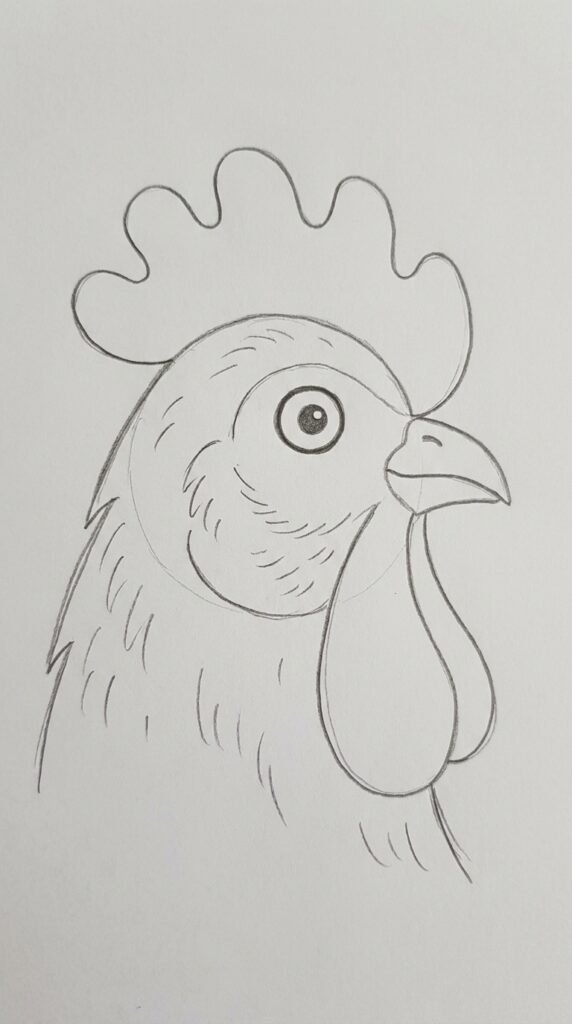
Drawing just the head of a rooster is a wonderful exercise in detail and a striking image on its own. The large comb, dramatic wattle, sharp beak, and proud eye make for a bold and satisfying portrait that is still very simple to complete step by step.
Step-by-Step Instructions:
- Draw a medium circle in the center of your paper for the rooster’s head. Make it larger than you might think necessary because you need room to add details around it.
- Add a large, dramatic comb on top of the circle. Draw five or six tall rounded bumps in a row, with the tallest bumps in the middle and shorter ones on each end.
- Draw a short, strong beak on the right side of the circle. Use two curved lines to form a top and bottom beak, with the top beak curving downward at the tip.
- Add a bold circular eye just above and behind the beak. Draw a small pupil inside and a tiny highlight circle to give the eye expression.
- Below the beak, draw a long flowing wattle using two curved teardrop shapes hanging downward and overlapping slightly.
Two Chicks Walking Together
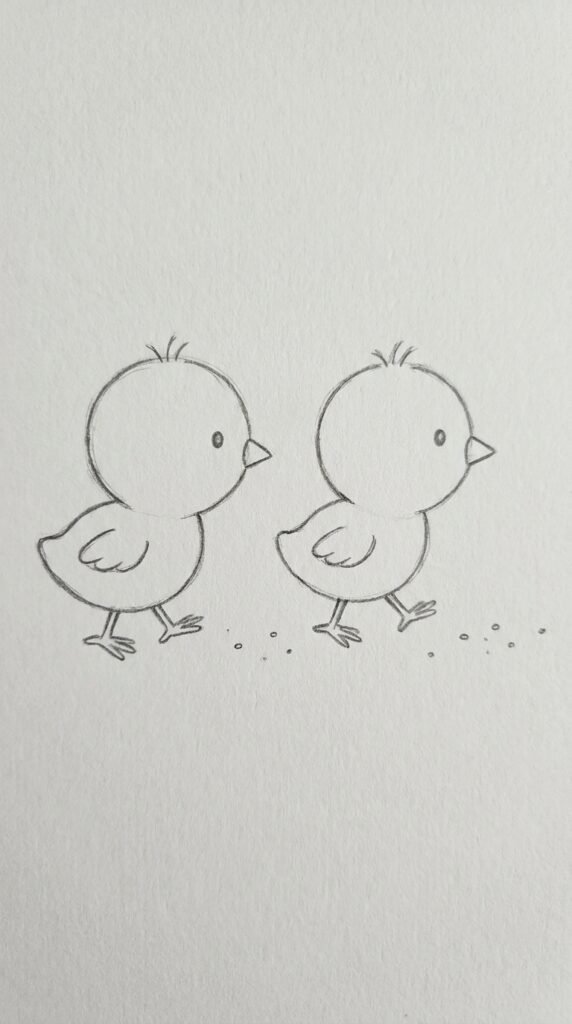
Drawing a pair of chicks side by side adds a sweet narrative to your sketchbook page. One chick leads while the other follows, creating a sense of movement and story. This drawing is excellent for practicing repeated shapes and spacing.
Step-by-Step Instructions:
- Draw two small oval body shapes near the lower center of your paper. Place them side by side with a small gap between them. The left chick should be slightly ahead of the right one.
- For each chick, add a round circle head on top of the oval body, slightly overlapping. The head should be nearly as large as the body because chicks have proportionally large heads.
- On each head, draw a small pointed beak on the forward-facing side and a tiny circular eye just behind the beak.
- Add two short, thin legs beneath each chick body. Draw three simple forward-pointing toes on each foot.
- On each body, draw two small oval wing shapes on the sides to suggest tiny developing wings.
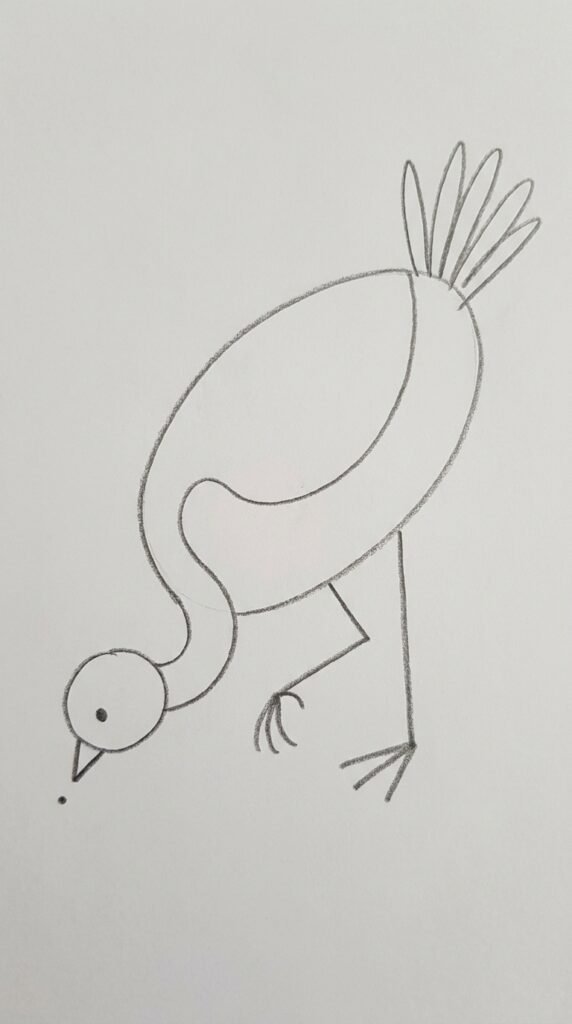
Chicken Pecking at the Ground
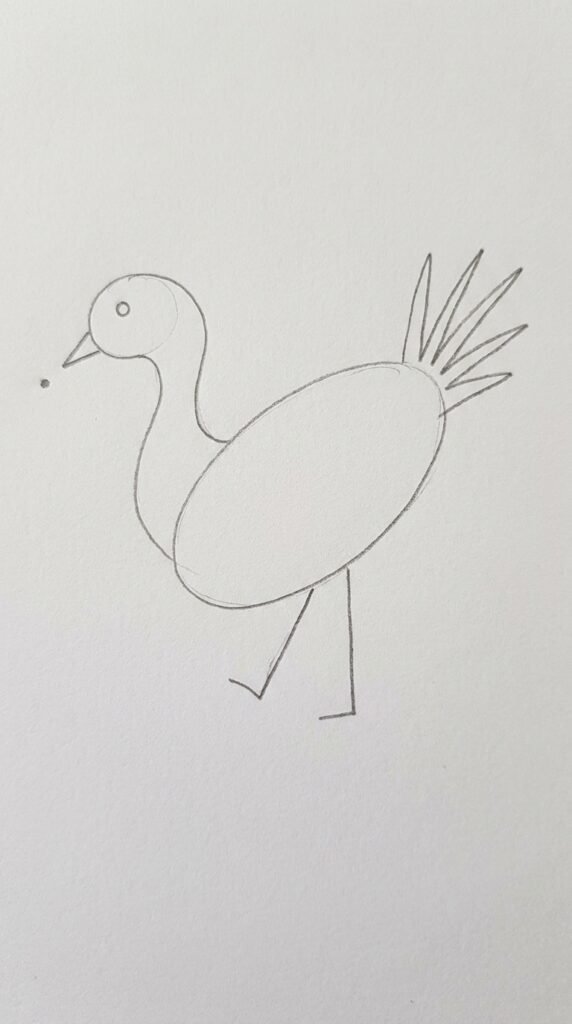
A chicken with its head bent forward toward the ground is one of the most natural and lively poses you can draw. This posture is immediately recognizable and tells a clear story of a bird looking for food. The curved neck in this pose is the main drawing challenge and is explained clearly below.
Step-by-Step Instructions:
- Draw a large oval body in the center of your paper, tilted so the front is angled downward and the back is higher. This tilt is the key to capturing the pecking posture.
- From the lower front end of the tilted body, draw a curved neck that swoops downward toward the bottom of the page. The neck should be S-shaped, curving forward and then angling the head toward the ground.
- At the end of the neck, draw a small flat circle for the head, oriented almost horizontally since the chicken is looking down.
- Add a small sharp beak pointing directly downward, as if touching the ground. Draw a small eye on the upper side of the head.
- Draw two legs beneath the body. Make one leg slightly bent forward and the other straight to suggest the shifting weight of a bird moving and pecking
Cartoon Chicken Family Scene
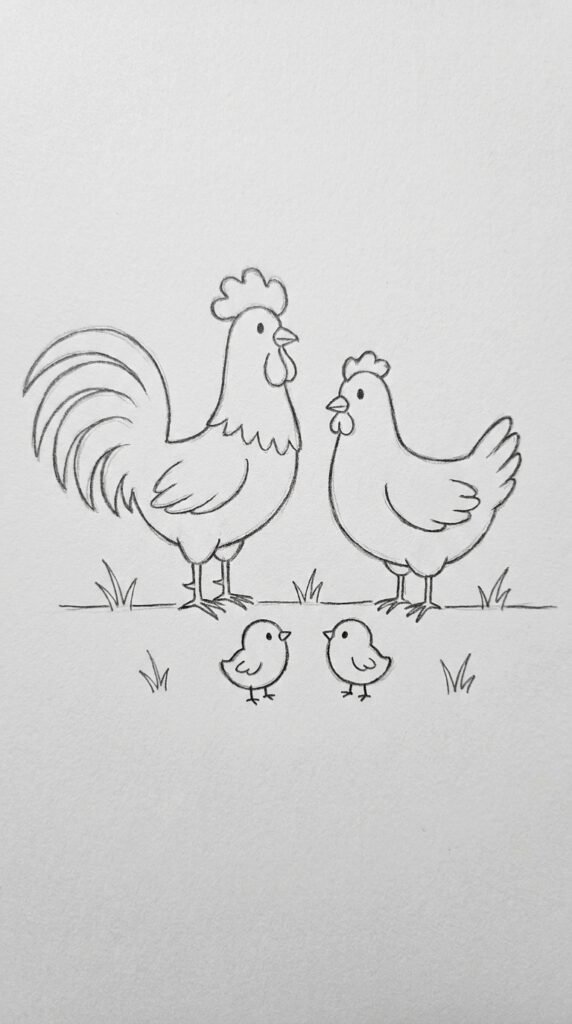
Drawing a full chicken family together is a rewarding project that combines multiple simple chicken drawings into one cohesive scene. This drawing features a rooster, a hen, and two chicks together, making it perfect for a full sketchbook page or a greeting card illustration.
Step-by-Step Instructions:
- Plan the placement first. Sketch a light horizontal ground line across the lower third of your paper. The rooster will stand at the left, the hen in the center-right, and the two chicks near the front center.
- Draw the rooster first using a tall upright oval body with a dramatic fan tail and tall comb. Make him the largest figure in the scene.
- Draw the hen next using a round, slightly smaller oval body with a modest tail and smaller comb. Place her to the right of the rooster, facing the same direction.
- Add the two small chicks near the bottom center of the scene. Make them much smaller than the adults, with large round heads and tiny bodies. Face them in slightly different directions for a natural look.
- Add feet and ground contact lines for each bird so they all appear to be standing on the same ground plane
Chicken Standing on a Fence Post
This drawing adds an environmental element by placing a single chicken perched on top of a wooden fence post. It is a classic farm image and a great exercise in combining a figure with a simple prop or background element.
Step-by-Step Instructions:
- Draw a short rectangular post in the lower center of your paper. The post should be about 1.5 inches wide and 2 inches tall, with a flat or slightly angled top.
- On top of the post, draw a horizontal fence rail extending to both sides of the post. Use two parallel horizontal lines to give the rail some thickness.
- On top of the post, draw a medium oval body for the chicken. The chicken should appear to be balancing, so position the body centered over the post top.
- Add a round head at the upper right of the body with a short neck connection. Add a small beak, eye, comb, and wattle.
- Draw two gripping feet curling around the top edges of the post. Show three forward-curling toes on each foot to suggest the chicken is gripping the post.
Chicken Seen from the Front
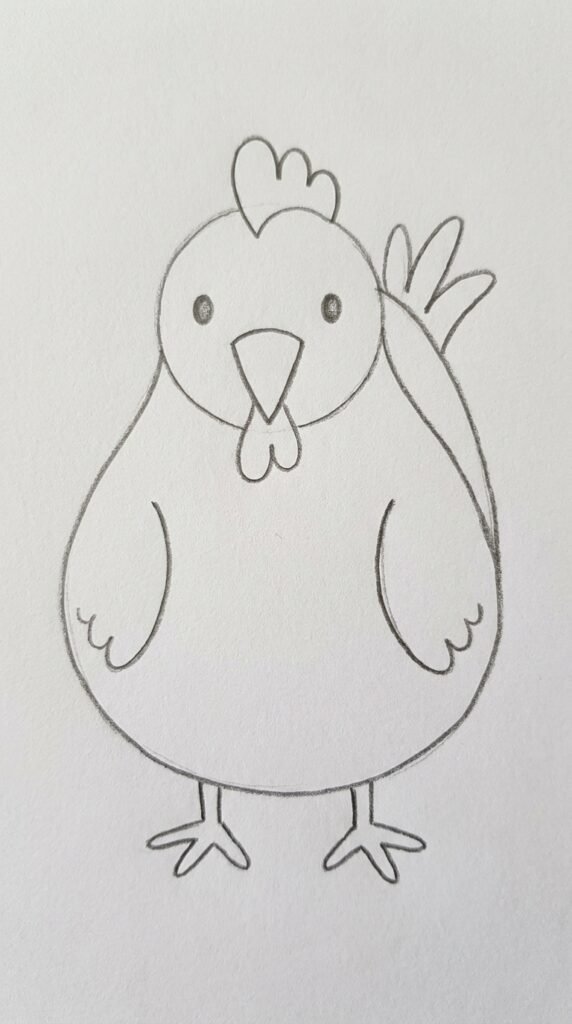
Drawing a chicken from the front is a unique perspective that most beginners never try, but it produces a funny, wide-eyed portrait that is immediately charming. The front view requires a slightly different set of shapes than the side view.
Step-by-Step Instructions:
- Draw a large teardrop or pear shape in the center of your paper for the body as seen from the front. The shape should be wider at the bottom and narrower at the top.
- Add a small round circle at the top of the teardrop for the head, overlapping the top edge of the body slightly.
- Draw a small triangular beak in the center of the head, pointing straight downward. Add two circular eyes, one on each side of the head, placed symmetrically.
- Draw a comb on top of the head with three rounded bumps, centered. Add a small wattle below the beak.
- On each side of the wide lower body, draw a wing shape that curves outward from the body, like two curved parentheses facing each other.
Sleeping Chicken with Tucked Head
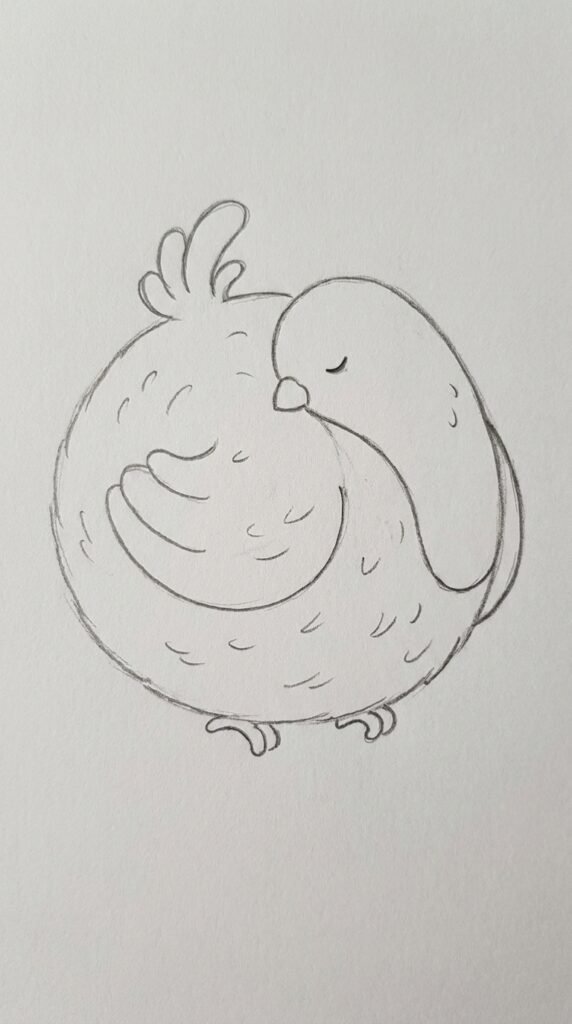
A sleeping chicken is a peaceful and endearing subject. In this posture, the chicken tucks its head under one wing, creating a very distinctive round silhouette that is simple to draw and recognizable at a glance.
Step-by-Step Instructions:
- Draw a large round circle for the sleeping chicken body. Because the bird is fluffed up and relaxed, the body is rounder and more compact than usual.
- On the right side of the body circle, draw a wing shape that curves around and over the front, as if the head is tucked underneath. Use a curved line that arcs from the top of the circle and sweeps down to the center right.
- Where the wing meets the body, draw a small rounded shape partially visible to suggest the tucked head. Add a barely visible small closed eye on this shape.
- On the left side, draw another wing outline folded flat against the body using two gentle curved lines following the body shape.
- Add a small fan of tail feathers at the top-back of the circle, curling upward gently..
DRAWING TIPS SECTION
Drawing chickens becomes much easier when you always start with the largest shape first and work toward the smallest details. The body oval or circle is always your anchor. Every other part of the drawing, including the head, tail, legs, and beak, connects to and relates to that central body shape. If you draw the beak first, you will almost certainly end up with a chicken that looks unbalanced.
Keep your pencil pressure light during the early stages of any drawing. Use very gentle lines to sketch the basic shapes. This makes it easy to erase and adjust without leaving marks on your paper. Only press harder with your pencil once you are happy with the proportions and placement of all the major shapes.
Practice drawing the oval and circle shapes separately on a scrap piece of paper before you begin a drawing. Freehand oval drawing is a skill that improves with repetition and directly affects how satisfying your chicken drawings look.
Study the proportions of a real chicken. The head is surprisingly small compared to the body. The legs are very thin. The tail feathers can be quite dramatic on roosters. Knowing these basic proportional facts will help every drawing feel more accurate even when drawn in a simplified style.
COMMON MISTAKES SECTION
The most common mistake beginners make when drawing chickens is making the head too large relative to the body. A chicken’s head is small. If your chicken looks like a cartoon character with a huge head, shrink the head circle and the drawing will immediately improve.
Another frequent issue is drawing the legs too thick or too short. Chicken legs are long, thin, and slightly bent at the joint. Many beginners draw short stubby legs that make the chicken look like it is floating above the ground. Extend your leg lines further down the page than you think is necessary.
Beginners often forget to tilt the body oval. A flat horizontal oval creates a stiff, static-looking chicken. A slight tilt to the body gives the drawing life and a sense of posture and personality.
Rushing through the tail feathers is another common mistake. The tail is one of the most distinctive features of a chicken drawing and deserves attention. Draw each feather line separately rather than trying to draw the whole tail in one hasty stroke.
FAQ SECTION
What is the easiest chicken to draw for absolute beginners?
The easiest chicken drawing for beginners is the simple side view hen. It uses only three basic shapes, an oval for the body, a circle for the head, and a fan of curved lines for the tail, and it produces a recognizable and satisfying result even on the first attempt.
Do I need special pencils to draw these chicken drawing ideas?
No special pencils are required. A standard HB pencil works perfectly for all the drawings in this collection. An HB pencil gives you enough darkness to see your lines clearly while remaining easy to erase during the early stages of sketching.
How do I make my chicken drawing look less stiff?
The key to making a chicken drawing look natural and lively is to tilt the body oval slightly rather than keeping it perfectly horizontal, and to vary the thickness and curvature of your lines slightly as you draw. Small imperfections actually make drawings look more organic and hand-drawn.
Can young children complete these chicken drawing ideas?
Yes, most of the drawings in this collection are suitable for children aged six and older with basic pencil control. The baby chick, simple side view hen, and sleeping chicken are the three most beginner-friendly options for younger artists because they involve the fewest steps and most forgiving proportions.