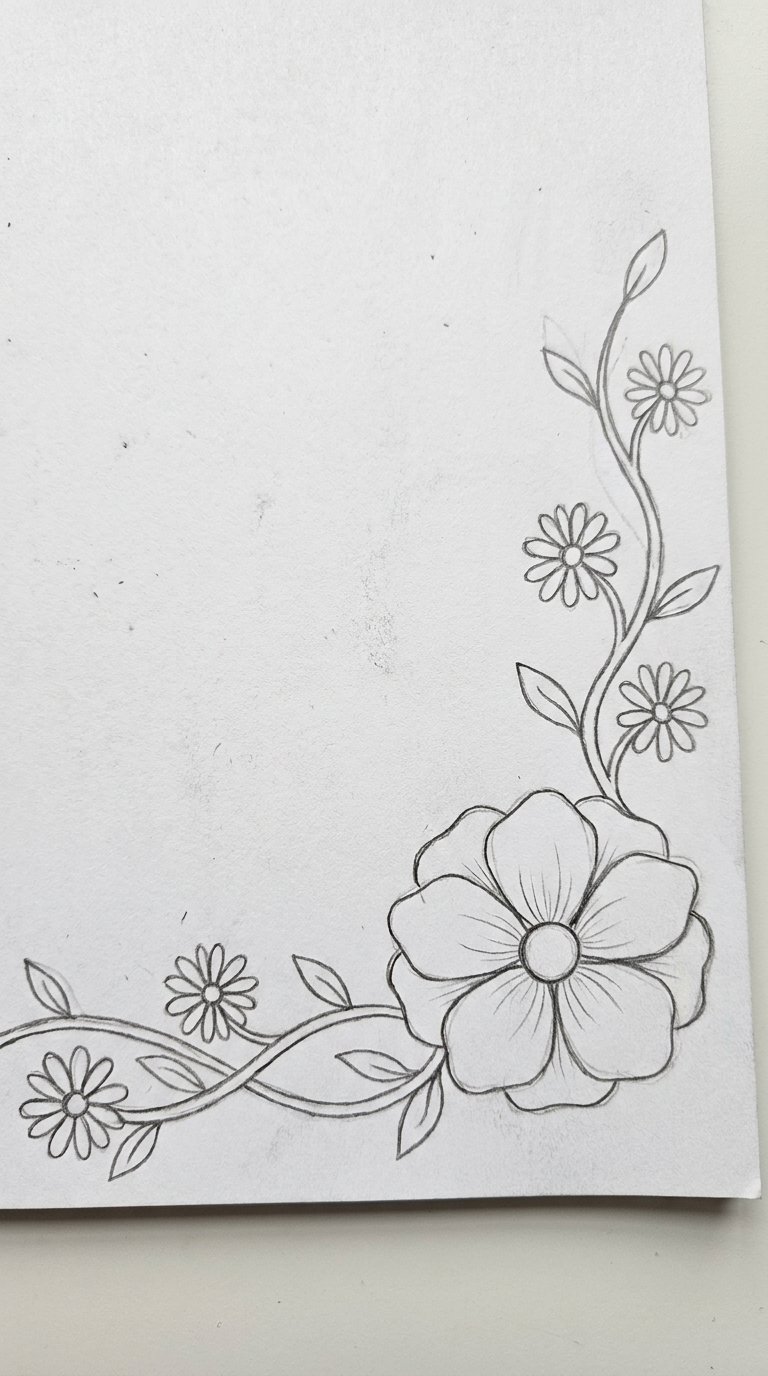
If you have ever looked at an anemone flower and thought it was too complicated to draw, you are not alone. With its delicate petals radiating outward and its distinctive dark center, the anemone can feel a little intimidating at first glance. But here is the good news: once you break it down into simple circles, curved lines, and petal shapes, it becomes one of the most enjoyable flowers you will ever draw.
This guide gives you 13 anemone flower drawing ideas that are completely beginner-friendly. Whether you are a child picking up a pencil for the first time, a student filling a sketchbook, or an adult exploring botanical art as a hobby, these ideas are designed to meet you exactly where you are. Every single idea uses basic shapes like ovals, teardrops, and rounded petals. There is no complicated shading required, and you do not need any special supplies beyond a pencil and a piece of paper.
Anemone flowers are a popular subject on Pinterest because they look elegant but are surprisingly simple to recreate. They work beautifully in sketchbooks, journals, greeting card designs, and nature illustration projects. You can draw them alone, pair them with leaves, cluster them into bouquets, or use them as borders and page decorations.
Each idea in this article comes with a clear step-by-step guide, an image description, and a detailed prompt so you know exactly what to draw. By the end of this article, you will have 13 fresh anemone flower drawing ideas ready to try, along with tips, common mistakes to avoid, and answers to the most frequently asked questions. Let us get started.
Classic Single Anemone Bloom
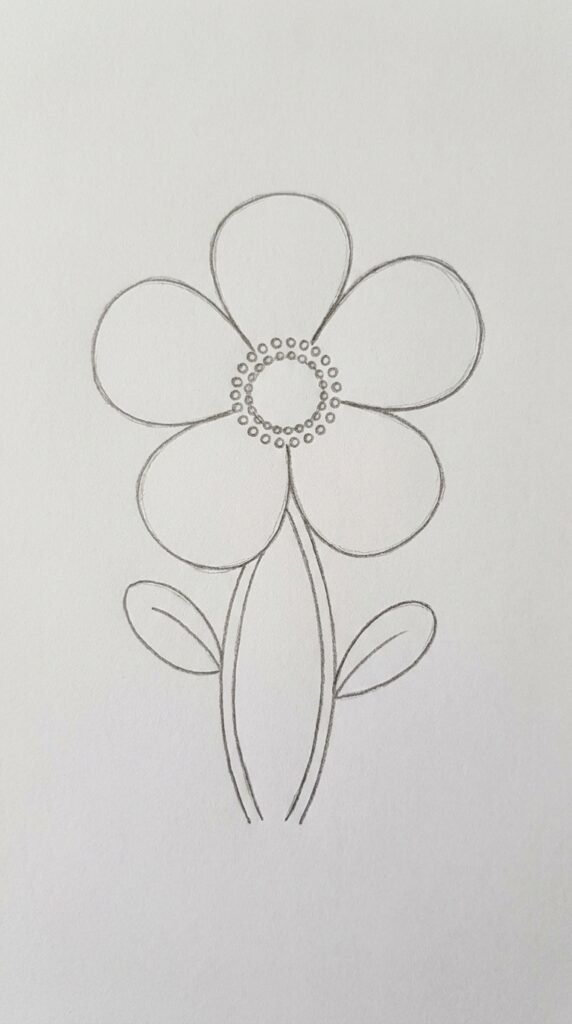
The classic single anemone is the best place to start if you are new to drawing this flower. It features five to six broad, rounded petals fanning out from a circular center filled with small dots or short lines. This drawing teaches you the basic structure of an anemone and helps you practice petal spacing. Once you can draw this version confidently, every other idea in this list will feel much easier.
Step-by-Step Instructions:
- Draw a small circle in the center of your paper, roughly the size of a large coin. This is the flower center.
- Around the circle, draw five rounded petals. Each petal should be about twice as wide as the center circle and slightly cupped at the tip. Space them evenly like a clock.
- Add a second layer of two or three smaller petals peeking out from behind the first layer, placed between the main petals.
- Inside the center circle, draw a cluster of small dots arranged in a ring, leaving a small oval shape open in the very middle.
- Draw two thin curved stems below the flower, and add a few simple oval leaves along the stem.
Side-View Anemone Sketch
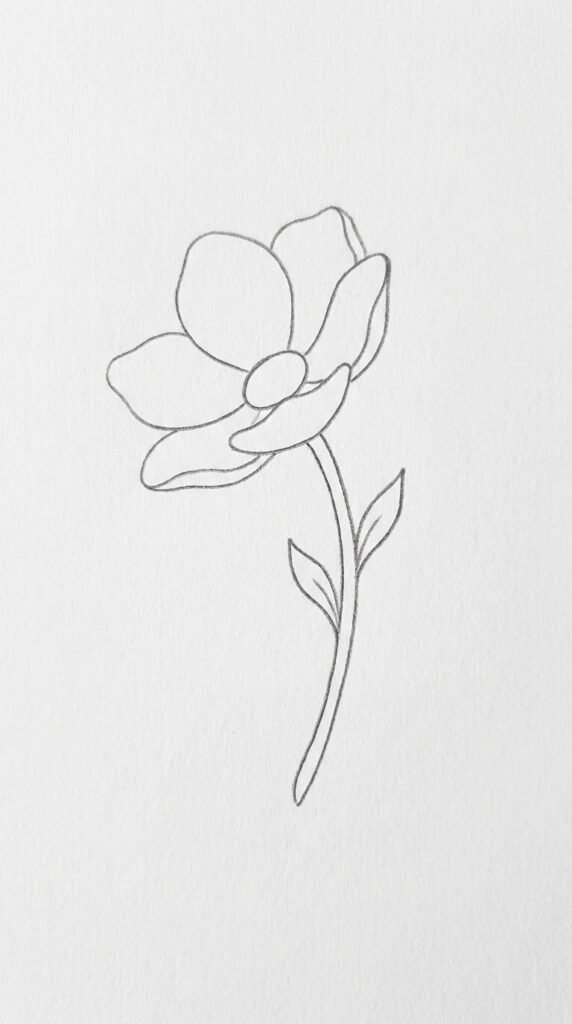
Drawing a flower from the side is a great skill to learn because it adds variety to any sketchbook page or floral arrangement. The side-view anemone shows the flower tilting slightly, revealing only part of the petal structure and giving a sense of depth without any shading. This is a popular pose for botanical illustrations and Pinterest flower art.
Step-by-Step Instructions:
- Draw a small oval slightly tilted to one side near the upper middle of your paper. This represents the flower center seen from the side.
- On the left and right sides of the oval, draw three to four petals curving outward. The petals on the near side should appear wider and the petals curving away should appear slightly narrower.
- Add two or three petals at the back of the flower that are partially hidden, showing only their curved upper edges above the center.
- Draw short parallel lines inside the oval to indicate the center texture.
- Extend a curved stem downward from the base of the flower and add one or two leaves growing from the stem.
Anemone Bud Drawing
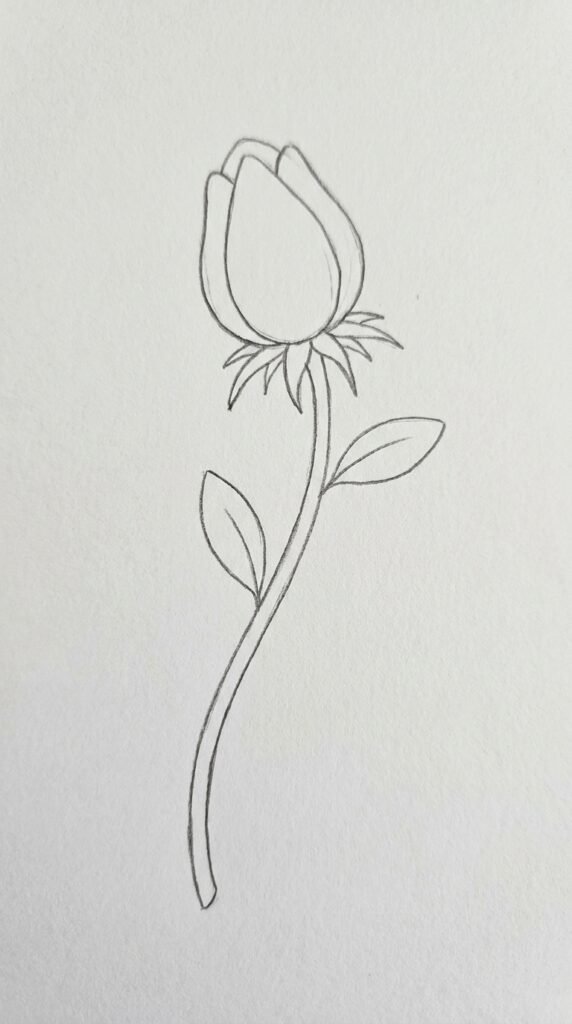
Not every flower needs to be fully open. Drawing a closed or partially open anemone bud is a wonderful skill that makes your floral compositions look more natural and complete. Buds are simpler than full blooms because you are drawing fewer petals, making this a great confidence builder for beginners.
Step-by-Step Instructions:
- Draw a small teardrop shape pointing upward in the center of your paper. This is the closed bud.
- Around the bottom half of the teardrop, draw three or four small curved petals just beginning to open. They should hug the teardrop shape closely.
- At the very base where the petals meet the stem, add three to four pointed sepals spreading outward like a small star.
- Draw a long, slightly curved stem extending downward from the sepals.
- Add two simple leaves attached to the stem, each one an elongated oval with a central vein line drawn down the middle.
Anemone Flower with Detailed Center
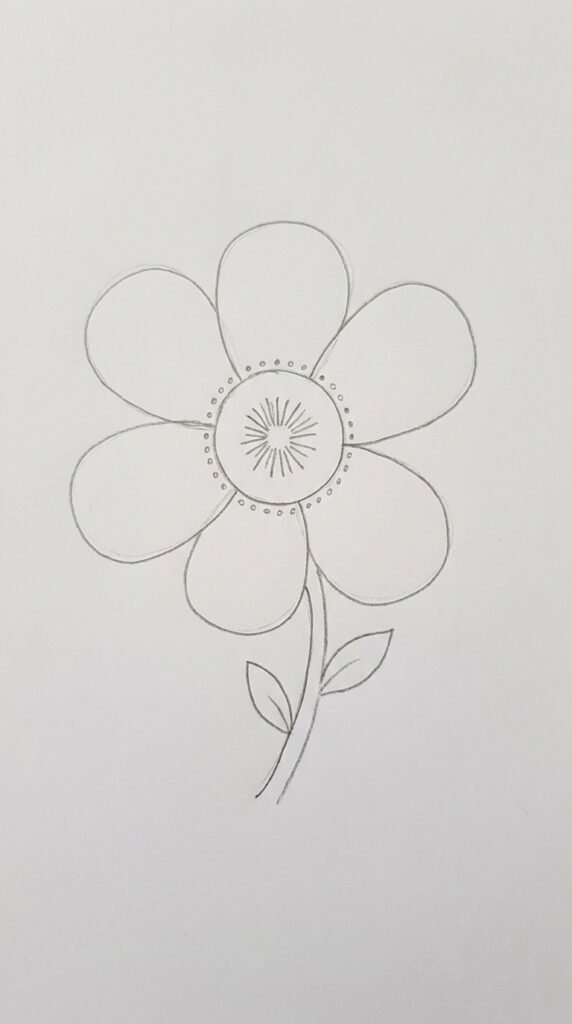
The center of an anemone is one of its most recognizable features. This drawing idea zooms in on that detail, giving you a chance to practice drawing stamens, pollen dots, and the layered look of the inner flower. Even though it sounds complex, you are still using only simple circles and short lines.
Step-by-Step Instructions:
- Draw a medium circle in the center of your page, larger than usual. This will become the detailed flower center.
- Inside the circle, draw a smaller inner circle. Fill the ring between the two circles with small, closely spaced dots.
- Inside the inner circle, draw five to seven short straight lines radiating outward from the very center, like tiny spokes on a wheel.
- Around the outer edge of the large center circle, draw six wide rounded petals spreading outward. Each petal should be broad at the tip and slightly narrow at the base.
- Add a short stem with one small leaf on each side.
Anemone Bouquet with Three Flowers
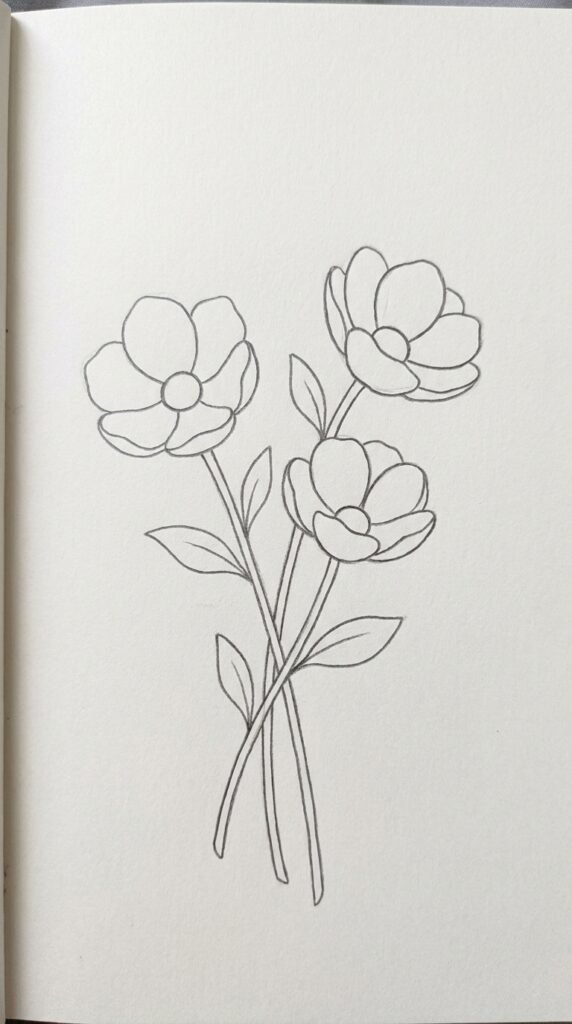
Grouping flowers together is one of the most satisfying things you can draw, and a small bouquet of three anemones is the perfect introduction to multi-flower compositions. This idea teaches you how to arrange blooms at different heights and angles without making the drawing feel crowded.
Step-by-Step Instructions:
- Lightly mark three dot positions across your paper: one in the upper center, one slightly lower to the left, and one slightly lower to the right. These mark where each flower center will sit.
- Draw each flower center as a small circle and build the petals around each one using five to six rounded petal shapes.
- Vary the flowers slightly. Make one fully open, one showing a side view, and one with petals that overlap the neighboring flower slightly.
- Draw curved stems from each flower, bringing them together toward the bottom of the page where they cross lightly.
- Add leaves growing outward from the lower stems and draw a simple loose ribbon or bow shape where the stems gather, if desired.
Anemone Flower with Leaves Wreath
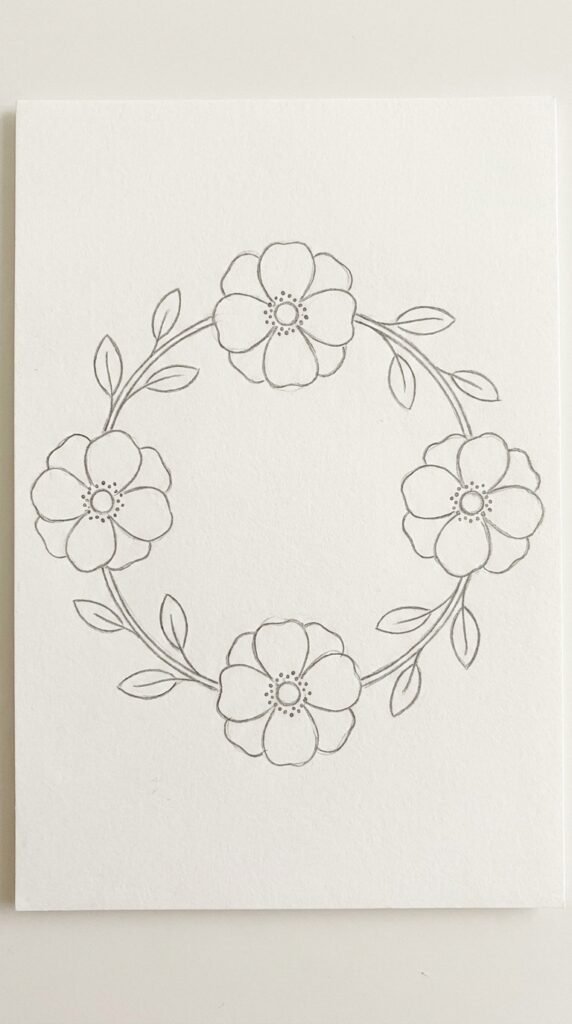
A circular wreath made of anemone flowers and leaves is a beautiful decorative drawing that works well for journal pages, cards, and wall art sketches. It looks impressive but is built entirely from repeating the same simple flower shape arranged in a circle.
Step-by-Step Instructions:
- Lightly draw a large circle on your page to use as a guide. This does not need to be perfect.
- Place four to five anemone blooms evenly spaced around the circle. Draw each bloom with five rounded petals and a small dotted center.
- Between each flower, draw clusters of two to three simple oval leaves with a central vein line. Position the leaves so they point outward from the circle.
- Add short curved stems connecting each flower and leaf cluster, following the line of your guide circle.
- Erase the original guide circle once all elements are in place, leaving only the wreath drawing.
Anemone in a Simple Vase
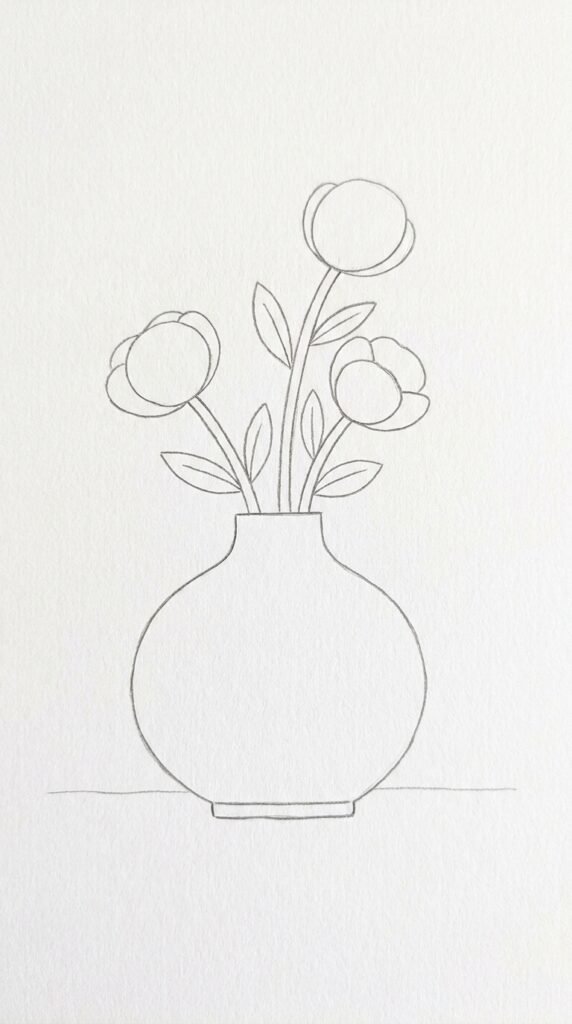
Placing your anemone inside a vase instantly turns a flower sketch into a complete scene. This drawing idea is especially good for beginners because the vase gives the composition a grounded, finished feeling without requiring extra artistic skills.
Step-by-Step Instructions:
- Draw a simple vase shape in the lower half of your page. A classic vase has a wide middle, a narrower neck, and a flat base. Use simple curved lines.
- Draw three anemone flowers of slightly different heights rising from the top opening of the vase. Make the center flower the tallest.
- Add leaves on curved stems in between the flowers, filling any large gaps between the blooms.
- Draw a few loose stems visible inside the vase through a suggestion of two vertical lines inside the vase shape.
- Add a simple horizontal line below the vase to indicate a surface, and draw a very light oval shadow shape beneath the base if desired.
Anemone Flower Field Scene
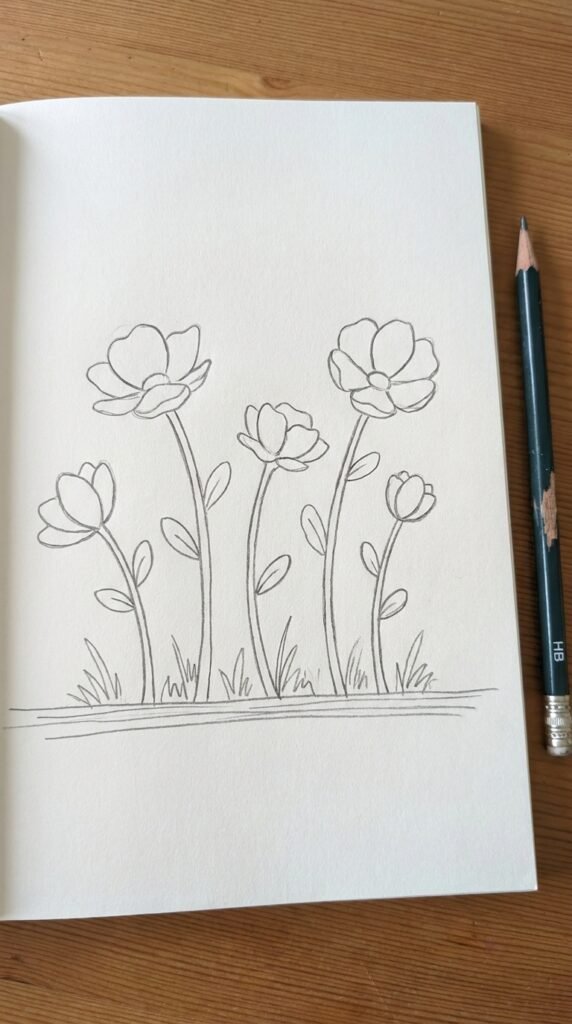
A simple field scene with several anemones at different heights creates a story within your drawing. This idea is excellent for practicing how to draw multiple flowers without making the page look messy, using spacing and varying stem lengths as your main tools.
Step-by-Step Instructions:
- Draw a light horizontal ground line roughly two-thirds of the way down your page.
- Draw five to seven anemone flowers of varying heights above the ground line. Make flowers in the foreground slightly larger and those further back slightly smaller.
- Draw long, gently curved stems going down to or into the ground line. Let some stems slightly overlap.
- Add simple grass blades near the ground line by drawing short, slightly curved V-shapes between and around the stems.
- Add a few oval leaves on some of the stems and, if desired, draw one anemone bud among the open flowers for variety.
Mandala-Style Anemone Drawing
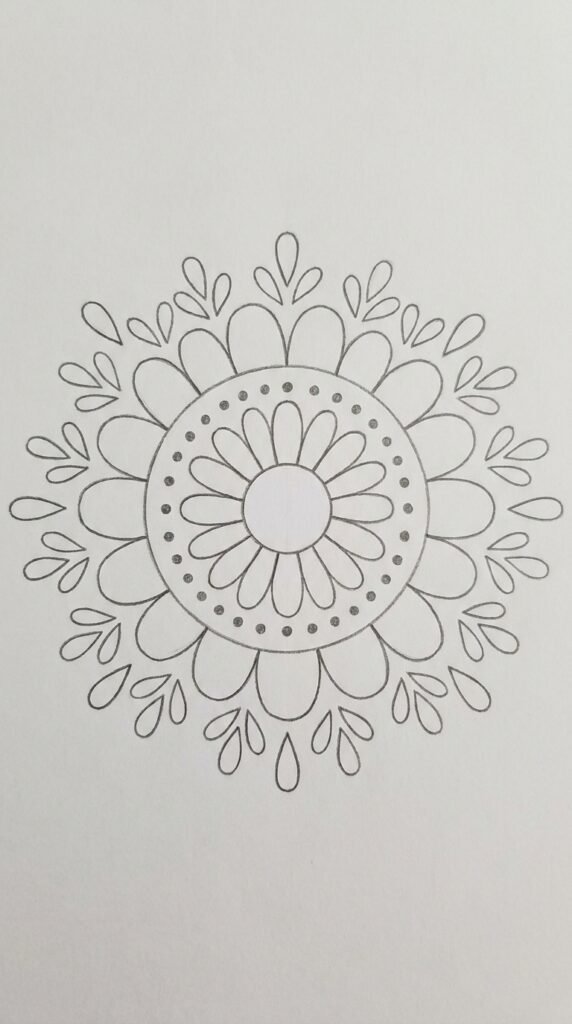
This idea takes the circular symmetry of the anemone bloom and extends it into a simple mandala-style design. It is a meditative and satisfying drawing exercise that works especially well in sketchbooks and art journals.
Step-by-Step Instructions:
- Draw a small circle in the exact center of your page.
- Around it, draw eight evenly spaced rounded petals to form the inner flower ring.
- Outside the first ring of petals, draw another set of eight slightly longer petals, each one positioned between two petals of the inner ring.
- Add a ring of small dots or short dashes between the two petal layers to create separation and visual texture.
- Around the outer edge of the whole design, draw simple leaf shapes or small teardrop forms pointing outward at regular intervals to complete the mandala-style frame.
Anemone with Butterfly
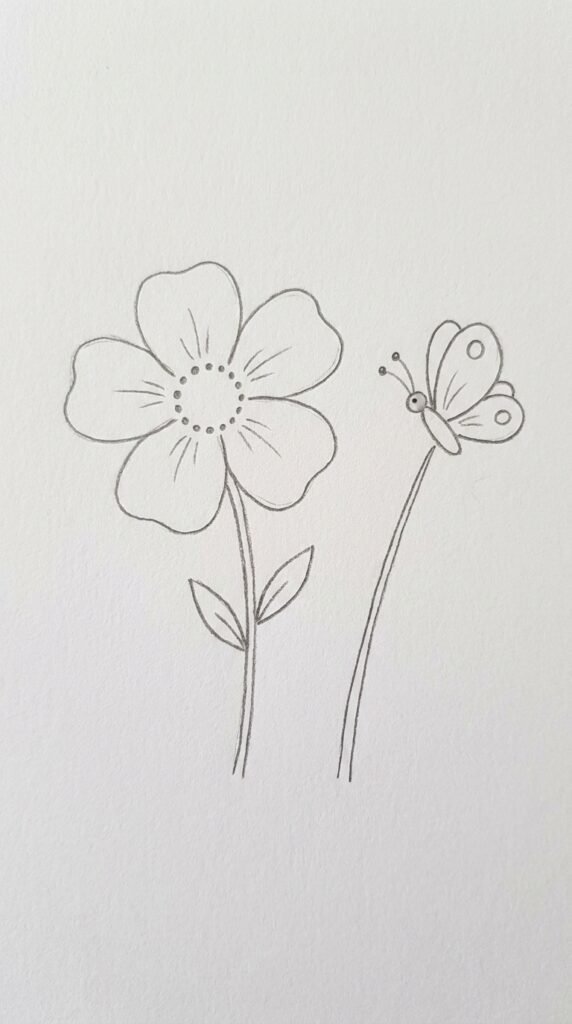
Adding a simple butterfly to an anemone drawing creates a charming nature scene that is extremely popular in sketchbooks and on Pinterest. The butterfly shape is easy to draw using two mirrored wing ovals, making this a very manageable composition for beginners.
Step-by-Step Instructions:
- Draw a single full anemone bloom in the upper center of your page with five petals and a dotted center.
- Draw a long, slightly curved stem going down to the lower portion of the page with a leaf or two attached.
- Slightly to one side of the flower, draw a simple butterfly. Start with a small oval body and two rounded upper wings on either side.
- Below the upper wings, draw two smaller triangular lower wings.
- Add two straight antennae with small circles at the tips rising from the butterfly’s head, and draw a few simple vein lines inside each wing.
Anemone Corner Border Design
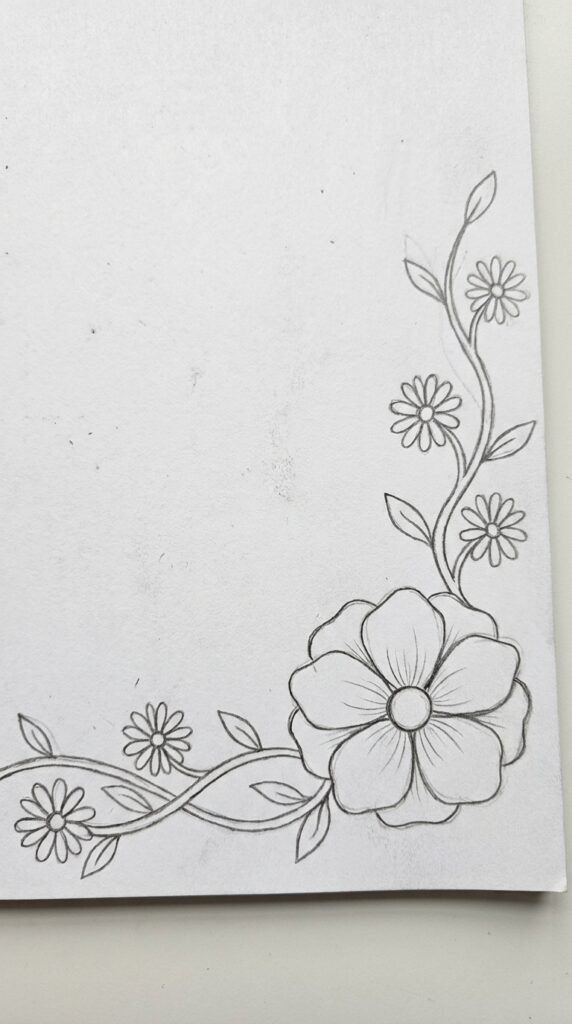
Corner borders are incredibly useful for journal pages, greeting cards, and decorative paper art. This idea shows you how to use anemone flowers and leaves to create a flowing corner design that frames any page beautifully.
Step-by-Step Instructions:
- Start in one corner of your page and draw one full anemone bloom about two centimeters from the corner edge.
- Draw a curved vine or stem extending from the flower in two directions: one going along the top edge of the page and one going down the side edge.
- Along each vine, add two to three smaller anemone blooms at intervals, each one slightly smaller than the central corner flower.
- Add clusters of two to three oval leaves between each flower along the vines.
- At the very ends of each vine, add a small anemone bud or a tight spiral to finish the border neatly.
Realistic-Style Anemone Outline Drawing
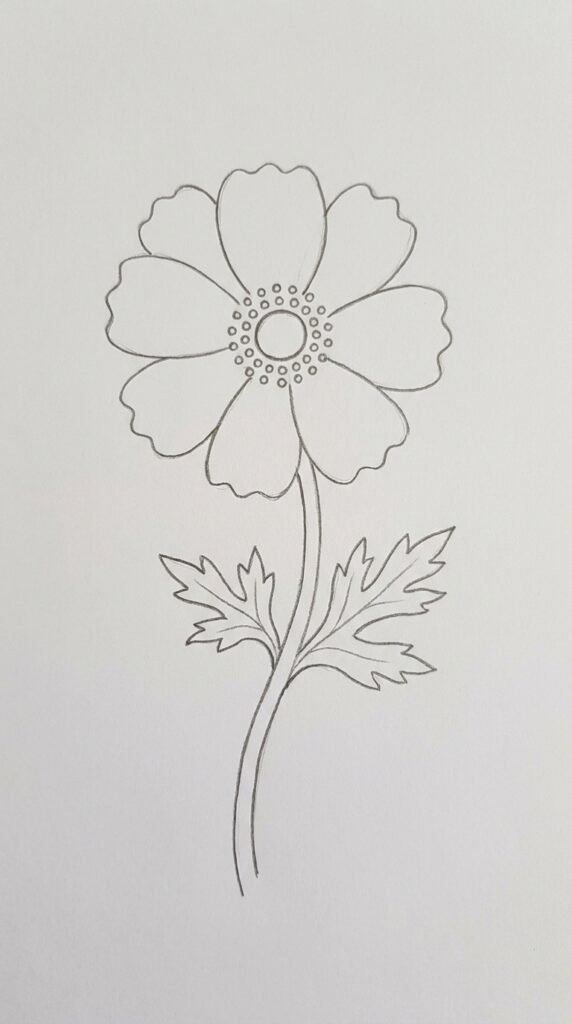
This idea is for those who want to challenge themselves slightly more while still keeping things approachable. The realistic-style outline drawing focuses on petal shape variation and a more natural-looking arrangement, without adding any shading or tonal work.
Step-by-Step Instructions:
- Lightly sketch the overall shape of the flower using a very faint oval as a guide for the outer petal boundary.
- Draw six to eight petals of slightly uneven widths radiating from the center. Some petals can be wider, some narrower, and some can slightly overlap neighboring petals.
- Make the tips of the petals gently wavy rather than perfectly round, giving a more natural look.
- Draw the center circle with a double ring of dots: a tighter inner ring and a wider outer ring of slightly larger dots.
- Erase the original guide oval, then draw a natural-looking curved stem and two or three multi-lobed leaves below.
Anemone Flower in a Mason Jar
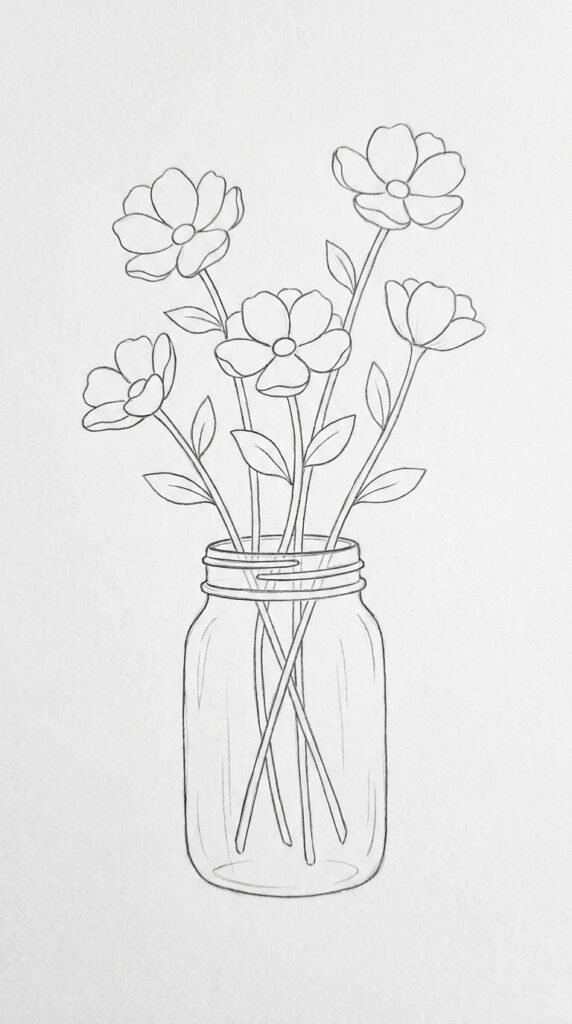
The mason jar is one of the most popular containers in botanical sketch art, and pairing it with anemone flowers makes for a charming, Pinterest-ready drawing. The jar shape adds a cozy, rustic feeling to the composition.
Step-by-Step Instructions:
- Draw a simple mason jar shape in the lower half of your page: a wide cylindrical body, a slightly narrower neck, and a flat lid with a screw band drawn as a horizontal rectangle near the top.
- Draw three to four anemone blooms of varying heights rising above the jar opening. Stagger the heights so none of the flowers are at exactly the same level.
- Add curved stems and simple leaves filling the space inside the jar and between the flowers.
- Draw a few faint vertical lines on the jar body to suggest the glass shape, and add a small curved line on the lower side of the body to indicate the jar’s roundness.
- Draw a simple surface line below the jar and add a small tag shape tied to the jar with a thin string if desired.
Drawing Tips Section
Practice the basic petal shape on a separate piece of paper before starting any of these ideas. A single anemone petal is essentially a rounded teardrop, and once your hand is comfortable drawing it consistently, the full flower will come together much faster.
Always start with the flower center first. Drawing the center circle before the petals gives you a fixed anchor point from which to space your petals evenly. If you draw the petals first, it becomes much harder to place the center accurately.
Keep your pencil pressure light in the early stages. Use very gentle marks for your initial structure and shapes, then press slightly firmer once you are satisfied with the placement. This way you can erase and adjust without leaving heavy ghost lines behind.
Vary the sizes of your flowers whenever you draw more than one anemone on the same page. A mix of large, medium, and small blooms instantly makes a composition look more natural and visually interesting.
Do not try to make every petal perfectly identical. Real anemone petals are slightly varied in width and angle, and that natural irregularity is what makes a drawing look lively rather than stiff.
Common Mistakes Section
One of the most common mistakes beginners make is spacing the petals unevenly. If you place all the petals on one side without checking the spacing as you go, the flower will look lopsided. Fix this by lightly marking five or six evenly spaced dots around your center circle before drawing any petals.
Another frequent mistake is making the center circle too large. When the center is too big relative to the petals, the flower looks more like a sunflower than an anemone. Keep the center circle small, roughly one quarter of the total flower width.
Beginners often press too hard with the pencil from the very beginning, which makes it difficult to erase guide lines and adjust shapes. Always start with a light touch and only firm up your final lines once the structure is correct.
Skipping the stem and leaves is another mistake that leaves a flower drawing looking incomplete. Even the simplest stem and one or two oval leaves immediately make a bloom look finished and grounded.
Finally, many beginners try to add shading before the outline is fully clean and correct. Always complete and refine your outline drawing first. If you find shading confusing, simply leave the drawing as a clean outline, as all the ideas in this guide demonstrate.
FAQ Section
What is the easiest anemone flower drawing for beginners?
The classic single anemone bloom is the easiest starting point. It uses only a small circle for the center, five rounded petals around it, and a few dots inside the center. There are no complex shapes involved, and the entire drawing can be completed in under ten minutes once you have practiced it a couple of times.
Do I need special pencils to draw anemone flowers?
No special pencils are required. A standard HB pencil is perfect for all the drawings in this guide. HB gives you enough darkness to see your lines clearly while still being easy to erase when you need to make corrections. If you want slightly lighter guide lines, a 2H pencil works well for the initial sketch stage.
Can children draw anemone flowers using these ideas?
Yes, absolutely. All 13 ideas in this guide are designed to be accessible for children as well as adults. The step-by-step instructions break every drawing down into simple shapes and clear stages. Children from around eight years old and up should be able to follow these steps comfortably with a little guidance.
How can I use anemone drawings for my sketchbook or journal?
Anemone drawings work beautifully as standalone pages, as decorative borders around written text, as cover page designs, or as filler art between journal entries. The wreath idea and the corner border idea in this guide are particularly well suited for journal and sketchbook use. You can also use them as greeting card designs or frame them as simple wall art.