Have you ever looked at a lavender field and wished you could capture that soft, peaceful beauty on paper? Most beginners feel stuck the moment they try to draw flowers. They worry about getting the petals wrong, making stems too stiff, or ending up with something that looks nothing like the reference. The good news is that lavender is one of the friendliest flowers you can draw. Its long slender stem, small clustered blossoms, and simple leaf shapes mean you can build a beautiful result using nothing more than basic lines and ovals.
This article gives you 13 lavender flower drawing ideas that are fully beginner-friendly. Each idea walks you through exactly how to draw it, step by step, starting from the simplest shapes. You do not need to know how to shade. You do not need expensive art supplies. A regular HB pencil and a blank sheet of paper are enough to get started right now.
Whether you are a child learning to draw for the first time, a hobbyist looking for a relaxing weekend activity, or a teacher searching for a fun classroom project, these lavender drawing ideas will work for you. Every idea in this guide is built on simple shapes like ovals, curves, and straight lines. There is no complicated shading, no tricky perspective, and no confusing instructions. Just clear, easy steps that build one on top of the other until you have a finished lavender drawing you can be proud of.
Lavender drawing ideas are also extremely popular on Pinterest, where flower sketches, botanical line art, and easy pencil drawings attract huge amounts of engagement. If you are building a drawing journal, a sketchbook practice, or looking for ideas to post online, these lavender sketches are a fantastic starting point.
Let us get into all 13 ideas now.
Single Lavender Stem Drawing
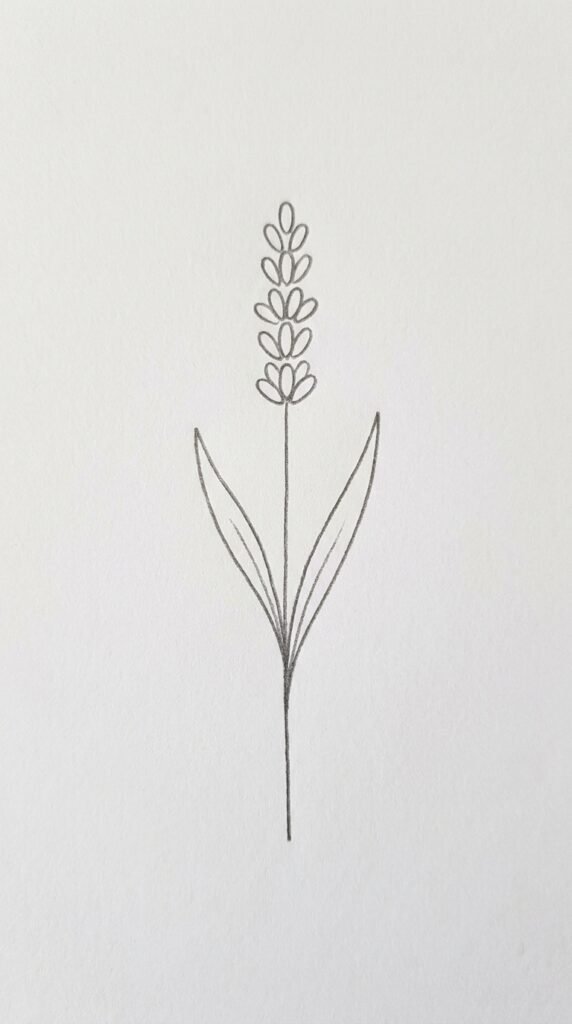
A single lavender stem is the most classic starting point for any beginner. This drawing focuses on one tall, straight stem with small oval flower buds clustered near the top. It teaches you how to control line direction and how to arrange repeated shapes evenly without making the drawing look messy. The simplicity of this idea makes it ideal for absolute beginners and young children.
Step-by-Step Instructions:
- Draw a single straight vertical line about 5 inches tall in the center of your paper. This is your main stem.
- At the top of the stem, begin adding small oval shapes on both sides, slightly overlapping each other. Start from the very tip and work your way down about 1.5 inches. These ovals represent the lavender florets.
- About halfway down the stem, draw two narrow leaves curving gently outward on each side. Keep them long and thin, like pointed teardrops.
- At the very base of the stem, draw a small curved line to suggest where the stem meets the ground or a pot.
- Review the spacing of your florets and add any missing ones to fill gaps near the top cluster.
Lavender Bunch Tied with Ribbon
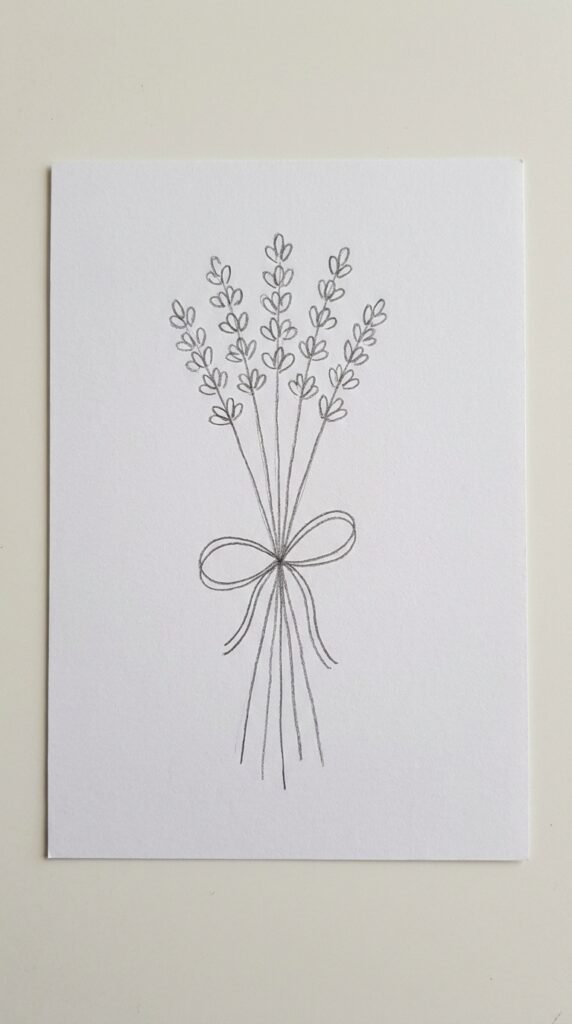
A tied lavender bunch is a charming and recognizable shape. This idea draws several lavender stems held together at the base with a simple ribbon bow. It is slightly more complex than a single stem but still very manageable for beginners. The ribbon adds a decorative element that makes the finished drawing feel complete and elegant.
Step-by-Step Instructions:
- Draw three to five slightly diagonal straight lines close together in the center of your paper. These are your grouped stems. Let them fan outward very slightly at the top.
- At the top of each stem, add the familiar small oval florets clustered together. Because the stems are grouped, the floret clusters will overlap a little, which looks natural.
- Where the stems meet in the lower middle area, draw a simple ribbon bow. The bow is made of two curved teardrop shapes facing each other, with a small oval in the center and two short ribbon tails hanging down.
- Below the ribbon, let the stems continue downward for about an inch before ending.
- Add two or three narrow leaves to some of the stems just below the floret cluster.
Lavender in a Mason Jar
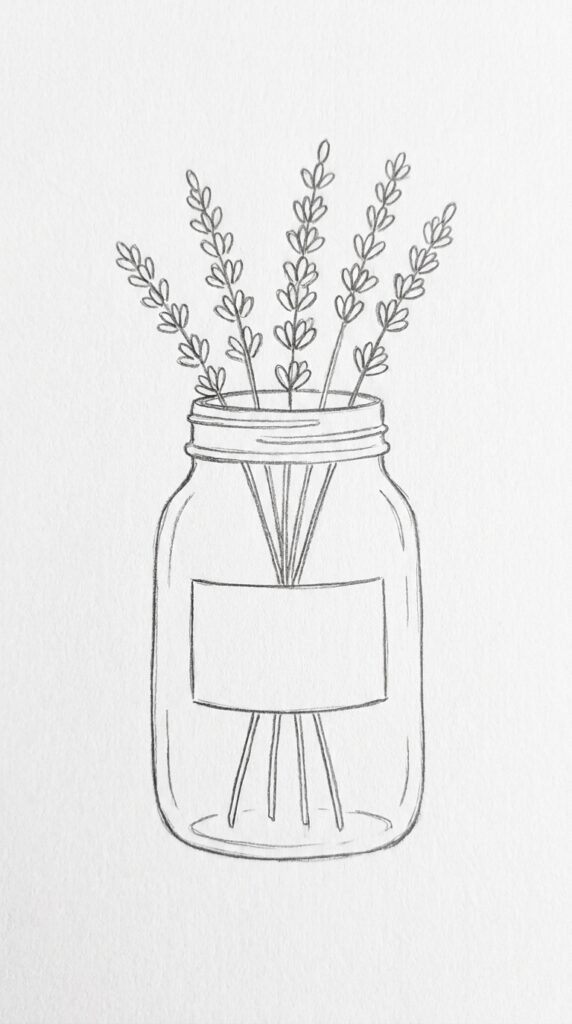
This idea places a lavender bunch inside a simple mason jar shape. It is a very popular subject for beginner drawing practice because the jar provides a satisfying geometric anchor while the lavender adds organic softness. Together they create a pleasing contrast that is easy to manage step by step.
Step-by-Step Instructions:
- In the lower half of your paper, draw a simple mason jar shape. Start with a slightly wide rectangle for the jar body, then add a narrower rectangle on top for the neck, and a small flat oval for the rim.
- Inside the jar, draw several straight vertical stems rising up out of the jar opening. The stems should be tall enough to extend well above the jar rim.
- At the top of each stem, add clusters of small oval florets. Vary the height of each stem slightly so the bunch looks natural.
- Add two or three narrow pointed leaves to the stems where they exit the jar.
- On the jar body, draw a simple label shape using a small rectangle with slightly wavy edges to suggest a paper sticker.
lavendr wreath drowing
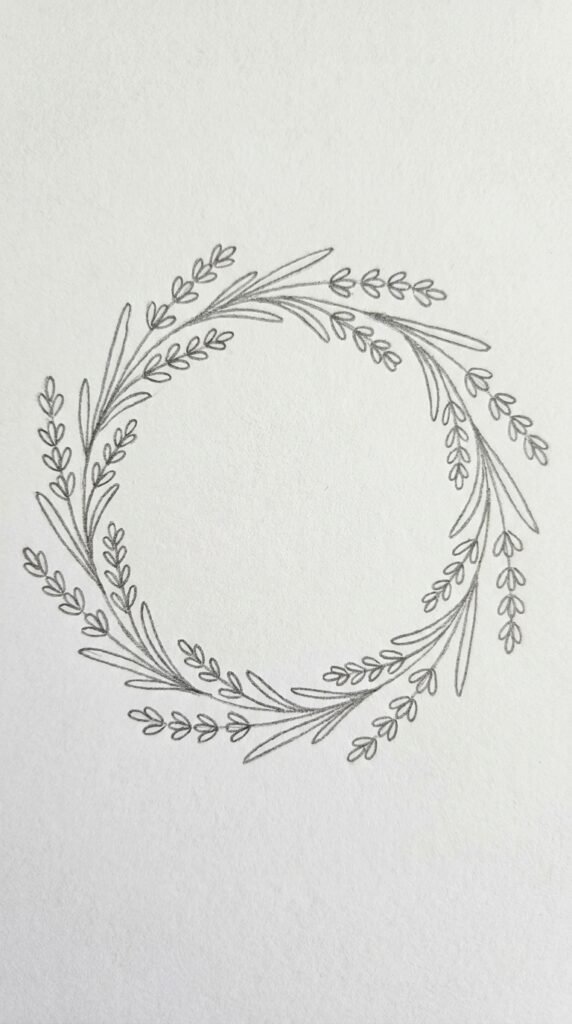
A lavender wreath is a circular arrangement of stems and florets that creates a lovely frame-like shape. This is a slightly more advanced idea because it requires drawing in a curved formation, but each individual element is still made of the same simple shapes you have already practiced. The circular composition makes this drawing feel decorative and finished.
Step-by-Step Instructions:
- Lightly draw a large circle in the center of your paper using a pencil. This is your guide circle. Make it about 4 inches in diameter.
- Along the top arc of the circle, draw several small lavender stems curving outward from the circle edge. Each stem should point away from the center.
- Add small oval florets at the tip of each stem. The florets should follow the curve of the circle naturally.
- Repeat along the bottom arc, then connect the sides with more stems until the wreath feels full and balanced.
- Once the wreath is complete, erase the guide circle gently. Add a few scattered leaves between the stems to fill any gaps.
Lavender Sprig with Detailed Florets
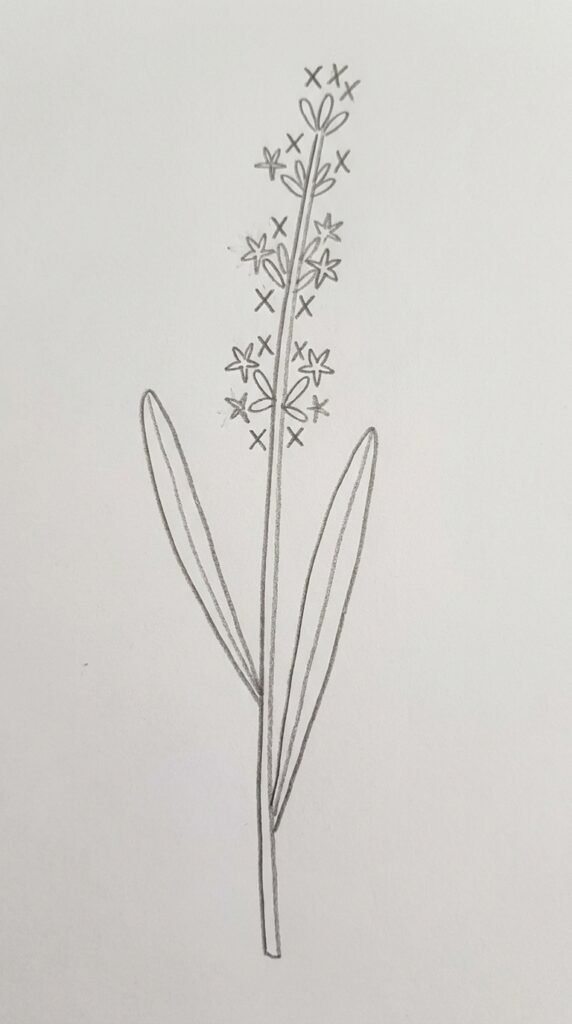
This idea focuses on drawing one single lavender sprig with more attention paid to the shape of individual florets. Instead of simple ovals, this version shows each floret as a tiny cluster of small petals. This is a great exercise for beginners who are ready to add a little more detail without moving into shading or complicated techniques.
Step-by-Step Instructions:
- Draw a long straight stem about 4 inches tall in the center of your paper.
- Starting from the top of the stem, draw small cross-shaped or star-shaped floret marks instead of plain ovals. Each mark should be tiny, about the size of a pencil eraser.
- Work your way down the stem adding these detailed florets on alternating sides. Leave small gaps between each floret.
- About one third of the way down the stem, stop adding florets and instead draw two long narrow leaves curving outward.
- At the base, add a short curved line to finish the stem neatly.
Two Crossing Lavender Stems
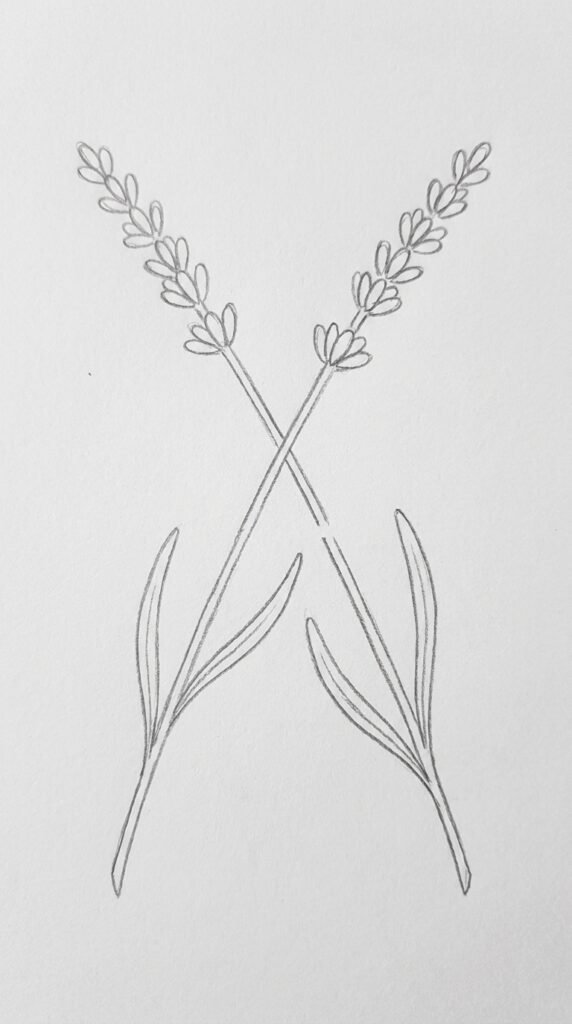
This idea draws two lavender stems that cross over each other at a diagonal angle, creating an elegant X-shaped composition. It is a simple but visually interesting layout that teaches beginners how to overlap elements without making the drawing look confusing.
Step-by-Step Instructions:
- Draw one diagonal line going from the lower left to the upper right of your paper. This is your first stem.
- Draw a second diagonal line crossing the first, going from lower right to upper left. The crossing point should be roughly in the center of your paper.
- At the top end of each stem, add a cluster of small oval florets following the direction of the stem.
- Add two narrow leaves near the bottom of each stem, curving outward from the stem.
- At the crossing point, one stem should appear to pass in front of the other. Erase a short section of the back stem at the crossing to create a simple overlap effect.
Lavender Growing from the Ground
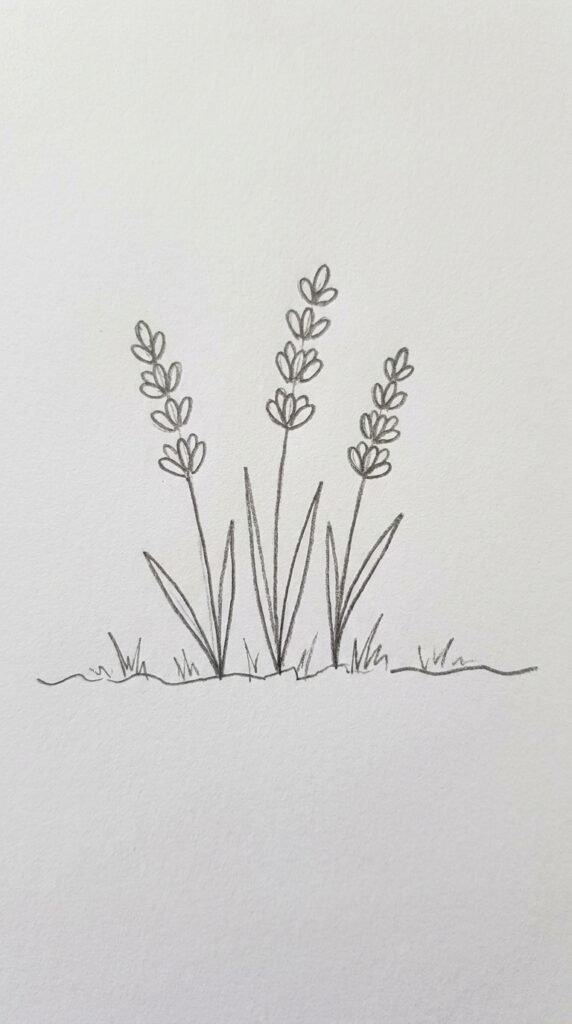
This idea shows lavender growing naturally from the ground, with a simple ground line and multiple stems rising from the same base. It introduces the concept of a ground plane to beginners, which helps drawings feel more rooted and realistic without requiring any landscape skills.
Step-by-Step Instructions:
- Draw a slightly uneven horizontal line across the lower third of your paper. This represents the ground.
- From the ground line, draw three to five straight stems of slightly different heights rising upward. Cluster them close together at the base.
- Add small oval florets at the top of each stem. Vary the floret cluster density between stems to make the group look natural.
- Add narrow leaves on each stem, pointing outward just above the ground level.
- Along the ground line, add a few short grass-like lines to suggest soil or grass at the base of the plant.
Lavender Corner Border Design
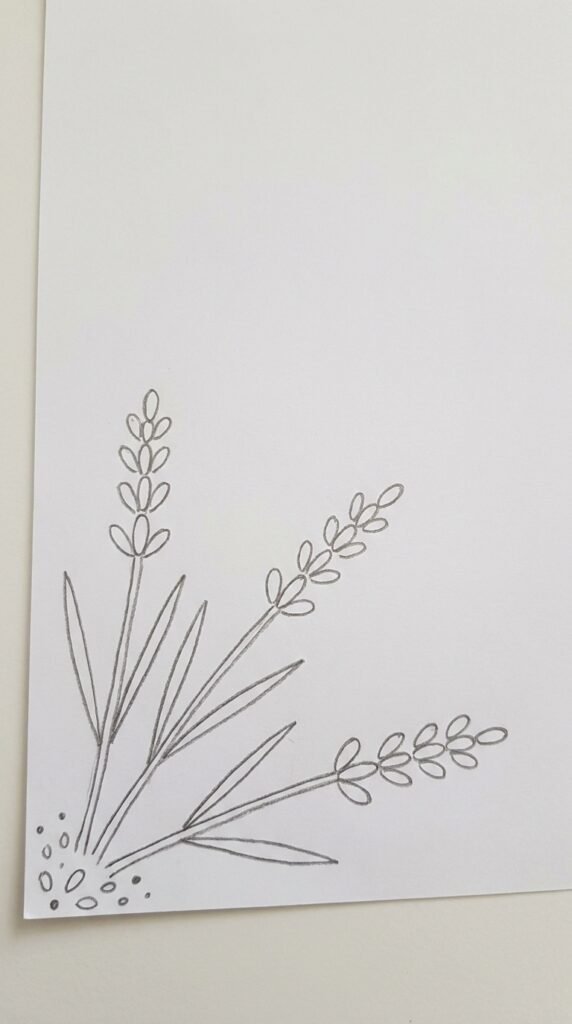
This idea creates a decorative corner design using lavender stems and leaves arranged to fill the corner of a page. It is commonly used to decorate journal pages, greeting cards, and sketchbook covers. The arrangement radiates from one corner, making it easy to plan and place.
Step-by-Step Instructions:
- Choose one corner of your paper, for example the top left. Start at the very tip of that corner.
- Draw three to four lavender stems radiating outward from the corner at different angles. One stem should go mostly upward, one mostly sideways, and the others at angles in between.
- Add small oval florets at the top of each stem.
- Fill in the spaces between stems with narrow leaves curving outward.
- Add a few small scattered dots or tiny ovals near the corner tip to fill any blank space and make the design feel complete.
Lavender Bouquet in a Vase
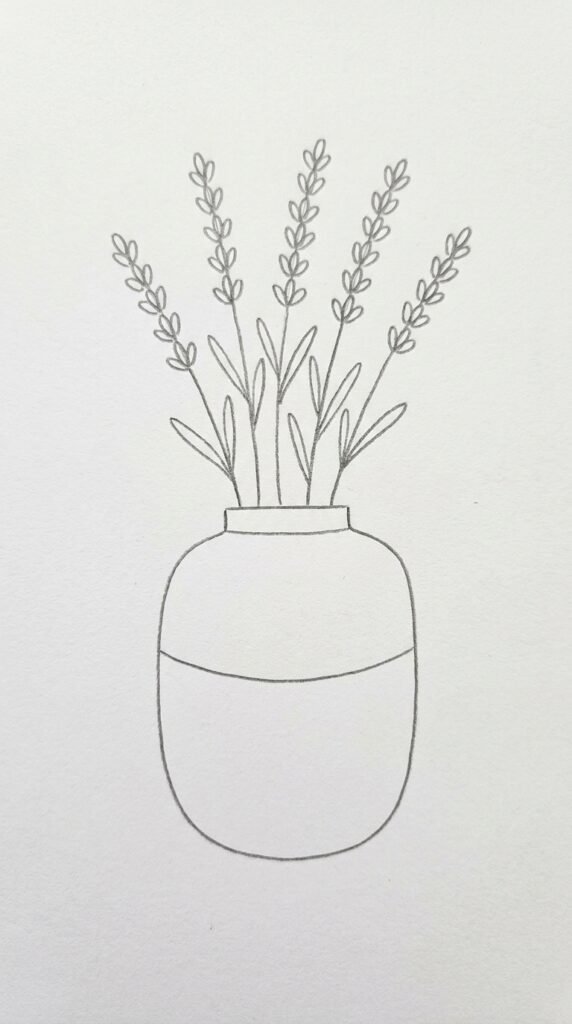
This idea draws a generous bouquet of lavender stems arranged in a rounded vase. The vase shape grounds the composition while the varied stem heights and overlapping floret clusters create a lush, full feeling. This is a satisfying drawing for beginners because the finished result looks impressive with very little technical difficulty.
Step-by-Step Instructions:
- In the lower center of your paper, draw a simple vase shape. Use a wide U-shape for the body, narrow it slightly at the neck, and add a short straight rim at the top.
- Draw several stems rising from the vase opening. Use different heights and angles so they fan outward naturally. Aim for five to seven stems.
- Add small oval florets at the tip of every stem. Let the floret clusters overlap slightly where stems are close together.
- Add narrow leaves on some stems, especially the ones in the middle of the bouquet.
- On the vase, draw a simple curved line across the widest part to suggest the front surface of the vase.
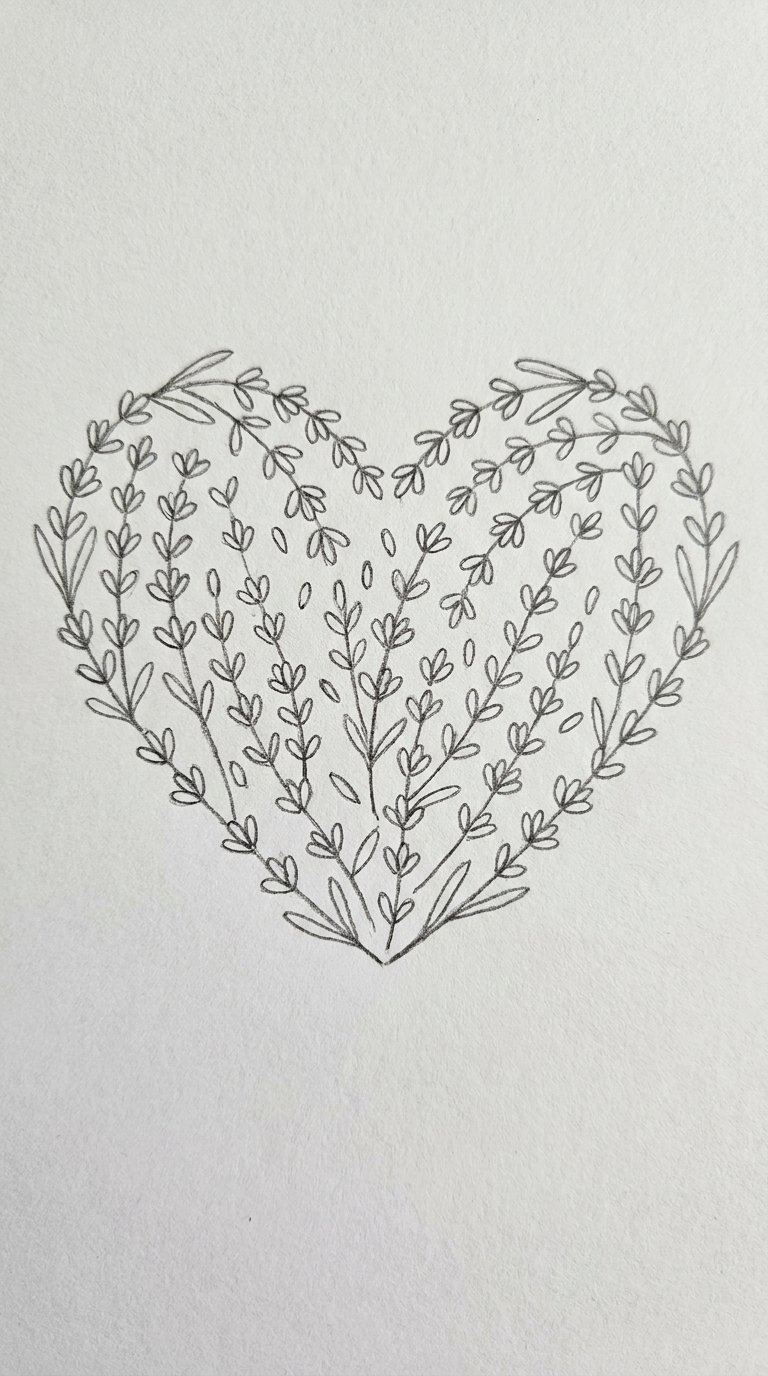
Lavender Heart Shape
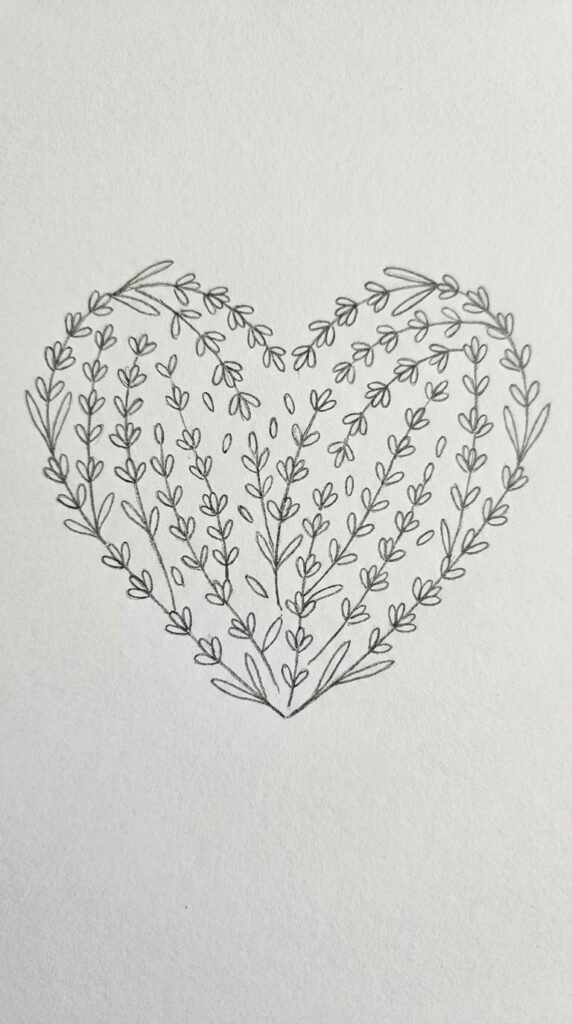
This idea arranges lavender stems and florets in the shape of a heart. It is a popular choice for Valentine drawings, greeting cards, and decorative art. The heart silhouette is familiar and satisfying, and the lavender elements fill it naturally.
Step-by-Step Instructions:
- Lightly sketch a large heart shape in the center of your paper using a pencil. Make it at least 4 inches wide.
- Along the outline of the heart, draw small lavender stems pointing inward toward the center of the heart. Space them evenly around the entire heart edge.
- Add small oval florets at the tip of each inward-pointing stem.
- Fill the interior with additional stems and florets until the heart silhouette feels full but not crowded.
- Once complete, gently erase the original heart guide line. The lavender stems and florets should now define the heart shape clearly on their own.
Lavender Branch with Multiple Side Sprigs
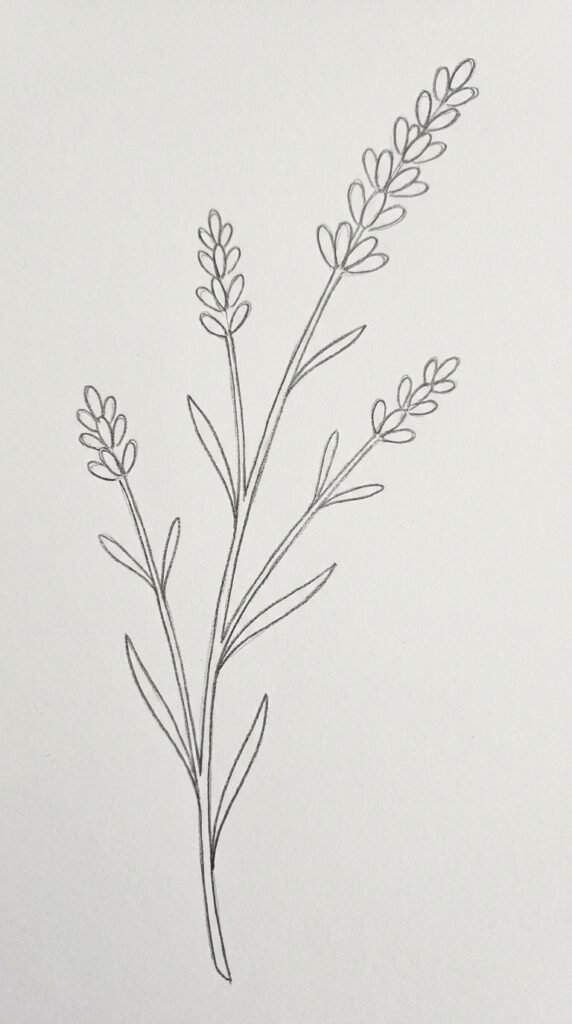
This idea draws a main lavender branch from which smaller side sprigs grow outward. It resembles a botanical illustration and introduces beginners to the concept of branching structure. Despite looking complex, this drawing is built from the same simple steps repeated multiple times along a single main line.
Step-by-Step Instructions:
- Draw one long diagonal line from the lower center to the upper right of your paper. This is the main branch.
- From the main branch, draw three to five shorter lines branching off at upward angles on alternating sides. Space them evenly along the branch.
- At the tip of each side branch, add a cluster of small oval florets.
- On the main branch between side branches, draw narrow pointed leaves facing outward.
- At the tip of the main branch itself, add the largest floret cluster of the drawing.
Lavender and Butterfly Drawing
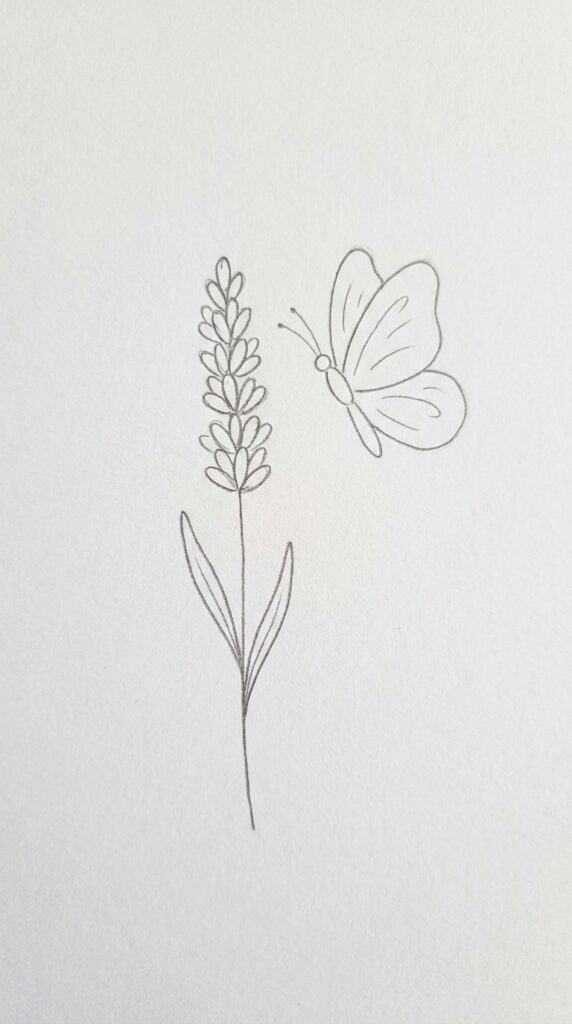
This idea combines a simple lavender stem with a small butterfly resting on or hovering near the florets. It is a charming nature-themed drawing that is very popular with beginners and young artists. The butterfly is kept extremely simple, made of four wing shapes and a small oval body.
Step-by-Step Instructions:
- Draw a single tall lavender stem slightly to the left of center with a full floret cluster at the top.
- Add two narrow leaves about halfway down the stem.
- To the right of the floret cluster, draw a small oval shape for the butterfly body. Add two small antennae lines curving upward from the top of the oval.
- Draw two large wing shapes on either side of the body. The upper wings are slightly larger than the lower wings. Each wing is a simple rounded triangle or teardrop shape.
- Add a few curved lines inside each wing to suggest simple wing patterns.
Lavender Bookmark Design
This final idea creates a tall narrow lavender drawing designed to look like a bookmark. The composition is intentionally vertical and compact, making it a practical art project that results in something usable. This is a great project for kids because the finished drawing can be cut out and actually used as a bookmark.
Step-by-Step Instructions:
- Draw a tall narrow rectangle about 2 inches wide and 6 inches tall in the center of your paper. This is your bookmark outline.
- Inside the rectangle, draw one central lavender stem running vertically from the lower quarter to near the top of the rectangle.
- Add a full floret cluster at the top of the stem. Keep the florets contained within the rectangle edges.
- Add two narrow leaves on either side of the stem at the midpoint.
- At the very bottom of the rectangle, draw a small simple decorative element such as a tiny flower or a few dots. Round the bottom corners of the rectangle slightly to finish the bookmark shape.
Drawing Tips for Lavender Flowers
Start every lavender drawing with a light pencil stroke for the stem before adding any florets. This gives you a guide line to work from and makes it easier to keep the stem straight or at the angle you intended.
Use small consistent oval shapes for your florets rather than trying to draw each one differently. When all the ovals are a similar size and shape, the floret cluster looks natural and controlled. Variation in floret size is fine, but avoid making any single floret too large compared to the others.
Draw the leaves last. Many beginners add leaves too early and then feel crowded when placing the stem or florets. Adding leaves at the end gives you full control over their placement.
Work from top to bottom when adding florets to a stem. Lavender florets naturally cluster more densely at the tip and thin out slightly toward the base of the bloom, so building your cluster from the top down helps you mirror this natural pattern.
Keep your pencil sharp when drawing lavender. A sharp pencil gives you thin, controlled lines that make the small florets readable and clean. A dull pencil creates thick lines that smudge and make small detail work harder to manage.
Common Mistakes to Avoid
Making the stem too thick is one of the most frequent errors beginners make with lavender drawings. The stem should be a single thin line. If your stem looks heavy, lighten your pencil pressure and draw it in one confident stroke rather than tracing back and forth.
Placing the florets too far apart makes the cluster look sparse and unconvincing. Real lavender florets are tightly grouped. Keep your oval shapes close together, especially near the tip of the stem, and let them touch or very slightly overlap.
Drawing leaves that are too wide changes the look from lavender to a generic flower. Lavender leaves are long and narrow. When in doubt, make your leaves thinner than you think they should be.
Pressing too hard with the pencil early in the drawing makes corrections difficult. Always start with lighter strokes and go darker only when you are confident about placement. This is especially important for guide shapes like the heart in the lavender heart idea or the bookmark rectangle.
Rushing through the floret cluster without varying height slightly makes the top of the stem look flat and unnatural. Even a small variation in how far each floret oval extends from the stem tip adds a lot of life to the drawing.
Frequently Asked Questions
How do you draw lavender flowers for beginners? Start with a single straight vertical line for the stem. At the top, add small oval shapes close together on alternating sides of the stem to represent the florets. Add two narrow pointed leaves about halfway down the stem. That is the complete basic lavender drawing and a perfect starting point for any beginner.
What simple shapes are used to draw lavender? Lavender is drawn using straight lines for stems, small ovals or oval clusters for florets, and narrow teardrop or pointed oval shapes for leaves. These three basic shapes are enough to draw any lavender idea in this guide.
Can kids draw lavender flowers easily? Yes, lavender is one of the easiest flowers for kids to draw because the shapes are repetitive and simple. The floret cluster is made of the same small oval shape repeated many times, which children can master quickly. The single stem idea in this guide is a perfect first project for young beginners.
Do I need to shade lavender drawings to make them look good? No. Lavender drawings look clean and attractive without any shading at all. Clear pencil outlines with well-placed florets and neat leaves are enough to create a finished-looking lavender sketch. Shading is entirely optional and is not necessary for beginners to produce great results.