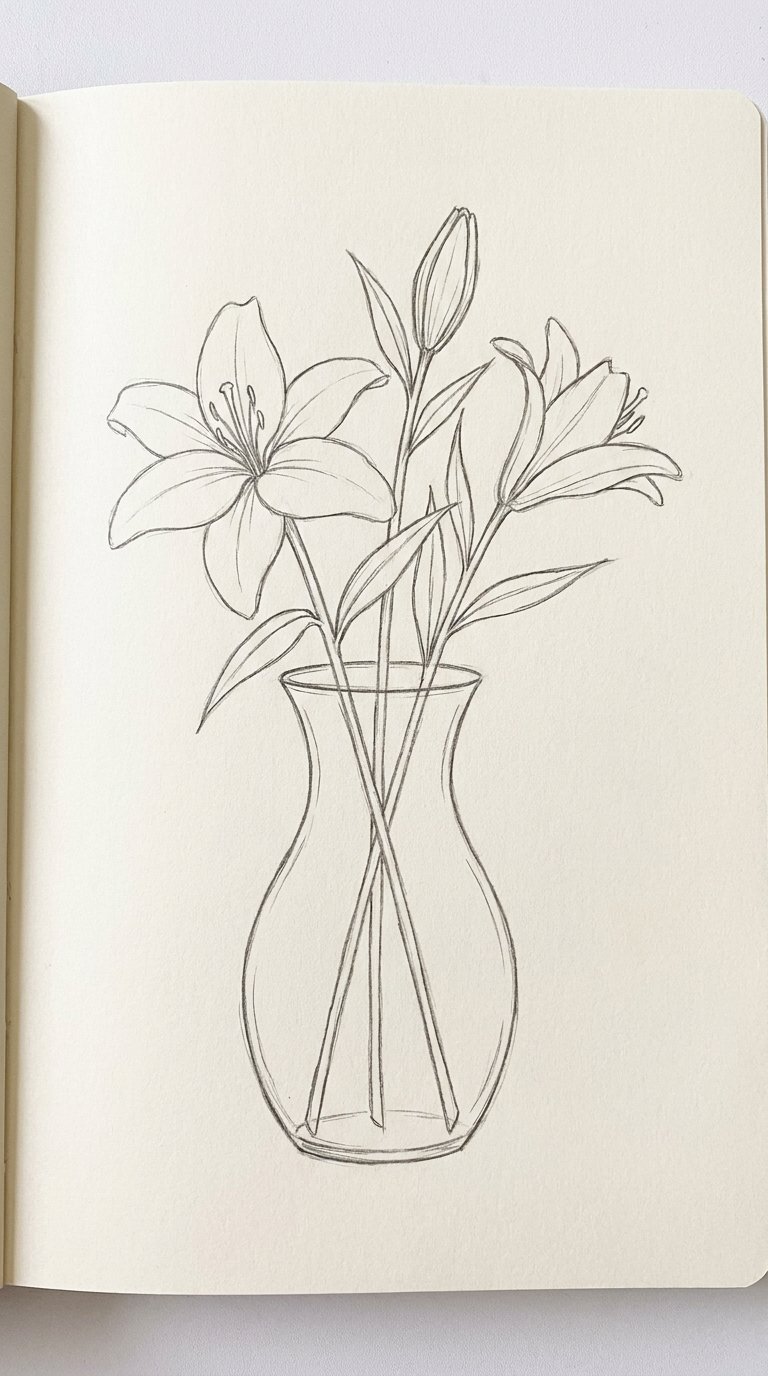
Have you ever looked at a lily and thought it was too beautiful to draw? You are not alone. Many beginners feel intimidated by flowers, but here is the truth: drawing a lily is much easier than it looks. This guide features 16 easy lily drawing ideas designed for beginners, kids, and casual art lovers who want to build their floral drawing skills without feeling overwhelmed.
Each idea starts with simple shapes like ovals, curved lines, and U-shapes, so no prior experience is needed. These are clean pencil outline drawings that look great in sketchbooks, art journals, or as coloring references. From the classic tiger lily to cute cartoon buds, every tutorial is written in plain English that children and adults can follow. Grab your pencil and let us get started.
Simple Open Lily Bloom
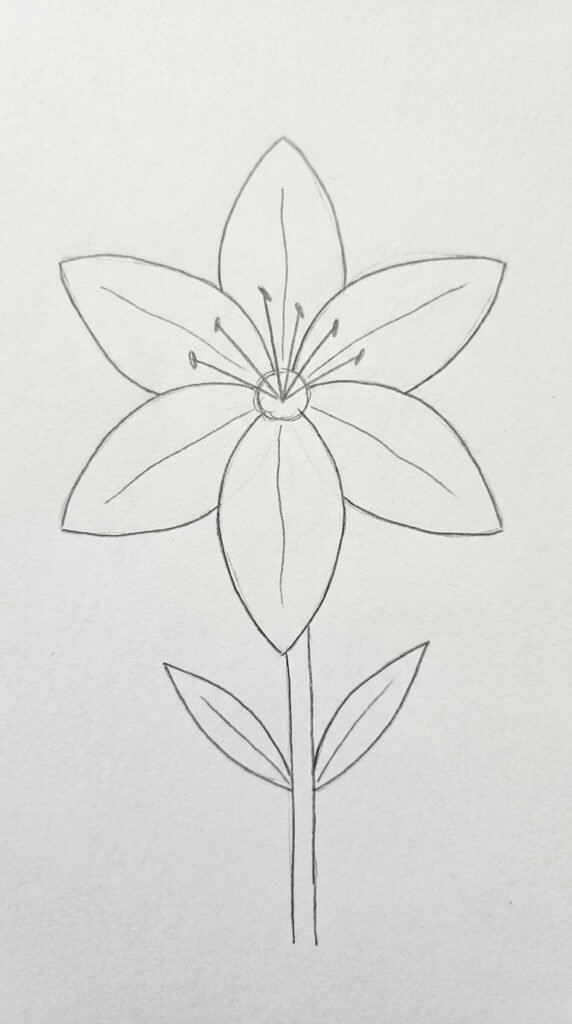
A simple open lily bloom is the perfect starting point for anyone new to flower drawing. This design uses six wide petals arranged in a circular pattern around a small center. The petals are slightly pointed at the tips and gently curved at the sides, giving the flower a natural and fresh look. This is one of the most recognizable lily drawing ideas and works beautifully in sketchbooks.
Step-by-Step Instructions:
- Draw a small circle in the center of your paper. This will be the flower’s core and should be about the size of a large pea.
- Add six wide teardrop-shaped petals around the circle. Each petal should fan outward evenly and measure about three times the size of the center circle.
- Draw a soft curved midline through each petal from the base to the tip to add definition and make each petal look real.
- Add three or four thin stamens extending from the center circle using short straight lines topped with tiny oval shapes.
- Draw a short straight stem beneath the flower and add two simple lance-shaped leaves on either side of the stem.
Lily Bud on a Long Stem
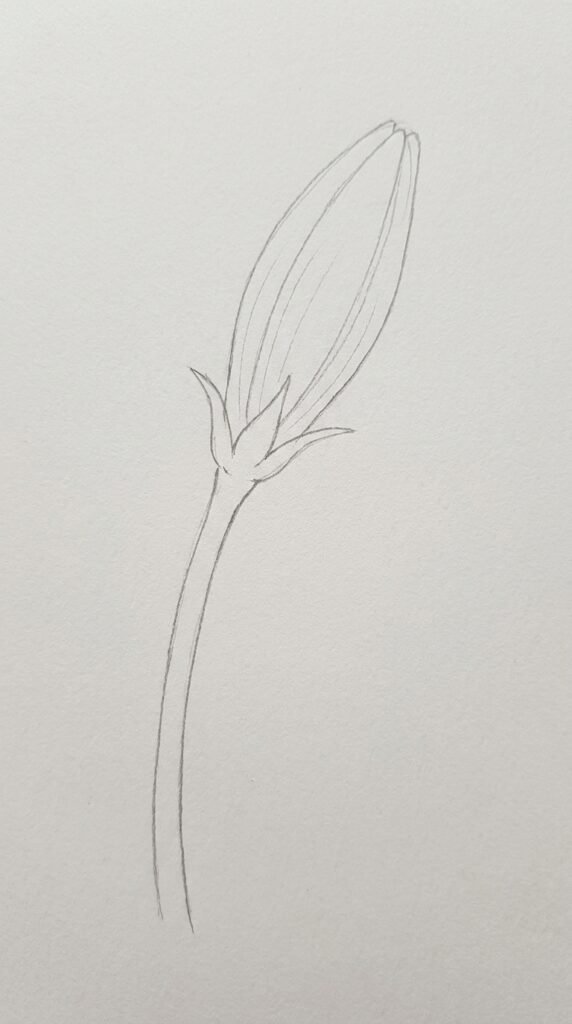
A lily bud drawing is ideal when you want something quick but elegant. Instead of a fully open flower, this design shows the lily just before it blooms, with petals tightly wrapped together in a teardrop or oval shape. This type of drawing is popular among floral sketchbook enthusiasts and beginners who find full bloom flowers too complex to start with.
Step-by-Step Instructions:
- Draw a long, slightly curved vertical line in the center of your page to create the stem. It should be about five to six inches tall.
- At the top of the stem, draw an oval or elongated teardrop shape. This represents the closed bud. Make it narrow at the top and slightly wider at the base.
- Add three or four thin curved lines running from the base to the tip of the bud to show the petal edges wrapping around the inside.
- Draw two or three pointed sepals at the base of the bud where it meets the stem. These are small leaf-like shapes that cradle the bud.
- Add two long, narrow leaves growing from the stem, one on each side, at different heights along the stem.
Tiger Lily with Spotted Petals
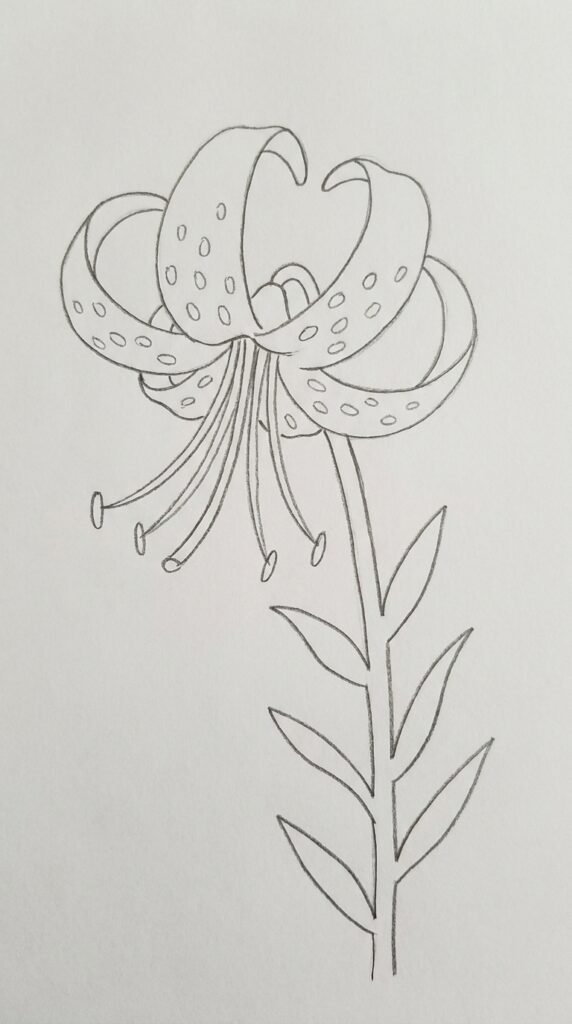
The tiger lily is one of the most popular lily drawing ideas because of its distinctive spotted petals that curve dramatically backward. This drawing features petals that sweep back and downward, giving the flower a dramatic, flowing look. The dots on the petals can be drawn as simple small circles or oval shapes scattered across each petal, making it fun and easy for kids to complete.
Step-by-Step Instructions:
- Draw a small oval in the upper center area of your paper to mark the flower center.
- Draw six petals curling backward and outward from the center. Each petal should be narrow at the base and wider in the middle, then tapering to a curled-back tip.
- Add small oval or circular dots scattered across each petal to represent the tiger lily spots. Keep them irregular for a natural look.
- Draw long curved stamens extending downward from the center with tiny oval anthers at their tips.
- Add a thick stem below and several lance-shaped leaves growing alternately along its length.
Side View Lily with Drooping Head\
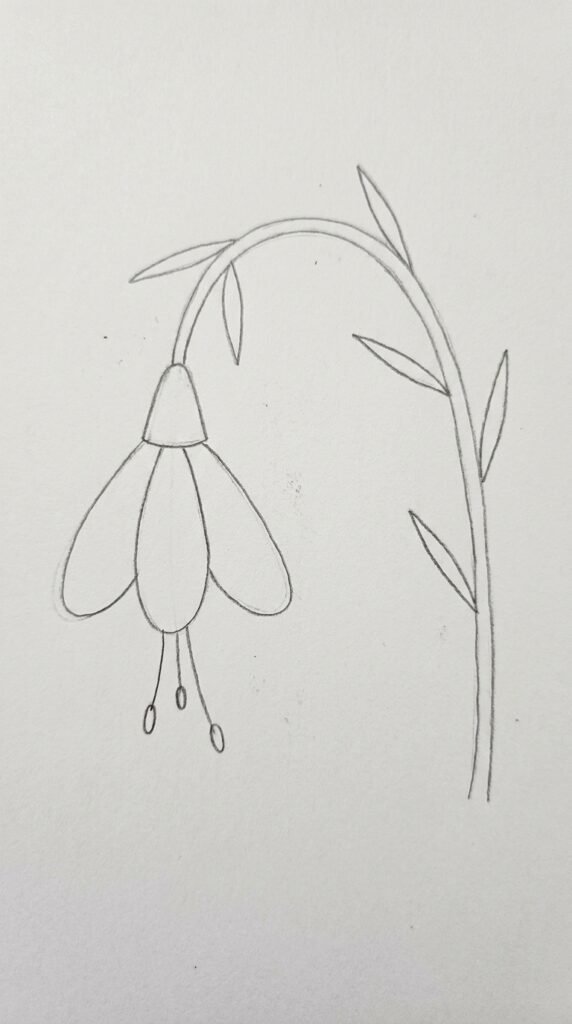
Drawing a lily from the side is a great way to show the full shape of the petals and the graceful droop that many lily varieties display. This angle makes it easier for beginners because you only see half of the petals at once, reducing the complexity of the composition. It is also one of the most visually striking lily drawing ideas for use in art journals and botanical sketches.
Step-by-Step Instructions:
- Draw a long curved stem that arches gracefully to the right or left, like a gentle hook at the top.
- At the hooked tip of the stem, draw the base of the flower as a short tube or cone shape pointing downward.
- Add three visible petals from this cone, fanning outward to the right and downward. Each petal should be wide and gently curved.
- Draw two or three stamens hanging down from inside the cone, each ending in a small oval or rectangular anther.
Add leaves growing upward along the curved stem in alternate positions, each leaf narrow and pointed
Cartoon Lily for Kids
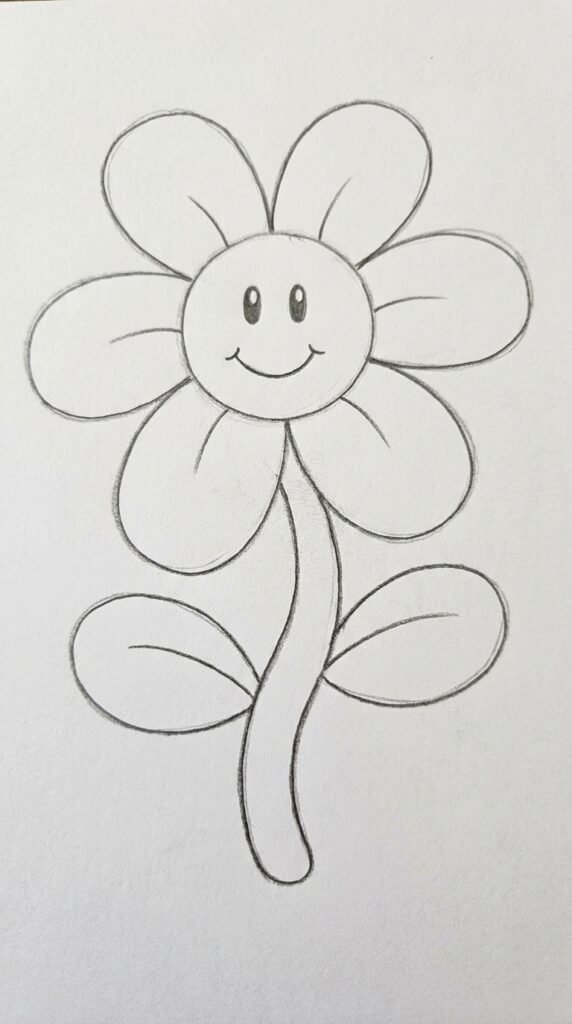
A cartoon-style lily is perfect for younger children or beginners who want a fun and simple version of the flower. This drawing uses exaggerated shapes, a smiley-like center, and thick but simple petal outlines. It is one of the friendliest lily drawing ideas for kids because every shape is large and easy to control with a pencil or crayon.
Step-by-Step Instructions:
- Draw a large circle in the upper middle of your paper to serve as the cartoon flower face and center.
- Add six large, round-tipped petals evenly spaced around the circle. Each petal should be wide and short, like a rounded rectangle.
- Inside the circle, draw two small ovals for eyes and a curved line for a smile to give the flower a happy cartoon face.
- Draw a thick, slightly wavy stem below the flower and add two large rounded leaves on either side.
Peace Lily Drawing
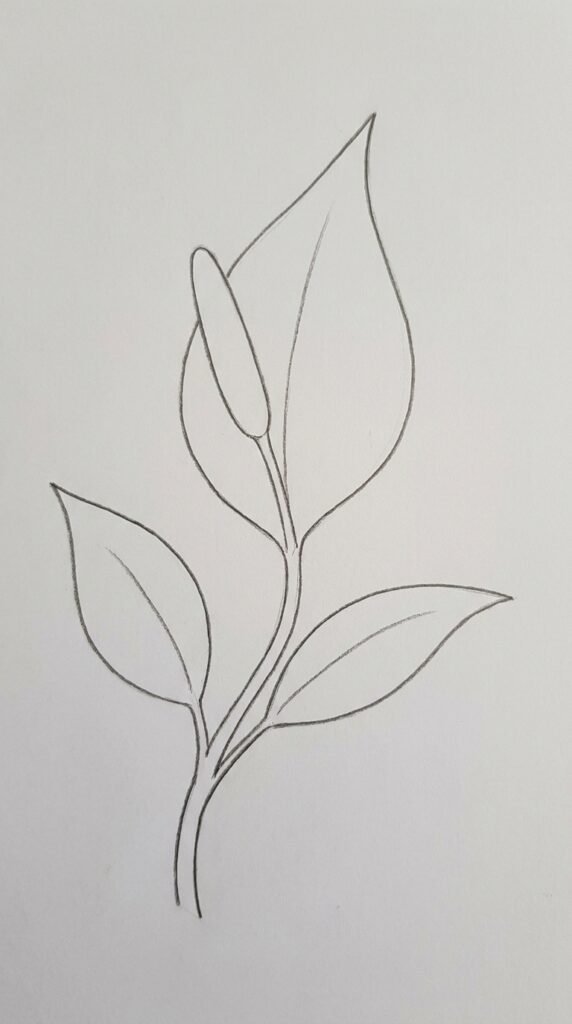
The peace lily has a very different shape from other lilies and is one of the most elegant lily drawing ideas available. Instead of multiple petals, it features a single large white spathe (a hood-like bract) and a tall thin spadix rising from its center. This minimal design is great for beginners who want something unique and modern-looking without drawing too many petals.
Step-by-Step Instructions:
- Draw a single large leaf-like shape in the center of your page that is wide at the bottom and comes to a gentle point at the top. This is the spathe.
- Inside the spathe, draw a thin vertical oval rising from the base. This is the spadix, the tall central spike of the peace lily.
- Add a midrib line through the center of the spathe from base to tip to give it a natural leaf-like texture.
- Draw a thin curved stem below the spathe and add two large, oval-shaped leaves with pointed tips emerging from either side of the base.
Easter Lily Drawing
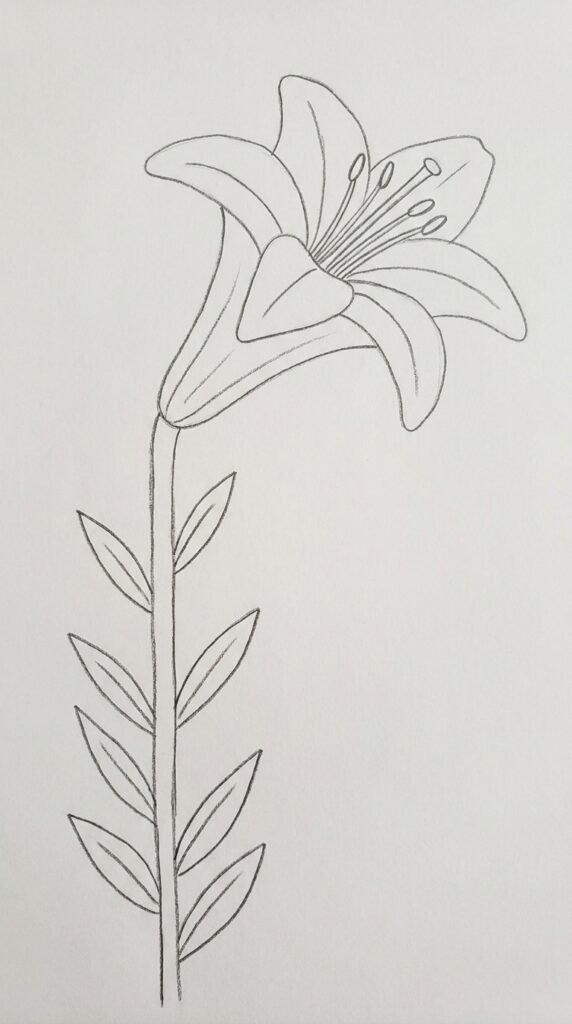
The Easter lily is known for its trumpet-shaped blooms that flare outward at the tips, creating a graceful bell or funnel shape. This is one of the most requested lily drawing ideas because of how beautiful and recognizable the flower is. The trumpet structure makes it slightly different from the flat open lily, giving beginners a fun challenge with a structured geometric starting shape.
Step-by-Step Instructions:
- Draw a narrow oval or cylinder pointing slightly to one side to form the opening of the trumpet. This is the front view of the funnel.
- From the edges of the oval, extend six petals that flare outward and backward. The petals should be wide and slightly wavy at their outer edges.
- Draw a midrib line through each visible petal for structure and detail.
- Add long stamens with oval anthers emerging from the center of the trumpet opening.
Draw a long straight stem below the flower with several lance-shaped leaves placed alternately along its length
Lily with Long Grass Leaves
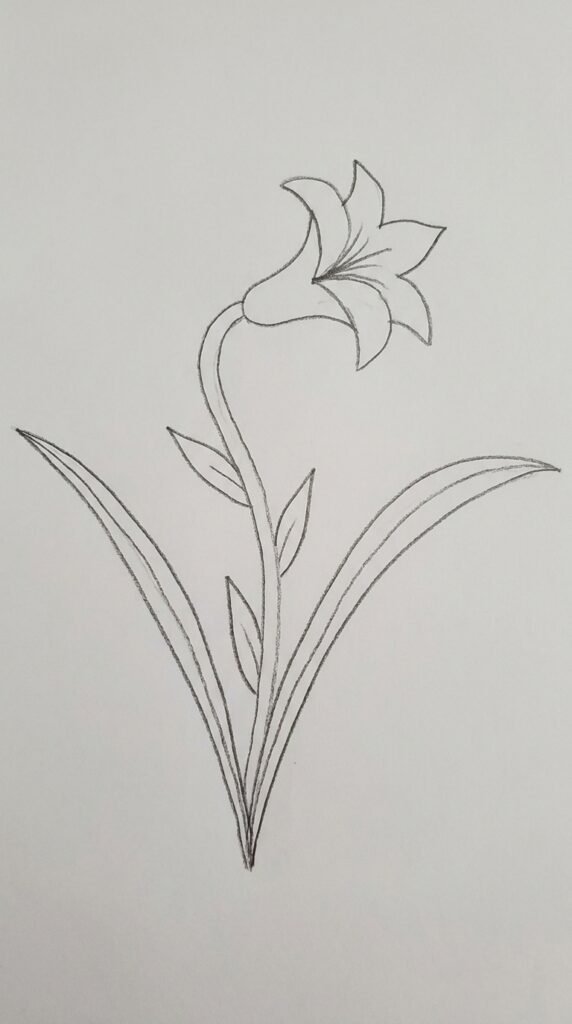
Adding long, sweeping grass-style leaves to a lily creates a beautiful botanical composition that looks complete and balanced. This drawing style is popular in nature art and floral sketchbook illustrations. The long curving leaves add movement and life to the composition, making it one of the most satisfying lily drawing ideas for intermediate beginners.
Step-by-Step Instructions:
- Draw the lily flower in the upper third of your page using the simple open bloom method from the first idea, but make it slightly smaller.
- Draw a medium-length stem below the flower that curves slightly to one side.
- Add two long, arching grass-like leaves that start from near the base of the stem and sweep upward and outward on both sides. These should be long, narrow, and gently curved.
- Draw a central vein line through each long leaf running from base to pointed tip.
- Add two or three shorter leaves growing from different points on the stem to fill the composition.
Three Lily Blooms on One Branch\
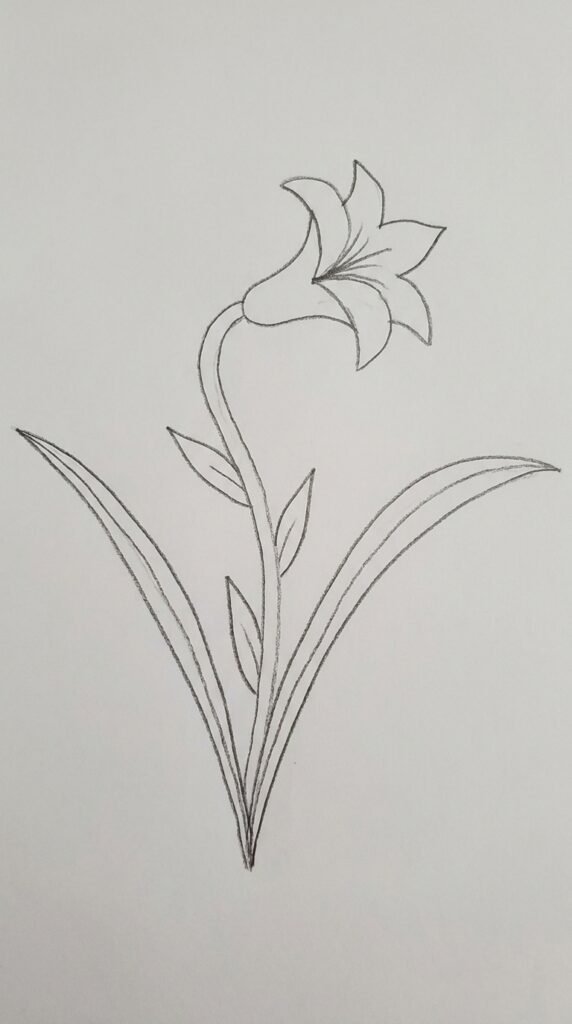
Drawing three lilies on one branching stem creates a fuller, more complex composition that still uses the same basic skills. This is one of the best lily drawing ideas for sketchbooks because it fills the page naturally and shows the flower at different stages. The varied positioning of the blooms, including one bud and two open flowers, adds visual interest and storytelling to the piece.
Step-by-Step Instructions:
- Draw a main vertical stem from the bottom of the page to about the center. At the top, branch it into two or three directions using shorter curved lines.
- On the highest branch, draw a fully open lily bloom facing slightly upward.
- On the middle branch, draw a second open bloom facing to the side so you see it from a three-quarter angle.
- On the lowest branch tip, draw a closed bud shape pointing upward to suggest a flower not yet in bloom.
- Add several lance-shaped leaves distributed along the main stem and branches to complete the composition.
Lily Inside a Circle Frame
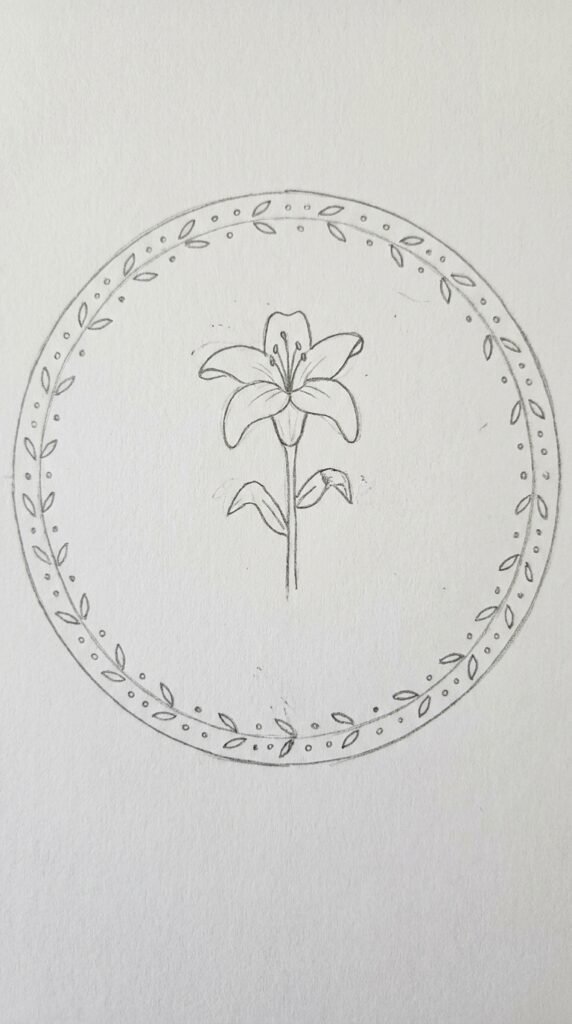
Placing a lily drawing inside a circle frame is a popular technique for creating decorative art, badges, and logo-style illustrations. This design is great for beginners because the circle gives you a clear boundary to work within, helping you control proportion and placement. It is one of the most versatile lily drawing ideas because the result works beautifully in bullet journals, stickers, and greeting card designs.
Step-by-Step Instructions:
- Use a compass or trace a round object to draw a clean circle in the center of your page. Make it large enough to comfortably hold a small lily bloom.
- Draw a small open lily bloom in the upper center area inside the circle. Keep the flower slightly smaller than you normally would so it fits within the frame.
- Add a short stem with two or three leaves extending downward from the bloom, keeping everything inside the circle.
- Optionally, draw small dots, simple leaf shapes, or tiny line decorations around the inside edge of the circle to create a border effect.
Lily With a Butterfly
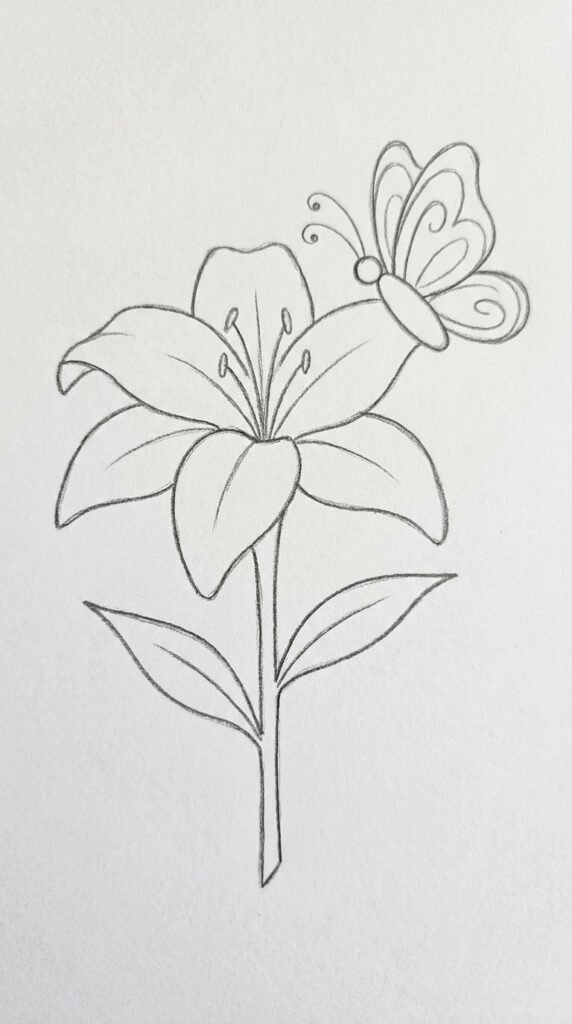
Combining a lily with a butterfly creates a charming nature scene that is one of the most popular lily drawing ideas for greeting cards, sketchbooks, and Pinterest-worthy art posts. The butterfly adds movement and life to the otherwise static flower, and both subjects use similar simple curved shapes, making the combination accessible to beginners.
Step-by-Step Instructions:
- Draw an open lily bloom slightly left of center on your page using the standard six-petal method.
- Add a straight stem with two leaves below the flower.
- On one of the top petals, draw a small butterfly. Start with a tiny oval body and add two large upper wings and two smaller lower wings on each side.
- Draw two thin antennae extending from the butterfly’s head with tiny circles at their tips.
- Add simple curved lines inside the butterfly wings to suggest a wing pattern without detailed shading.
Lily in a Glass Vase
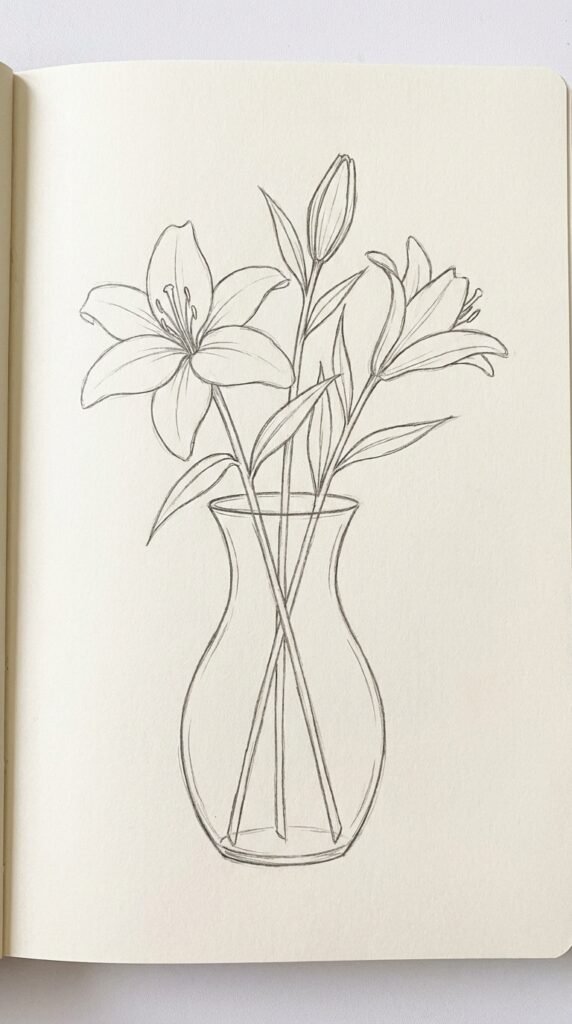
Drawing a lily inside a glass vase is a great exercise in combining two different types of objects into one scene. The vase acts as a grounding element that makes the drawing feel complete and ready to display. This is one of the most satisfying lily drawing ideas because the finished piece looks like something you would see on a greeting card or in a home illustration.
Step-by-Step Instructions:
- In the lower half of your page, draw a simple vase shape. Use two gentle curved lines that widen at the base and narrow slightly at the neck, then flare out slightly at the rim.
- Draw a horizontal ellipse at the top of the vase opening to show depth.
- From inside the vase, draw two or three stems rising upward, each one branching off in a slightly different direction.
- At the top of each stem, draw a lily bloom, mixing one open bloom, one bud, and one side-view flower for variety.
- Add pointed leaves growing from the stems at natural intervals both above and inside the vase.
small mini lily pattren
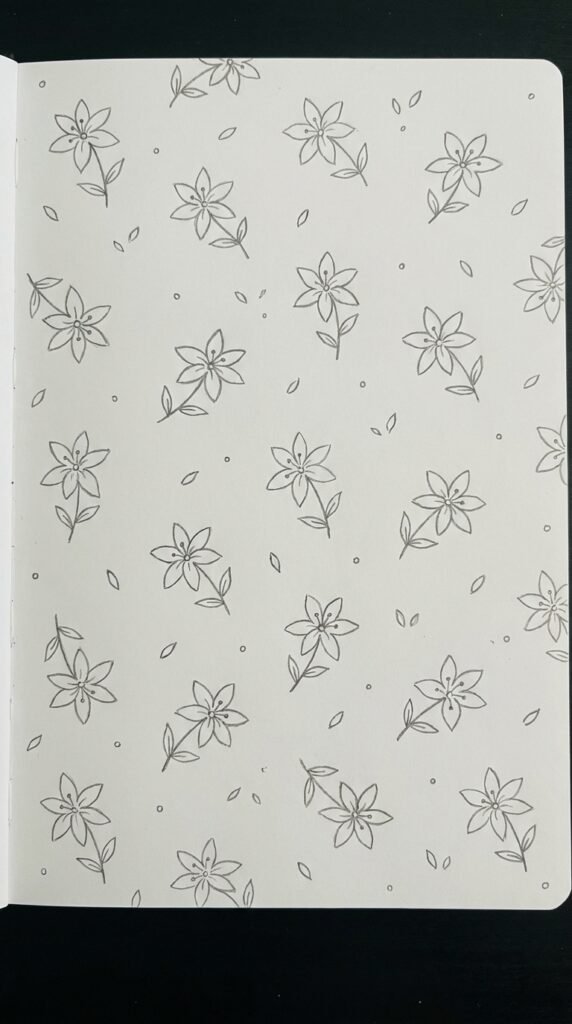
A mini lily pattern is created by repeating small lily drawings across the page in a regular or scattered arrangement. This is one of the most creative lily drawing ideas for filling blank pages in art journals and sketchbooks. It also works well as a background design for handmade cards and wrapping paper doodles. Each mini lily is about one inch tall and uses only a few simple lines.
Step-by-Step Instructions:
- Start in one corner of your page and draw one very small lily. Use six tiny pointed petals around a small dot center with a short stem and two tiny leaves.
- Leave a small gap and draw another small lily nearby, slightly tilted at a different angle.
- Continue repeating the same mini lily shape across the page, varying the angle and direction slightly for each one to give a natural scattered look.
- Fill in the gaps between the lilies with tiny leaf shapes, small dots, or simple curved lines to create a dense but airy floral pattern.
lily with a moon Background
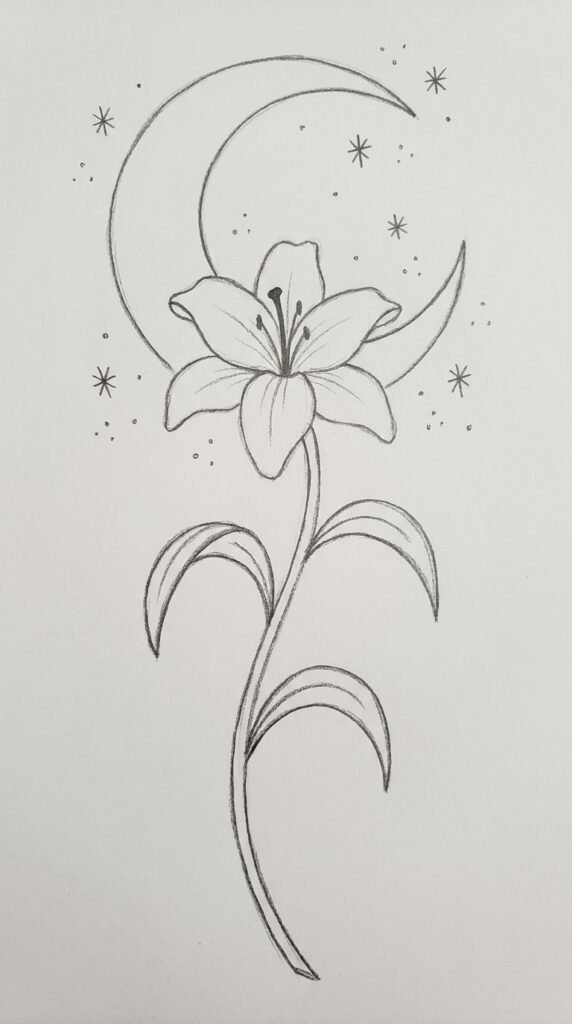
Drawing a lily with a crescent moon in the background creates a dreamy, celestial illustration that is very popular in Pinterest art communities. This is one of the most atmospheric lily drawing ideas and works beautifully in bullet journals, night-themed sketchbook pages, and decorative wall art. The simple crescent shape behind the lily provides contrast and visual interest without requiring complex skills.
Step-by-Step Instructions:
- Draw a large crescent moon shape in the upper right or upper center area of your page. Use two overlapping circles of different sizes to create a clean crescent outline.
- In front of and slightly overlapping the moon, draw a lily bloom facing upward with its full six petals open.
- Draw a long curved stem going downward from the lily bloom, bending gracefully toward the left.
- Add two or three long leaves growing from the stem, each gently curving to complement the arch of the composition.
- Optionally add tiny stars as small asterisk shapes or dots scattered around the moon to complete the night-sky feeling.
Water Lily on a Pond Surface
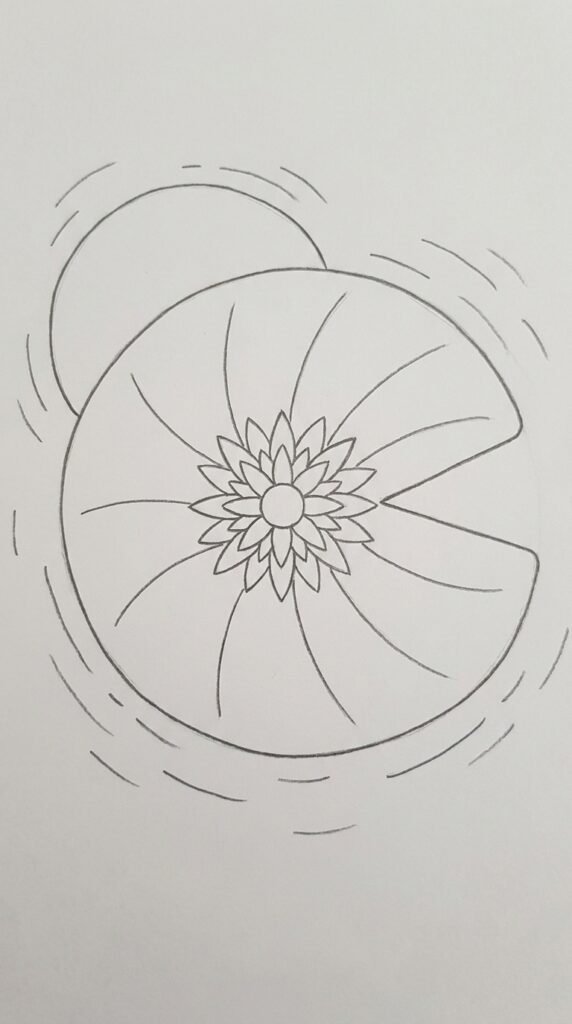
A water lily is a completely different variety from garden lilies and creates a serene, flat composition that is ideal for beginners. The flower sits on top of a large flat pad and is seen from above, which makes drawing it feel more like placing shapes than constructing a three-dimensional flower. This is one of the most peaceful lily drawing ideas and is perfect for mindfulness art and nature illustration practice.
Step-by-Step Instructions:
- Draw a large flat oval in the lower center of your page to represent the lily pad. Leave a small V-shaped notch on one side to make it look like a real lily pad.
- Add curved lines radiating from the notch across the lily pad surface to show the natural vein pattern.
- In the upper center of the lily pad, draw a water lily flower seen from above. Use a small circle in the center and arrange narrow pointed petals evenly around it in multiple layers.
- Add a second smaller lily pad partially behind the first one, showing only part of its edge and a bit of its vein pattern.
- Draw a few short curved lines around the pads to represent the surface of still water.
Drawing Tips for Better Lily Sketches
Use an HB pencil for all outline work. This pencil grade gives you clear, dark lines without being too heavy or too light. If you press too hard, the lines become difficult to erase and look uneven. Keep a steady, medium pressure throughout your drawing.
Always start with a light rough sketch before committing to your final lines. Draw the flower center first, then add petals outward. Working from the center outward gives you better control over proportion and spacing.
Rotate your paper as you draw each petal. Instead of moving your hand in awkward directions, rotate the page so that every petal stroke feels natural and consistent.
Use simple shapes as guides. An oval or teardrop is the base of almost every petal in every lily drawing idea in this guide. Once you can draw a controlled oval or teardrop, every lily type becomes manageable.
Do not worry about perfection. Slightly uneven petals make a lily look natural, not sloppy. Flowers in real life are not perfectly symmetrical, and your drawing does not need to be either.
Common Mistakes to Avoid When Drawing Lilies
Making all petals the same length and width creates a mechanical, unnatural look. Vary the length of each petal by a small amount to give the flower organic character.
Drawing the stem too thin relative to the flower makes the composition look unbalanced. The stem should be thick enough to look like it could realistically hold the weight of the blooms.
Skipping the stamens is a common shortcut that makes the flower look incomplete. Even two or three simple lines with tiny ovals at the tips will make a significant difference in how finished the drawing appears.
Adding leaves that point in a random direction unrelated to the stem makes the plant look disconnected. Leaves should always emerge from the stem at natural angles, pointing generally upward or outward.
Drawing the entire flower too large for the page leaves no room for the stem and leaves. Plan your composition by lightly marking the top and bottom of your intended drawing area before you begin.
Frequently Asked Questions About Lily Drawing Ideas
What are the easiest lily drawing ideas for beginners?
The easiest lily drawing ideas for beginners include the simple open lily bloom, the lily bud on a long stem, and the cartoon lily for kids. These three designs use the most basic shapes, require no shading, and can be completed in ten to fifteen minutes. They are perfect starting points for children and adults who have never drawn a flower before.
How do you draw a lily step by step for kids?
To draw a lily step by step for kids, start with a small circle in the center of the page, then add six large petals around it using rounded teardrop shapes. Add a straight stem below and two simple leaf shapes on either side. This basic lily can be drawn in under