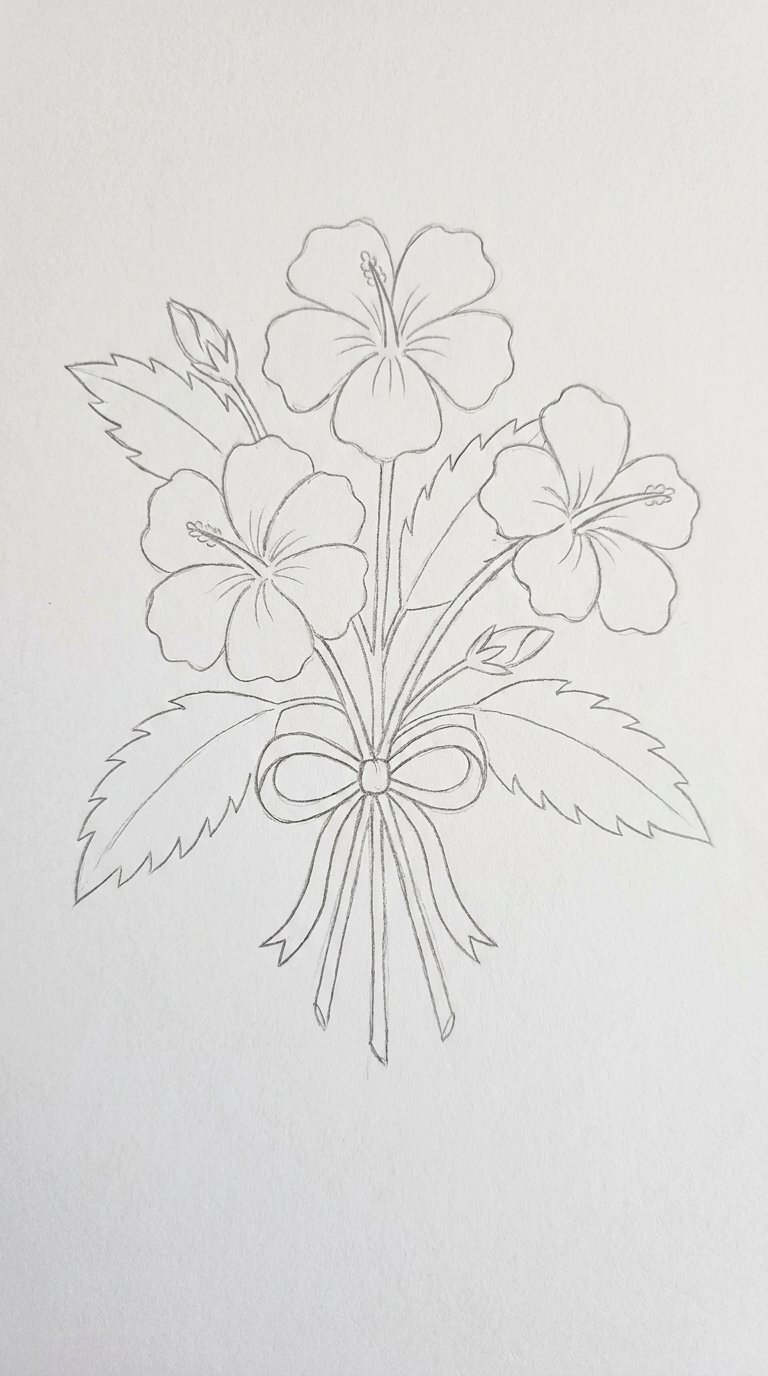
If you have ever looked at a hibiscus flower and thought it looked too complicated to draw, you are not alone. Many beginners feel that way about tropical flowers. The good news is that hibiscus flowers are actually one of the most beginner-friendly flowers to sketch once you break them down into simple shapes. Each petal is basically a rounded oval, and the center stamen is just a thin line with tiny dots at the top. That is it. Nothing scary about it at all.
This article gives you 15 hibiscus drawing ideas that are easy enough for kids and satisfying enough for adults who are just starting their art journey. You will learn how to draw hibiscus flowers from the front, from the side, with leaves, on branches, as outlines, and in many other fun arrangements. Every idea comes with clear step-by-step instructions so you always know exactly what to draw next.
All of these hibiscus drawing ideas use simple pencil lines only. There is no shading, no blending, and no advanced techniques involved. You just need a pencil, an eraser, and a piece of white paper. Whether you are filling a sketchbook, making a greeting card, or just killing time on a quiet afternoon, these ideas will give you plenty to practice. By the time you finish working through even a few of these, you will feel much more confident drawing flowers of any kind. So pick up your pencil and let us get started.
Simple Front-View Hibiscus Flower
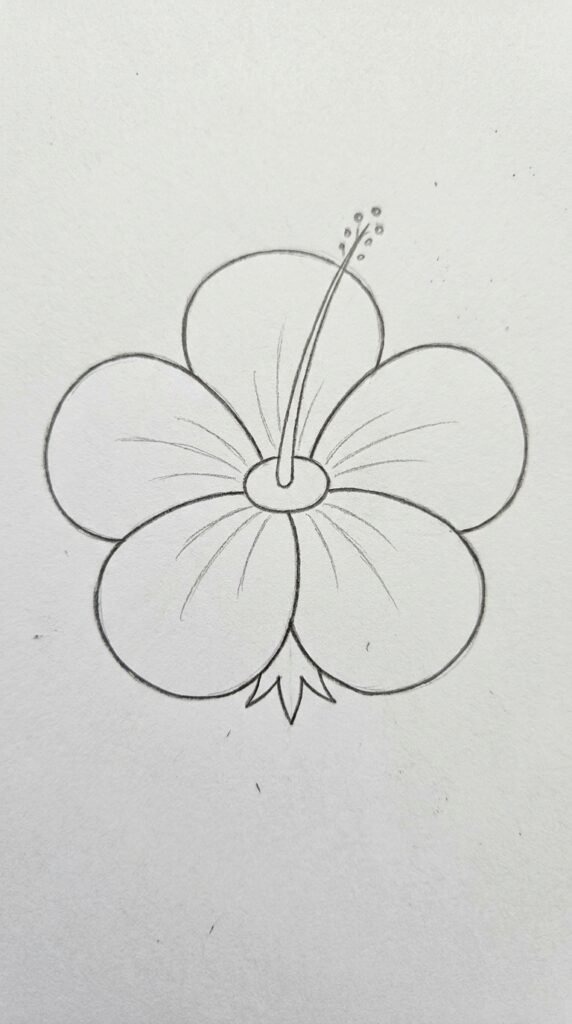
The classic front-view hibiscus is the most recognized form of this flower. It shows five wide petals arranged in a circle around a central stamen tube. This view is ideal for beginners because all the shapes are symmetrical and easy to control. Once you master this version, every other hibiscus drawing idea becomes simpler to approach.
Step-by-Step Instructions:
- Draw a small oval in the center of your paper. This will be the base of the stamen tube. Keep it about the size of a pea.
- Draw five rounded petal shapes around the oval. Each petal should be roughly the same size, wide at the tip and narrower near the center. Space them evenly so the flower looks balanced.
- Add a thin vertical line rising from the center oval. This is the stamen tube. At the top of the line, add five or six tiny dots or small circles to represent the pollen tips.
- Add two or three curved lines inside each petal running from the base toward the tip. These are the petal veins and make the flower look more natural.
- Draw a small five-pointed calyx shape behind the flower where the petals meet the stem.
Side-View Hibiscus Bloom
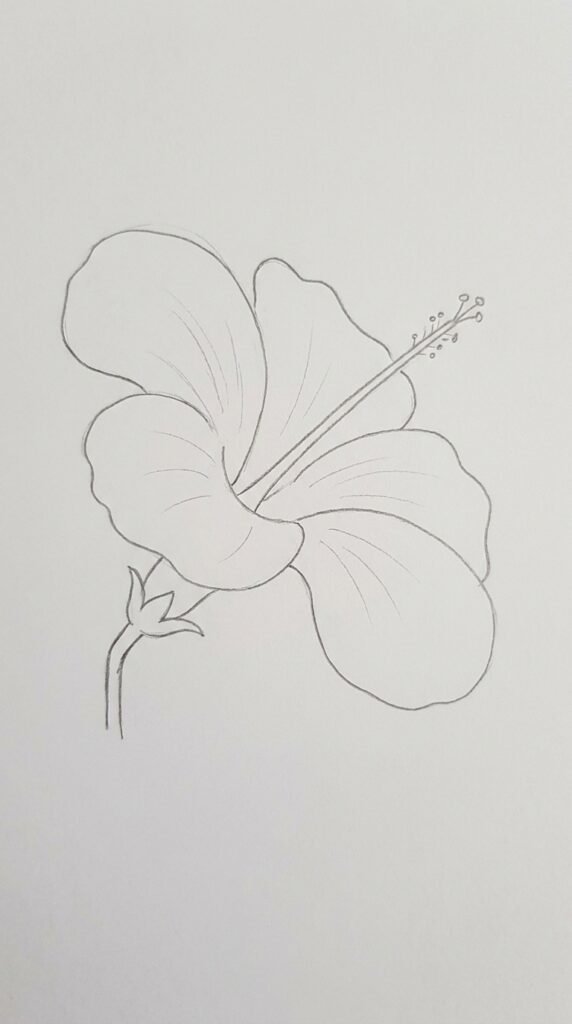
Drawing the hibiscus from the side gives it a graceful, nodding look that is perfect for botanical-style sketchbooks. In this view, you only see three or four petals clearly, and the stamen projects outward from the flower’s center. This is a great hibiscus drawing idea if you want variety in your sketchbook pages.
Step-by-Step Instructions:
- Start by drawing a small curved tube shape pointing diagonally to one side. This is the stamen tube. Add a cluster of tiny dots at its far end.
- Draw two large petals directly behind the stamen tube, slightly overlapping each other. These should be wide and rounded, pointing away from the tube.
- Add one smaller petal at the back that is partially hidden. It only needs to peek out from behind the larger petals.
- Draw the sepal and calyx at the base of the flower. These are small, pointed leaf shapes that wrap around where all petals meet.
- Extend a short stem downward from the calyx. Add a few curved lines on the petals to suggest their natural texture.
Hibiscus Flower Bud
Drawing a hibiscus bud is one of the most useful hibiscus drawing ideas because buds add variety to any floral composition. A bud is simply a flower that has not opened yet, which means the shapes are even simpler. You mostly just draw the calyx and a rolled-up petal mass peeking out from the top.
Step-by-Step Instructions:
- Draw a small oval or egg shape in the center of your paper. Make it slightly taller than it is wide.
- Around the lower half of the oval, draw five narrow pointed shapes fanning outward. These are the sepals of the calyx, the protective outer covering of the bud.
- At the top of the oval, draw two or three small curved lines to suggest the tightly rolled petals just starting to emerge.
- Add a short stem at the very bottom of the calyx. Draw it slightly curved rather than completely straight to make it look natural.
- Add one or two small pointed leaves branching off from the stem to complete the composition.
Hibiscus With Leaves on a Branch
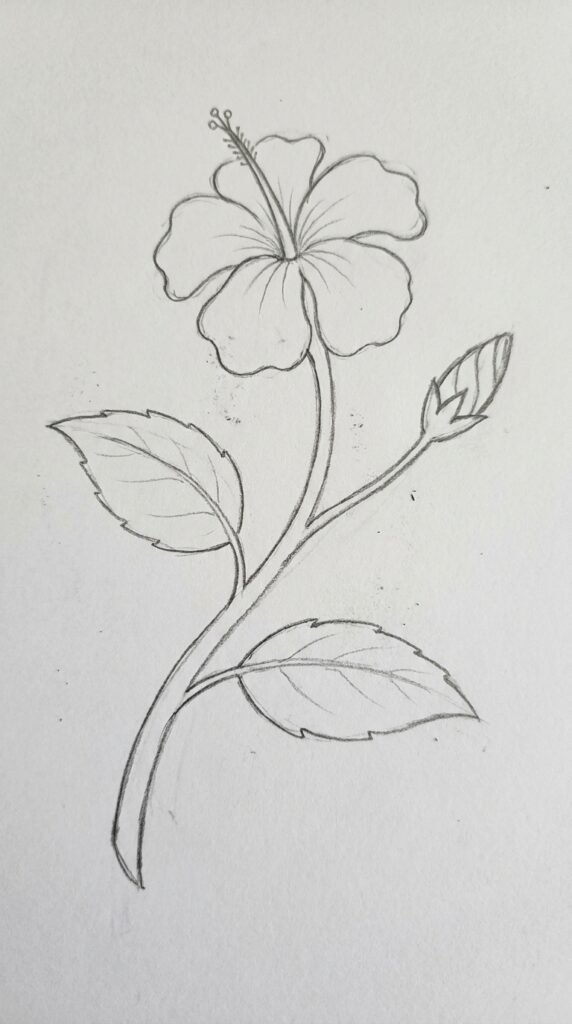
Combining the hibiscus flower with leaves and a branch creates a fuller, more complete drawing. This is an excellent hibiscus drawing idea for sketchbook pages or decorative borders. The branch grounds the composition and gives it a botanical illustration feel without needing advanced skills.
Step-by-Step Instructions:
- Draw a gently curving branch line from the lower left corner toward the upper right. Do not make it perfectly straight. A slight S-curve looks more natural.
- At the end of the branch, draw a full front-view hibiscus flower using the steps from the first idea. Keep the flower at the top of the branch.
- Draw two or three hibiscus leaves along the branch at different heights. Hibiscus leaves are broadly oval with slightly serrated or toothed edges. Add a center vein line and a few branching veins from it.
- Add one smaller side branch with a hibiscus bud on it. This adds depth and story to the drawing.
- Draw the connection between each leaf and the branch using a tiny short stem called a petiole.
Hibiscus Wreath Outline
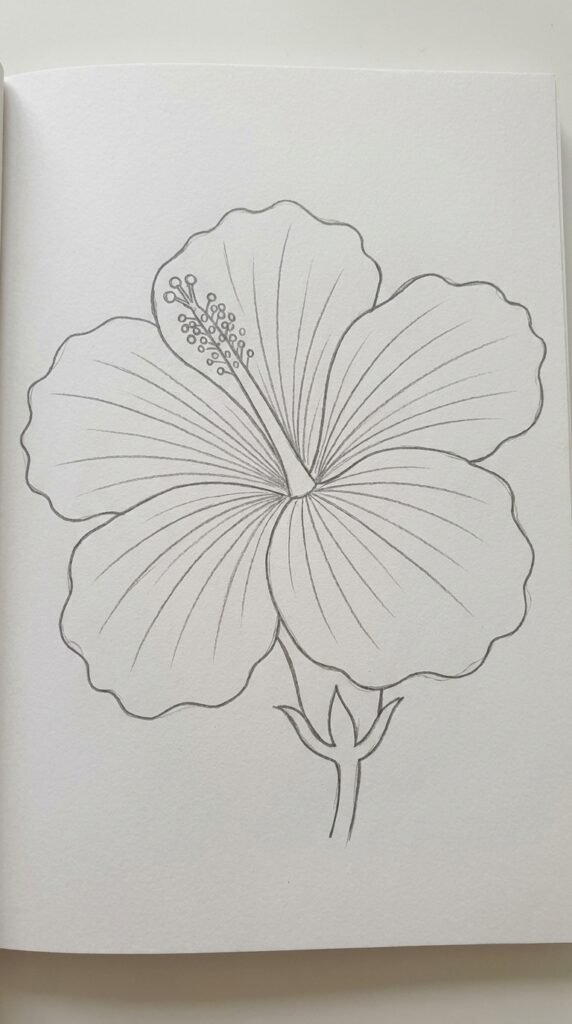
A wreath made of hibiscus flowers and leaves is one of the most popular hibiscus drawing ideas for decorative art. It makes a beautiful frame for a word or quote and is surprisingly simple to construct once you know how to draw a single hibiscus. The key is to place the flowers and leaves evenly around a circular guide.
Step-by-Step Instructions:
- Lightly draw a large circle with your pencil. This is just a guide and will be erased later, so keep the pressure very light.
- Place four hibiscus flower outlines around the circle at equal intervals: top, bottom, left, and right. Draw each flower so its stem points toward the center of the circle.
- Fill the spaces between the flowers with hibiscus leaves and buds. Alternate large and small leaves to vary the look.
- Connect the flowers, buds, and leaves with small curved stems that follow the path of the original circle guide.
- Erase the circle guide once everything is connected. Clean up any overlapping lines.
Hibiscus Pattern Repeat
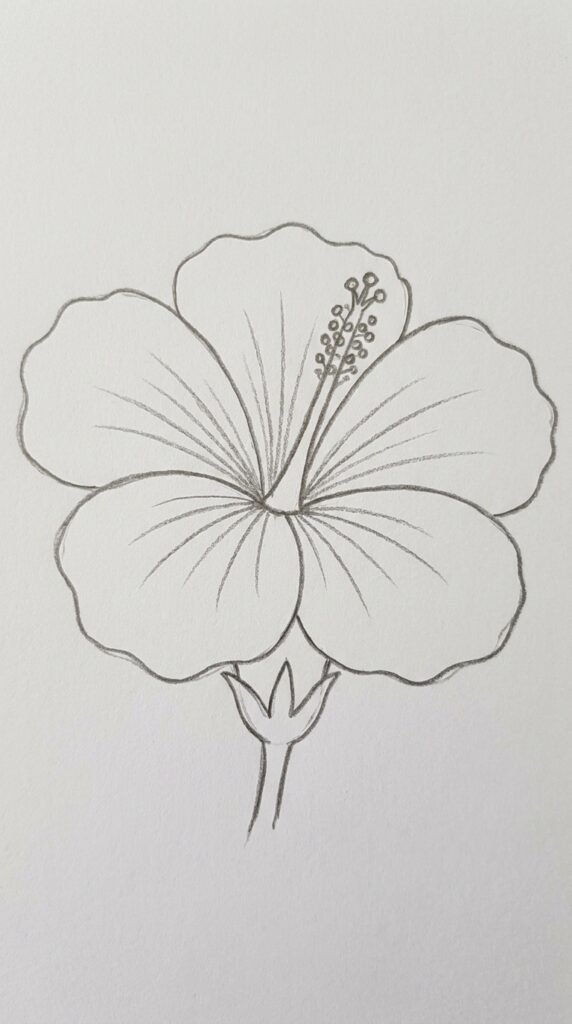
A repeating hibiscus pattern is one of those hibiscus drawing ideas that is both meditative and practical. Once you draw one hibiscus unit cleanly, you simply repeat it across the page in a grid or scattered arrangement. This makes it perfect for decorating notebook covers, borders, or gift wrap designs.
Step-by-Step Instructions:
- Draw your first small hibiscus flower in the upper left corner of the paper. Keep it simple: five petals and a stamen. Aim for about one to two inches in size.
- Leave an equal amount of space and draw another identical hibiscus to the right of the first one. Continue across the row.
- On the next row below, offset the flowers slightly so they fall between the flowers of the row above, like a brick pattern.
- Add two or three small leaves scattered between the flowers to fill the gaps. Keep them the same simple oval shape each time.
- Continue the pattern until the page is filled. The goal is consistency in size and spacing.
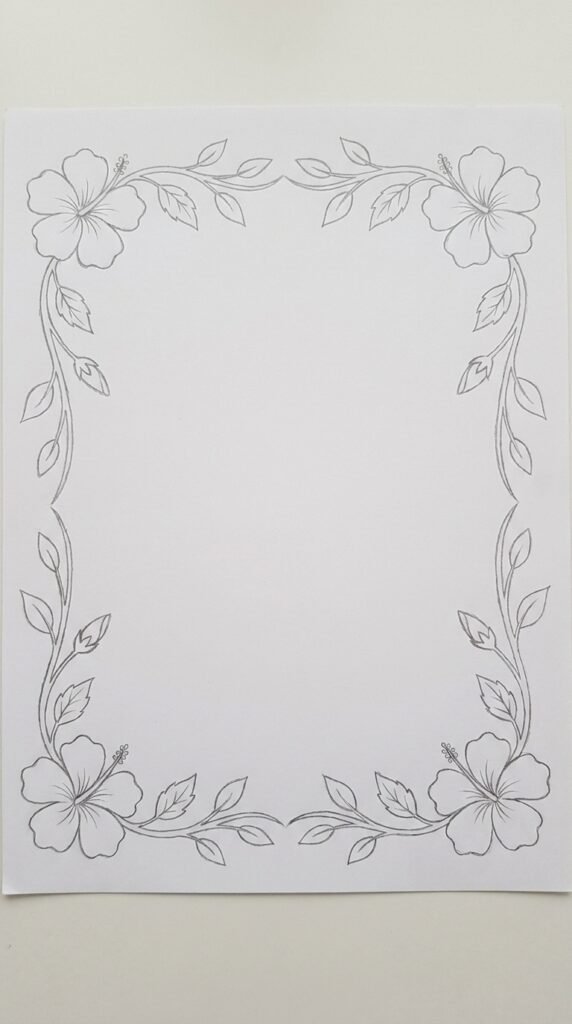
Hibiscus Corner Border Design
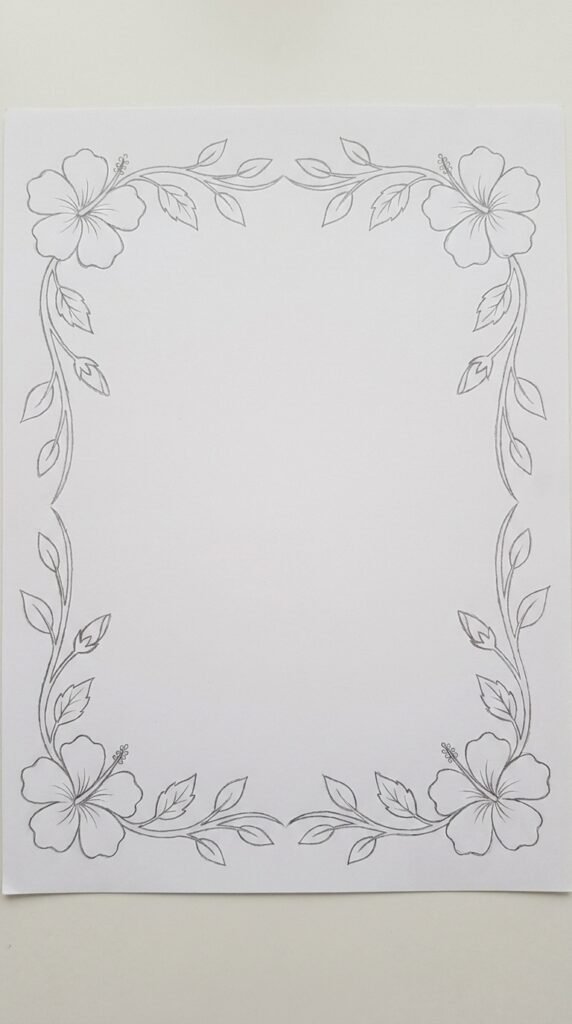
Corner borders using hibiscus motifs are elegant hibiscus drawing ideas for stationery, certificates, or journal pages. Each corner gets one hibiscus cluster that includes a flower, leaves, and a swirling stem. The four corners together frame the page beautifully.
Step-by-Step Instructions:
- In the top-left corner of the paper, draw a hibiscus flower facing inward toward the center of the page.
- From the flower’s base, draw a curved stem that sweeps along both the top and left edges of the page for about two inches each direction.
- Along the stems, add three to four leaves pointing outward. Alternate leaf sizes to keep it interesting.
- Add one small hibiscus bud near the end of each stem branch.
- Repeat this process in all four corners, mirroring the design so each corner matches its opposite.
Hibiscus With Butterfly
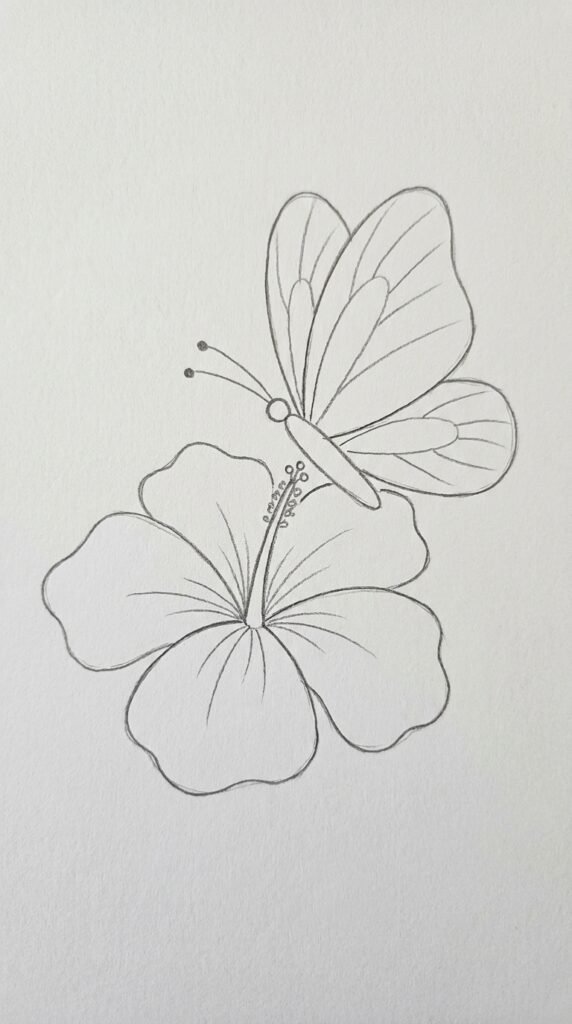
Adding a butterfly to your hibiscus drawing creates a lively nature scene and is one of those hibiscus drawing ideas that kids especially love. The butterfly does not need to be complex. A simple pair of large and small wings on either side of a thin body is all it takes.
Step-by-Step Instructions:
- Draw a full front-view hibiscus flower slightly to one side of the center of your paper.
- Draw a thin elongated oval for the butterfly body slightly above and to the right of the flower’s center.
- On either side of the body, draw two large rounded upper wings. Below each upper wing, draw a smaller, slightly pointed lower wing.
- Add a few simple vein lines inside each butterfly wing to give it structure.
- Draw two thin antennae curving upward from the butterfly’s head with a small dot at each tip. Optionally add the butterfly’s feet resting on the hibiscus stamen.
Hibiscus Tea Cup Illustration
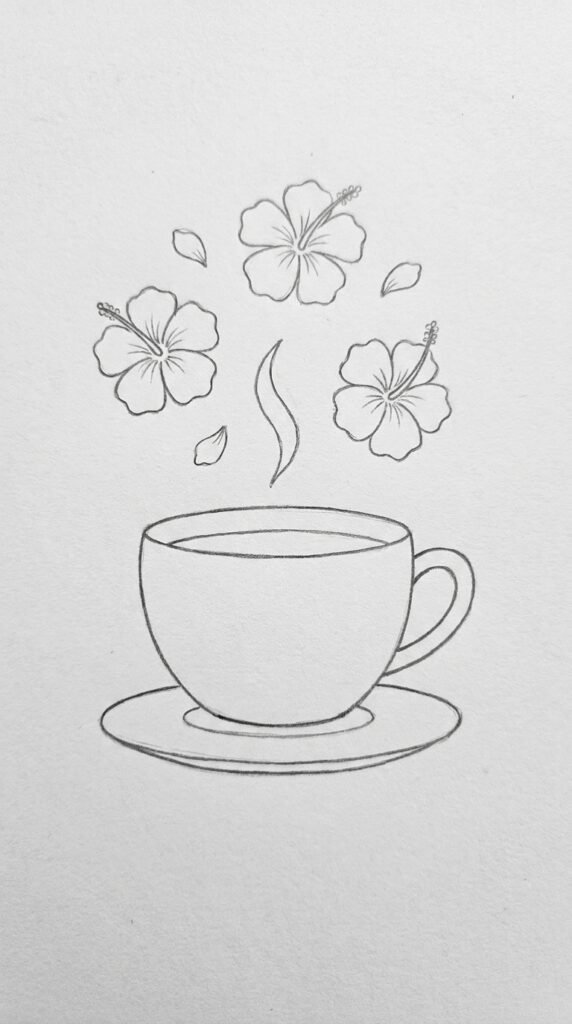
A hibiscus flower floating above or beside a cup of tea is a charming and creative hibiscus drawing idea. It connects the visual beauty of the flower to its popular culinary use. This is a lovely idea for kitchen art, food blogs, or just fun sketchbook practice.
Step-by-Step Instructions:
- Draw a simple tea cup shape in the lower center of the paper. A cup is essentially a rounded trapezoid shape with a curved base and a small handle on the right side.
- Add a saucer beneath the cup: a flat oval slightly wider than the cup bottom.
- Draw two or three hibiscus flowers floating above the cup as if they are falling into or rising from the tea. Keep the flowers simple with five petals each.
- Add a few scattered individual petals drifting in the space between the flowers and the cup.
- Draw a small curved line of steam rising from the top of the cup to suggest warmth.
Hibiscus Mandala Design
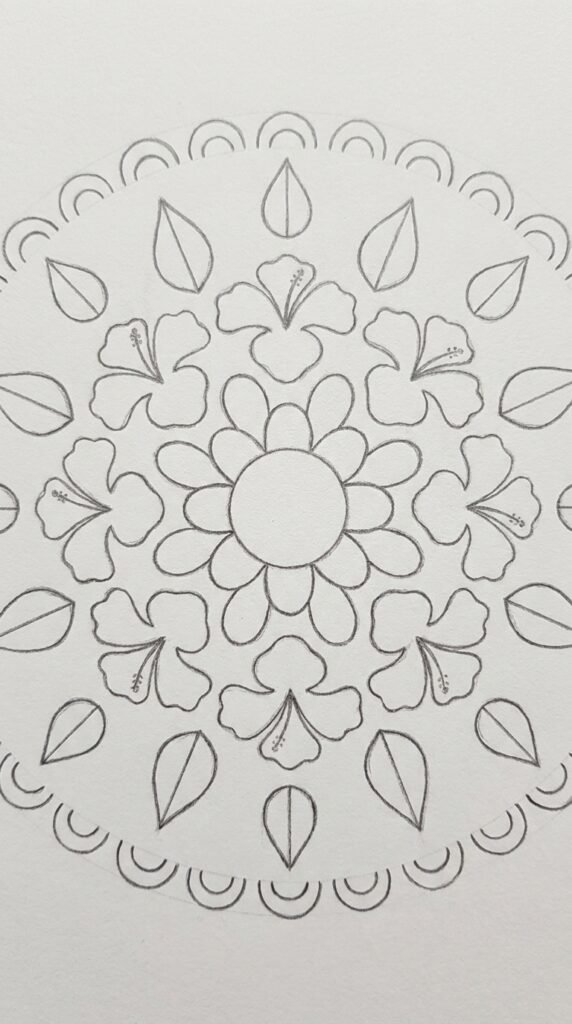
A hibiscus mandala is one of the more ambitious hibiscus drawing ideas on this list, but it is still very manageable for beginners. A mandala is just a pattern built by repeating the same shape around a central point. Using hibiscus petals as the main repeating element creates a beautiful symmetrical design.
Step-by-Step Instructions:
- Draw a small circle in the exact center of your paper. This is your mandala center.
- Around the center circle, draw eight small hibiscus petal shapes pointing outward like rays of the sun. Space them evenly.
- In the next ring outward, draw eight larger hibiscus petals between the inner petals. Each outer petal sits between two inner ones.
- Add a third ring of small teardrop or leaf shapes just outside the second ring of petals, again evenly spaced.
- Add a final outer ring of small curved brackets or arc shapes to define the outer boundary of the mandala.
Hibiscus Silhouette Outline
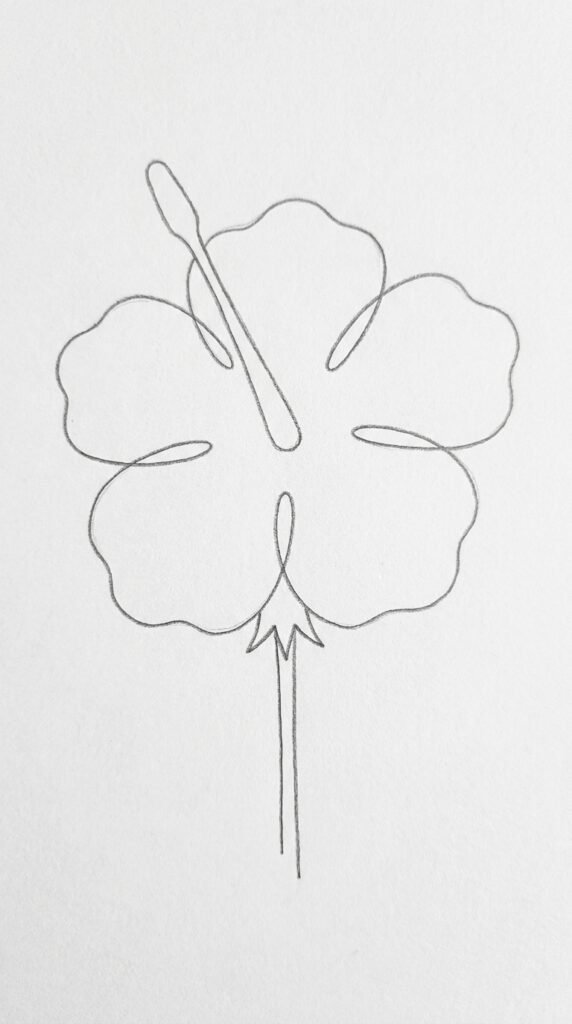
A silhouette outline is one of the simplest hibiscus drawing ideas but also one of the most visually striking. Instead of drawing the internal details of the flower, you draw only the outer boundary of the entire shape. This creates a clean, bold flower profile that is easy for young children to attempt.
Step-by-Step Instructions:
- Draw the outer edge of five petals in a round arrangement without worrying about the internal structure. Just trace the bumpy circular edge that five rounded petals would create.
- At the top of the shape, include a slight dip between each petal so the five-petal structure is visible in the outline.
- Extend the stamen tube outline above the center of the flower. It should be a thin elongated oval or spike projecting upward.
- Below the flower, draw the calyx outline: a small five-pointed star shape at the base.
- Add a single straight or slightly curved stem below the calyx to complete the silhouette
Hibiscus Bouquet Bundle
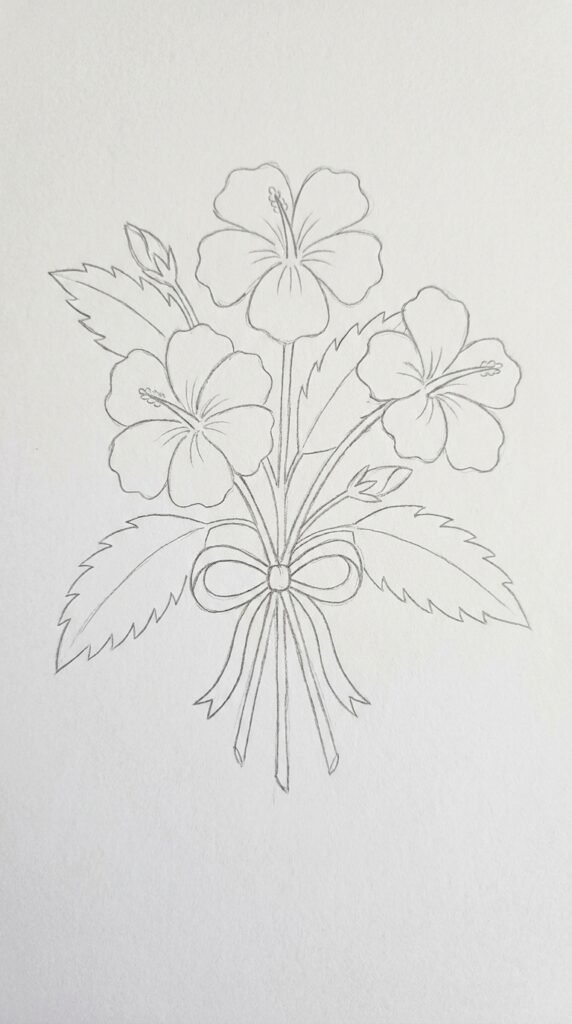
A tied bouquet of hibiscus flowers makes one of the warmest and most inviting hibiscus drawing ideas. Several flowers and leaves are gathered together and tied at the stems with a ribbon or string. This composition is great for greeting cards or celebratory art projects.
Step-by-Step Instructions:
- Draw three hibiscus flowers at different heights in the upper part of the paper. Tilt each flower head slightly in a different direction so they do not all look identical.
- Draw the stems of all three flowers converging toward a single point below the flowers, as if someone is holding them all together.
- At the point where the stems converge, draw a simple bow shape. Two loops and two ribbon tails hanging down are enough.
- Add three or four leaves along the stems pointing outward between the flowers. Vary their angles.
- Add one or two hibiscus buds among the flowers for variety.
Hibiscus Hair Flower Illustration
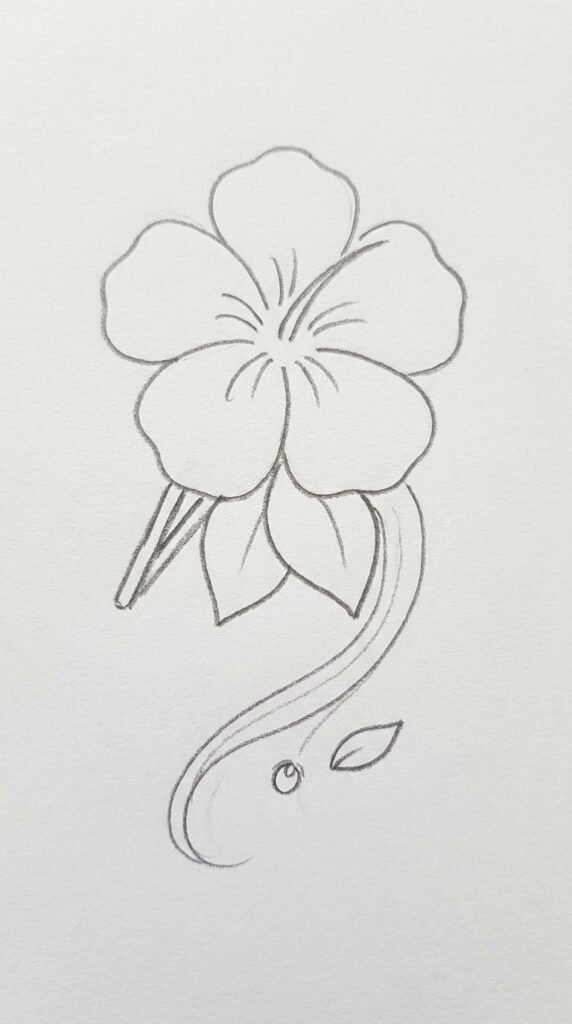
A hibiscus flower worn in the hair is a culturally rich image associated with Hawaiian and tropical traditions. Drawing it as a standalone illustration, as if it has just been tucked behind an ear, is one of those hibiscus drawing ideas that adds personality to a sketchbook page.
Step-by-Step Instructions:
- Draw a simple hibiscus flower in the classic front-view style with five petals and a stamen.
- To one side of the flower base, draw two overlapping curved leaf shapes that suggest the flower is nestled among foliage, as if tucked behind an ear.
- Add a few small lines at the very base of the flower to suggest a tiny hair stem or clip holding it in place.
- Optionally, draw a single curved line representing a lock of hair sweeping beneath the flower to provide context.
- Add a small bud or an extra leaf to balance the composition.
Hibiscus in a Flower Pot
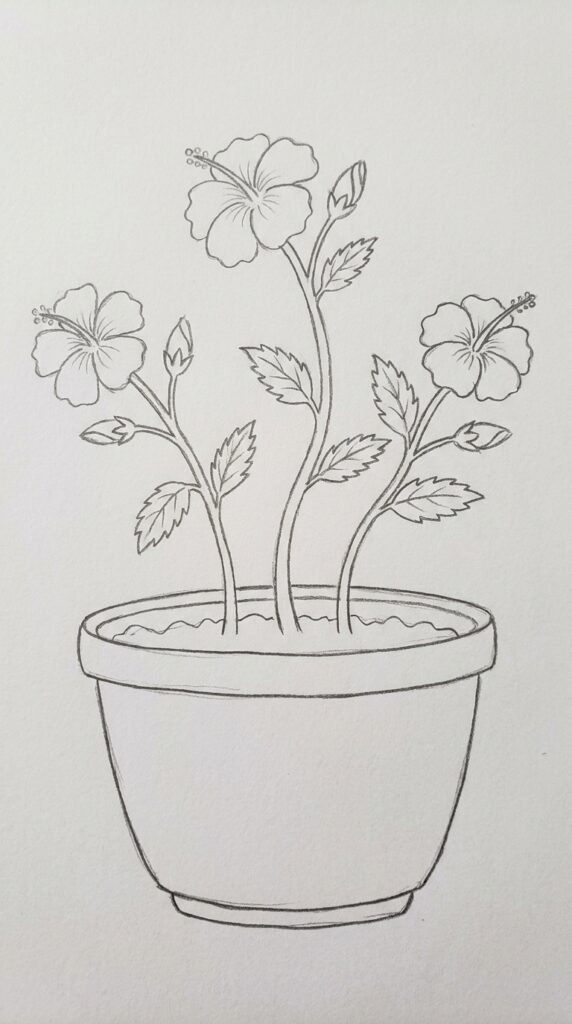
Drawing a hibiscus plant in a simple flower pot is one of the most practical hibiscus drawing ideas for beginners. It gives the flower a clear context and teaches you how to combine a plant with a container. The pot itself is very easy to draw and grounds the whole composition.
Step-by-Step Instructions:
- Draw the flower pot first at the bottom of the paper. A simple pot shape is a rounded trapezoid: wider at the top, narrower at the bottom, with a small curved rim at the top edge and a flat base.
- Draw two or three stems rising from the pot opening. Make them slightly curved and of different heights.
- At the top of each stem, place a hibiscus flower or bud. Use the front-view flower for the tallest stem and buds or side-view flowers for the shorter ones.
- Add hibiscus leaves along the stems at various points. Alternate their angles to look natural.
- Add a small soil line at the top of the pot interior if desired, and draw a simple shadow line at the base of the pot to anchor it visually.
FAQ
Q: What is the easiest hibiscus drawing idea for absolute beginners?
A: The easiest hibiscus drawing idea for beginners is the simple front-view hibiscus silhouette. You only need to trace the outer boundary of five petals and add a single stamen outline above the center. There are no internal detail lines required, which makes it very forgiving for first attempts.
Q: How do you draw hibiscus petals that look natural and not too stiff
? A: To draw natural-looking hibiscus petals, avoid using rulers or trying to make each petal perfectly symmetrical. Instead, draw each petal freehand using a loose, gentle curved motion. Allow each petal to vary slightly in width and shape. Also add a gentle wavy or ruffled edge at the petal tip, which is a natural characteristic of real hibiscus blooms.
Q: Can kids draw hibiscus flowers easily
? A: Yes, hibiscus flowers are excellent for kids. The basic flower shape uses simple rounded ovals for petals arranged around a center point, which is a skill most children can learn quickly. Starting with the hibiscus silhouette or the hibiscus in a flower pot are particularly good starting points for younger drawers because the shapes are bold and forgiving.
Q: What pencil should I use for hibiscus drawing ideas?
A: A standard HB pencil is the best choice for most hibiscus drawing ideas. It gives a medium line that is dark enough to see clearly but light enough to erase when needed. If you want softer, slightly darker lines for your final outline, an HB or a 2B pencil works well. Avoid very hard pencils like 4H because they produce lines that are too faint to see easily.